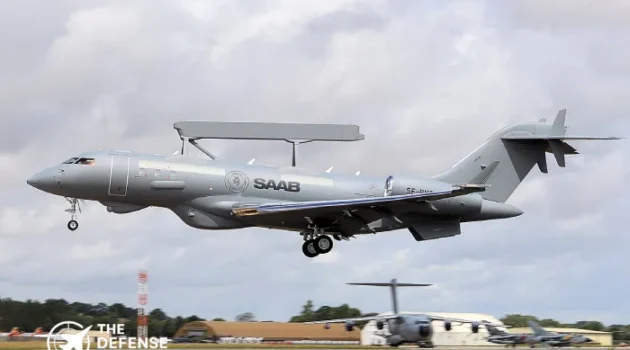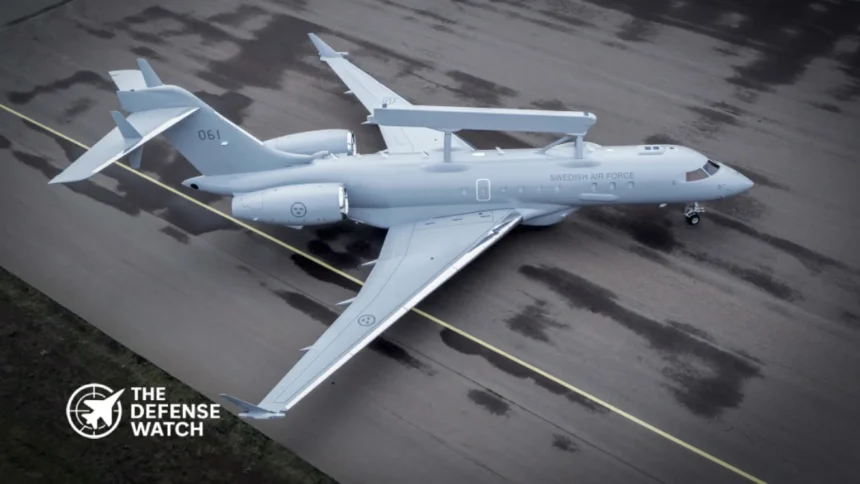
Saab presented Sweden’s first GlobalEye airborne early warning and control (AEW&C) aircraft on October 15, 2026, moving the Swedish Air Force’s new surveillance platform into the testing and verification phase ahead of its first flight and eventual delivery.
The aircraft was ordered by the Swedish Defence Materiel Administration (FMV) and is part of a three-aircraft procurement intended to strengthen Sweden’s ability to monitor activity across the air, land and maritime domains. Saab confirmed the presentation in an official announcement, but did not disclose a date for the aircraft’s first flight or operational entry into service.
The milestone brings Sweden closer to introducing a new airborne surveillance capability designed to provide commanders with information for air defense, maritime monitoring and joint military operations.
Testing Begins Before First Flight
The aircraft will undergo testing and verification before its maiden flight, according to Saab. These activities are necessary to assess the aircraft and its integrated mission systems before the platform can proceed toward delivery.
Presentation of the aircraft does not mean it has entered operational service. Further work will be required before the Swedish Air Force can employ it for routine missions, and Saab has not published a detailed schedule for completing the remaining stages.
Sweden’s GlobalEye aircraft carry the national designation S 106. The platform combines a modified business jet with an integrated surveillance and command system designed to detect and identify objects across multiple operational environments.
Three Aircraft Ordered for Sweden
Sweden’s procurement has developed through two contract decisions.
The Swedish Defence Materiel Administration contracted Saab for two GlobalEye aircraft in June 2022, with options for two additional aircraft. In June 2024, Sweden exercised an option for a third aircraft, with an order value of approximately SEK 2.6 billion and a stated delivery period of 2024 to 2029.
The three-aircraft programme is intended to expand Sweden’s airborne early warning and control capacity. Saab’s October 2026 announcement confirmed that all three aircraft had been ordered, but did not provide an updated delivery schedule for the fleet.
The procurement also follows a change in Sweden’s existing airborne surveillance fleet. In 2024, Sweden announced plans to donate one of its two Saab 340 AEW&C aircraft, known as ASC 890, to Ukraine. The GlobalEye programme provides a newer platform around which Sweden can develop its future airborne surveillance capability.
How GlobalEye Supports Military Operations
GlobalEye is a multi-domain surveillance system that combines active and passive sensors to detect and identify activity in the air, at sea and over land. Saab says the system can distribute real-time information to air force, army and navy units, helping commanders develop a shared picture of the operational environment.
The aircraft is based on the Bombardier Global 6000 business jet airframe, modified to carry mission equipment and a surveillance radar installation. Its design combines the mobility of a jet aircraft with sensors and mission systems intended for wide-area monitoring.
The platform’s role extends beyond conventional airborne early warning. Airborne surveillance aircraft can help identify and track aircraft, monitor maritime activity, and support the coordination of friendly forces. Depending on sensor coverage, mission conditions and the wider command network, this information can help military units respond more effectively to developing threats.
However, the precise performance of an operational surveillance system depends on several factors, including target characteristics, altitude, terrain, sensor configuration and electronic interference. Saab’s announcement did not provide detailed performance figures for Sweden’s aircraft, so specific detection ranges or mission effectiveness should not be inferred from the presentation alone.
Why the Aircraft Matters for Sweden’s Defense
For Sweden, GlobalEye offers a way to strengthen surveillance and situational awareness across a geographically varied operating environment. Monitoring airspace, coastal approaches and maritime activity requires information that can be shared across military services, rather than relying exclusively on individual ground-based radar sites or aircraft operating independently.
An airborne surveillance platform can complement ground-based sensors by providing a different viewing position and helping maintain a broader operational picture. It can also support the coordination of fighter aircraft and other military assets by supplying information to command networks.
These functions are relevant to Sweden’s defense planning in northern Europe and the Baltic Sea region. Effective surveillance can support the monitoring of military activity and help commanders understand developing situations, although the presence of an AEW&C aircraft does not by itself guarantee detection of every threat or protection against attack.
GlobalEye’s contribution will also depend on how well its sensors and communications systems integrate with Sweden’s existing air defense, command-and-control and allied networks. Training, maintenance, crew availability and the establishment of operational procedures will be important factors in translating the aircraft’s technical capabilities into a dependable military service.
Delivery and Operational Readiness Remain Ahead
Saab’s presentation is an important manufacturing and programme milestone, but several steps remain before Sweden can count the aircraft as an operational asset.
The immediate stage is testing and verification, followed by the first flight and subsequent delivery. Saab has not announced a confirmed date for the maiden flight in its October 15 statement.
The remaining aircraft will also need to progress through their respective production, testing and delivery processes. Public information does not establish the current completion status of each aircraft or provide a confirmed date for the entire fleet to reach operational readiness.
Once introduced, the three GlobalEye aircraft are expected to strengthen Sweden’s airborne surveillance and early warning capacity. Their practical value will ultimately depend on successful testing, delivery, crew training and integration with the country’s wider defense network.