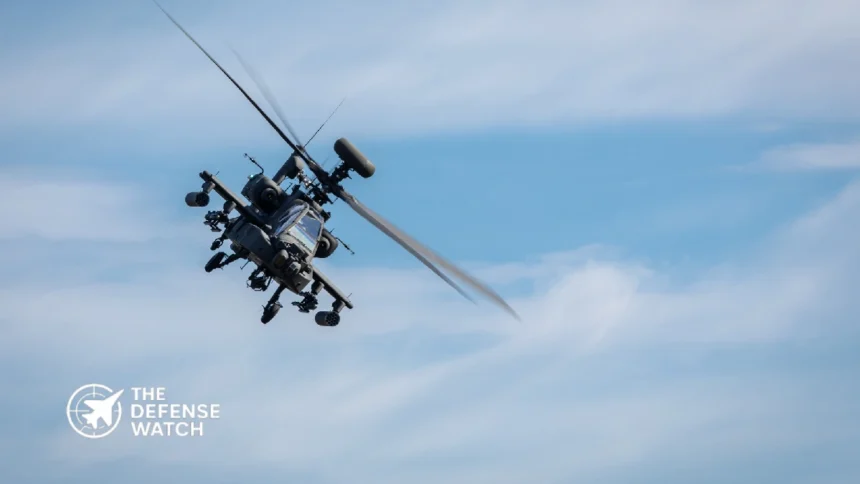
Israel Signs Deal for 12 AH-64E Apache Helicopters
Israel has signed an agreement with the United States to acquire 12 Boeing AH-64E Apache attack helicopters for the Israeli Air Force, securing a purchase that had faced delays over budget constraints. The Israeli Ministry of Defense announced the agreement on October 14, 2026, following approval by the Israeli government. Deliveries are scheduled to begin in the early 2030s.
The agreement covers the Apache Echo variant, the latest version of the US-built attack helicopter. The procurement will introduce newly built AH-64E aircraft into Israel’s existing Apache fleet, which includes earlier AH-64A and AH-64D variants.
The deal’s value has not been disclosed in the Israeli announcement. It follows a separate US government approval in January 2026 for a possible sale of up to 30 AH-64E helicopters and associated equipment to Israel, with an estimated total value of $3.8 billion. That earlier approval was a potential foreign military sale, not a confirmed contract for 30 aircraft.
A procurement delayed by budget constraints
Israel’s Ministry of Defense said the agreement was finalized through cooperation with the US administration and Pentagon. Director General Amir Baram instructed the ministry’s US mission to sign the deal after the Israeli government approved the purchase.
The negotiations had encountered funding difficulties, according to Israeli reporting. The government approval and subsequent agreement allowed the procurement to proceed after repeated delays. The ministry said the financing framework was developed jointly with its American counterparts to accommodate Israel’s budget constraints.
The agreement is part of Israel’s longer-term military force buildup, which also includes procurement of additional combat aircraft and aerial refueling capacity. The ministry has not published a detailed delivery schedule, the final contract value, or a complete breakdown of the equipment included in the 12-helicopter order.
The distinction between the January US approval and the October agreement matters. The original notification covered up to 30 helicopters, while the newly signed agreement confirms an initial purchase of 12. Public information does not establish whether Israel will proceed with the remaining aircraft under a later agreement.
What the AH-64E brings to Israel’s fleet
The AH-64E is an attack and reconnaissance helicopter designed to locate, track and engage ground targets while sharing information with other platforms. Its capabilities extend beyond carrying missiles and rockets, with integrated sensors, digital communications and support for cooperation between crewed aircraft and unmanned systems.
According to Boeing, the Apache can control unmanned aircraft, allowing its crew to receive information from systems operating beyond the helicopter’s immediate sensor coverage. The manufacturer also identifies Link 16 connectivity as a feature supporting the exchange of tactical information with other compatible platforms.
The January 2026 US arms-sale notification provides a more specific picture of the equipment originally requested for Israel. It included the Northrop Grumman AN/APG-78 Longbow fire-control radar, modernized targeting and pilot night-vision systems, missile-warning equipment, communications systems and manned-unmanned teaming receivers. However, the notification covered a possible 30-helicopter sale. The final configuration of the 12 aircraft in the October agreement has not been fully disclosed.
These systems are relevant to operations in which attack helicopters must identify targets, coordinate with ground forces and engage threats while limiting their exposure. Sensors and data links can improve situational awareness, but they do not remove the risks posed by modern air defenses, portable surface-to-air missiles, electronic warfare or small arms fire.
The Apache’s effectiveness will therefore depend on more than the helicopter itself. Intelligence support, mission planning, aircrew training, maintenance, weapons availability and coordination with other aircraft all affect its operational value.
Replacing older aircraft while retaining established capabilities
Israel has operated Apache helicopters since 1990. Janes reports that its remaining fleet includes 23 AH-64A Peten helicopters and 20 AH-64D Saraf helicopters, although fleet totals can change as aircraft are retired, repaired or returned to service.
The 12 new AH-64Es will allow the Israeli Air Force to introduce a newer version of a platform already integrated into its aviation operations. Whether they replace older aircraft outright or supplement the existing fleet has not been confirmed.
That distinction will affect the long-term force structure. Replacing older helicopters could help address aging equipment and sustainment requirements. Adding aircraft to the existing fleet could instead increase available capacity, depending on personnel, maintenance resources and operational readiness.
The new helicopters will also require training and logistical support. Although Israel already has Apache operating experience, transitioning to a newer variant involves familiarization with updated avionics, mission systems and maintenance procedures.
The planned delivery window in the early 2030s means the purchase will not provide an immediate increase in available aircraft. Its near-term significance lies in securing a future supply of helicopters and supporting equipment through the US defense procurement system.
The US connection and the cost question
The agreement reinforces the role of US defense exports in Israel’s military modernization. Boeing manufactures the Apache, while the US government oversees foreign military sales and associated approvals. This arrangement gives Israel access to an established aircraft production and support network, but it also ties delivery and sustainment to US industrial capacity and bilateral procurement processes.
The financial details require particular care. The US government estimated the possible 30-aircraft sale at $3.8 billion in January 2026. That figure included associated equipment and support, not just the helicopters. It should not be treated as the confirmed price of the 12-aircraft agreement.
The Israeli Ministry of Defense has not published the final value of the October deal or an itemized list of its contents. Without those details, a reliable per-helicopter cost cannot be calculated.
The agreement also leaves open whether Israel will pursue the remainder of the previously approved 30-aircraft package. No confirmed follow-on purchase was included in the October announcement.
For now, the clearest outcome is that Israel has secured an initial order for 12 AH-64E Apache helicopters, with deliveries expected in the early 2030s. The order provides a path to modernizing the country’s attack helicopter fleet, but the scale of the eventual force and the full cost of the procurement remain unresolved.