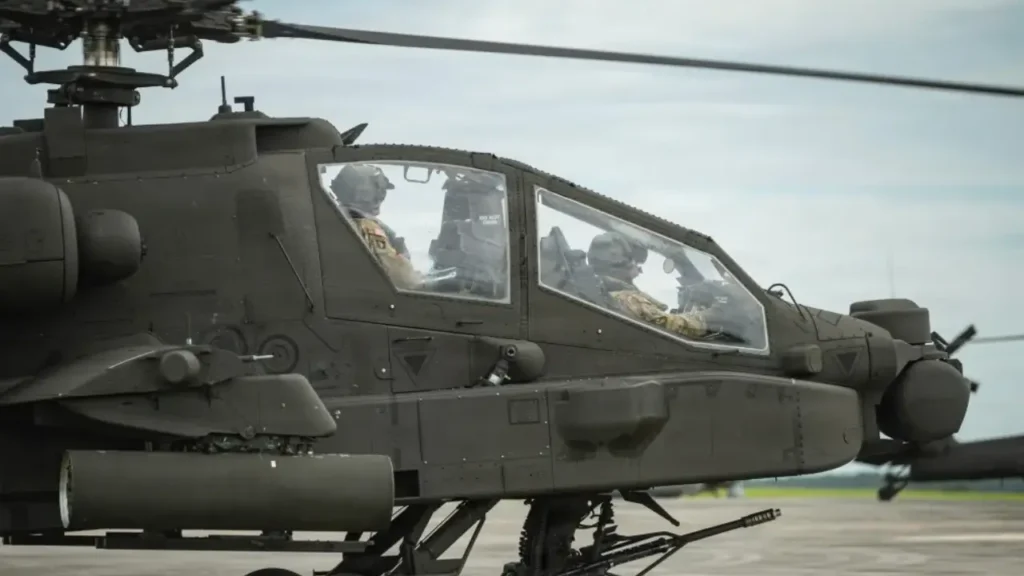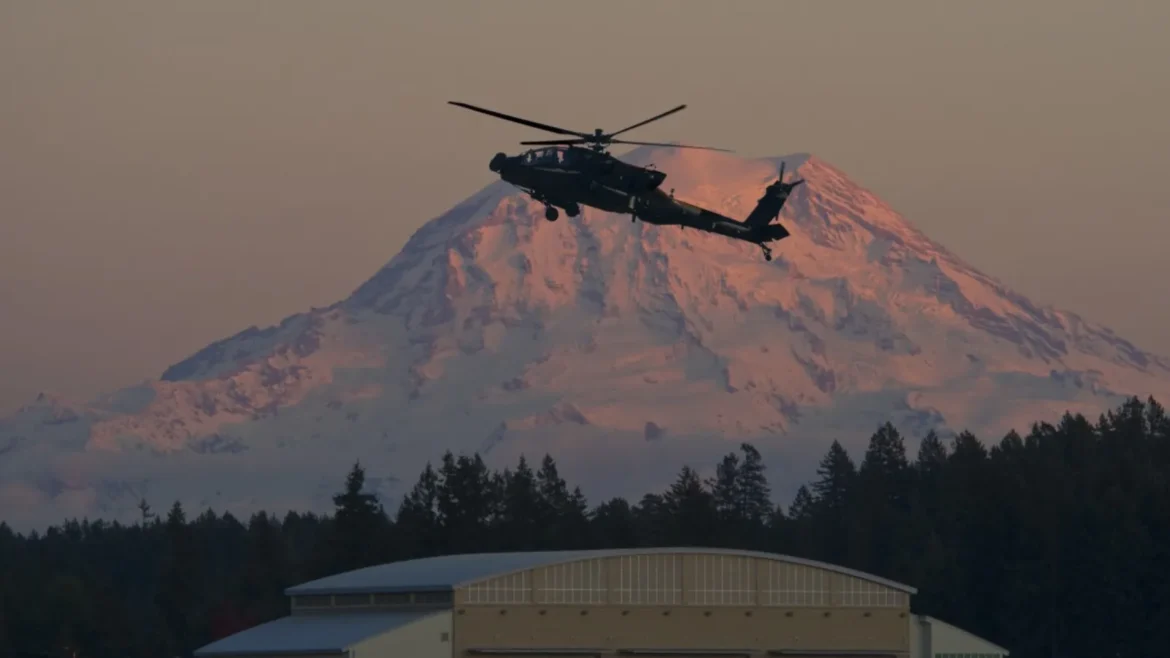
Executive Summary: Two U.S. Army aviators were killed on Aug. 12 when an AH-64E Apache attack helicopter crashed near Salado, Texas, during a maintenance test flight. The Army has temporarily halted AH-64 Apache training flight operations while a safety investigation seeks to determine the root cause of the accident.
AH-64E Apache Crash Prompts Army Aviation Stand-Down
The AH-64E Apache crash near Salado, Texas, has triggered a temporary Army-wide stand-down of Apache training flight operations as investigators examine the fatal accident. The crash occurred Wednesday, Aug. 12, near Fort Hood, with both crew members killed and a large grass fire developing at the site.
The Army identified the aircraft as an AH-64E that experienced a mishap during a maintenance test flight. Chief Warrant Officer 2 Deontre T. Huey and Warrant Officer Seth L. Olmstead were killed in the accident. Both were assigned to Bravo Company, 1st Battalion, 227th Aviation Regiment, 1st Air Cavalry Brigade, 1st Cavalry Division.
The Army’s temporary stand-down is intended to provide investigators time to establish the cause before Apache training flights resume. The Army Combat Readiness Center in Fort Rucker, Alabama, is leading the safety investigation, according to reporting on the Army’s response.
At this stage, there is no publicly established cause for the crash. That distinction is important because early reports of military aviation accidents often contain limited information while investigators secure the wreckage, examine maintenance records and reconstruct the aircraft’s final flight.
What Happened Near Salado
The helicopter went down in a field near Salado, approximately 50 miles north of Austin, during the afternoon of Aug. 12. Local emergency personnel responded after calls reporting the crash, and the impact triggered a grass fire that led to evacuations in the surrounding area.
No homes were reported struck by the helicopter, although the fire spread across a substantial area. Local firefighters and other emergency agencies worked to contain the blaze while military and law enforcement personnel secured the crash site.
The incident was initially described publicly as a routine flight, but subsequent reporting identified it more specifically as a maintenance test flight. That distinction matters for investigators because maintenance test flights can involve specific aircraft systems, post-maintenance checks or flight profiles that differ from ordinary training sorties. It does not, however, establish that maintenance caused this accident.
Why The Army’s Apache Stand-Down Matters
The temporary suspension of Apache training flights is one of the most consequential immediate responses to the accident.
The Army has previously used aviation stand-downs to examine recurring or potentially systemic safety concerns. In this case, the stated objective is to understand the root cause before normal Apache training operations resume.
The decision also highlights the importance of separating an individual aircraft accident from the broader safety performance of the AH-64 fleet. A single crash cannot by itself demonstrate a fleet-wide mechanical or design problem.
That assessment is particularly important for the Apache because the aircraft remains a major component of U.S. Army aviation. Boeing says the global Apache fleet has accumulated more than 5.3 million flight hours, including more than 1.3 million combat hours, across more than 1,300 aircraft in operation around the world.
The AH-64E is also still an active production platform. Boeing reported that more than 891 E-model aircraft had been delivered by November 2025 and said production is expected to continue into the 2030s.
Apache Safety Record Provides Important Context
Available Army safety data show why Apache aviation safety deserves close attention without drawing premature conclusions about the Salado crash.
An Army safety review covering fiscal years 2020 through 2024 recorded 105 AH-64 mishaps. Sixteen were Class A flight mishaps, producing a rate of 2.73 Class A mishaps per 100,000 flight hours. The comparable five-year average for Army rotary-wing aviation was 0.90 Class A mishaps per 100,000 flight hours.
The same Army analysis found that the AH-64 fleet accounted for about 15.6 percent of total rotary-wing flight hours during the period while representing 42 percent of rotary-wing Class A mishaps and 23 percent of Class A through C mishaps.
Those figures provide historical context, but they should not be interpreted as evidence that the Salado crash resulted from a particular defect or systemic failure. Mishap statistics combine different causes, aircraft configurations, operating environments and crew circumstances.
The Army’s published data also show a range of mishap categories involving the Apache fleet.
AH-64 Mishap Category, FY2020 to FY2024 Total Events Controlled flight into terrain 15 System failure or malfunction, non-powerplant 13 Ground handling and servicing operations 13 Pilot or operator loss of control in flight 6 Powerplant failure or malfunction 7 Abrupt maneuver 5 Midair collision 1 Wildlife strike 3 Source: U.S. Army Combat Readiness Center safety data.
The data demonstrate that Apache mishaps have multiple contributing categories. Investigators therefore need to establish the specific chain of events in the Texas accident before comparisons with historical Apache incidents can be made responsibly.
The AH-64E Is A Highly Complex Aircraft
The AH-64E is not simply an older attack helicopter with updated weapons. It combines flight systems, sensors, communications, electronic systems and weapons into a networked combat platform.
The U.S. Army describes the aircraft as a twin-engine, four-bladed attack helicopter with a two-person tandem crew. Its weapons suite includes the M230 30 mm cannon, 2.75-inch rockets and Hellfire missiles.
Boeing lists a maximum operating weight of 23,000 pounds, a maximum level flight speed above 150 knots and a service ceiling of 20,000 feet. The company also identifies the aircraft’s integrated sensors, digital connectivity and manned-unmanned teaming functions as core features of the E-model.
AH-64E Characteristic Published Specification Crew 2 Maximum operating weight 23,000 lb Maximum level flight speed 150+ knots Service ceiling 20,000 ft Rotor diameter 48 ft Main weapons 30 mm cannon, rockets, Hellfire missiles Maximum listed Hellfire load 16 Maximum listed 30 mm ammunition 1,200 rounds Source: Boeing and U.S. Army.
The aircraft’s complexity also means that a serious mishap investigation must consider a broad set of possibilities, including flight controls, propulsion, transmission and drivetrain components, avionics, maintenance actions, human factors, environmental conditions and operational procedures.
That is why investigators typically avoid assigning a cause until physical evidence and recorded aircraft data have been examined.
Maintenance Test Flight Adds An Important Investigative Dimension
The identification of the Salado sortie as a maintenance test flight is significant, but it should not be treated as proof that maintenance caused the crash.
Maintenance test flights are conducted to verify aircraft performance or system operation following maintenance activity. Depending on the work performed, crews may be required to evaluate particular systems or aircraft responses that would not necessarily be emphasized during a normal training flight.
For investigators, this creates an important evidence trail. Maintenance records, work orders, component histories, inspection documentation and aircraft data can help establish what work was performed before the flight and what systems were being evaluated.
The aircraft’s recorded information will also be important. Investigators can use available flight and maintenance data, cockpit information and wreckage examination to reconstruct the sequence of events.
Until that work is complete, claims involving a specific mechanical failure, pilot error or other cause remain unverified.
Apache Modernization Continues Despite The Crash
The accident comes as the Army and industry continue to modernize the Apache rather than immediately replace it with another conventional attack helicopter.
Boeing’s current modernization work builds on the AH-64E Version 6 and includes improvements to networking, sensors, crew interfaces, survivability and integration with unmanned systems. The company also describes future Apache configurations that could incorporate improved engines, drive systems and additional payload capacity.
In April 2026, Boeing said it was continuing to develop the Apache as part of a broader family of systems and noted that the aircraft is being adapted for evolving threats, including drones. The company also reported a nearly $4.7 billion 2025 contract covering 106 new-build AH-64Es, including 96 for Poland.
That modernization path makes aviation safety especially important. The Army must maintain enough aircraft availability for training and operational requirements while ensuring that new modifications, maintenance procedures and aging-airframe issues are properly managed.
The Texas crash does not by itself establish that modernization is required or that a particular Apache subsystem is responsible. It does, however, demonstrate why detailed safety investigations remain essential as the Army continues operating and upgrading a complex combat aviation fleet.
What Investigators Will Need To Establish
The central question is not simply why the helicopter crashed, but what sequence of events led to the loss of the aircraft.
Investigators will need to establish:
- The aircraft’s condition before the flight.
- What maintenance or inspection work had recently been completed.
- Which systems were being evaluated during the test flight.
- The helicopter’s flight path, altitude, speed and aircraft state before the accident.
- Whether any mechanical, propulsion or flight-control abnormalities occurred.
- Environmental and weather conditions at the time.
- Crew qualifications, training status and mission requirements.
- Whether any maintenance, operational or human factors contributed to the mishap.
The Army’s decision to halt Apache training operations provides investigators with time to examine whether any finding has implications beyond the individual aircraft.
That is the key safety question. A fleet stand-down becomes most valuable when it converts a single accident into actionable information that can prevent another loss.
What Happens Next
The immediate priority is the investigation and support for the families and unit of the two fallen aviators.
The Army has not publicly established the cause of the crash, and the temporary stand-down will remain in effect while officials work to understand the root cause.
For the broader Apache fleet, the outcome of the investigation will determine whether additional inspections, maintenance actions, training changes or other safety measures are required.
The AH-64E remains a central Army combat aviation capability, with extensive operational experience and a continuing modernization program. The Salado accident therefore warrants close scrutiny, but definitive conclusions about the Apache’s safety record or the cause of this particular crash should wait for the Army’s investigative findings.
Apache Proves Counter-Drone Muscle in Recent Drills
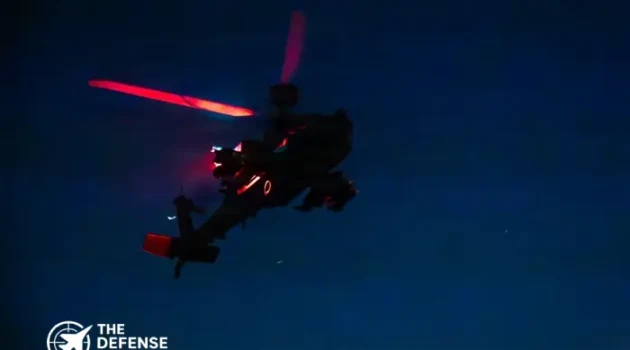
In a series of recent live-fire drills conducted by the South Carolina Army National Guard as part of Operation Flyswatter at Marine Corps Air Station New River (date not specified), the AH-64E Apache attack helicopter demonstrated its growing capability to counter unmanned aircraft systems (UAS). During the exercise, Apache crews recorded 13 kills out of 14 drone engagements — a high success rate that underscores the platform’s readiness to tackle one of the fastest-growing threats on modern battlefields.
The demonstration saw Apaches detecting, tracking, and then destroying small drones using a variety of munitions, including laser-guided rockets, precision missiles, and its onboard cannon.
Background: Why Apache’s Counter-UAS Role Matters
As low-cost, often one-way or “kamikaze” drones proliferate globally, militaries worldwide are scrambling to field effective counter-UAS (c-UAS) systems. While ground-based air defenses provide one layer of protection, mobile platforms capable of reacting quickly — especially in dynamic battlefield environments — are increasingly valuable.
The Apache, long valued for its attack and reconnaissance capabilities, has historically focused on anti-armor and conventional close air support. But upgrades to its software, sensors, and weapon integration have opened a new mission set: drone detection and defeat.
How the Apache Executed Counter-Drone Engagements
Sensor & Networking Integration
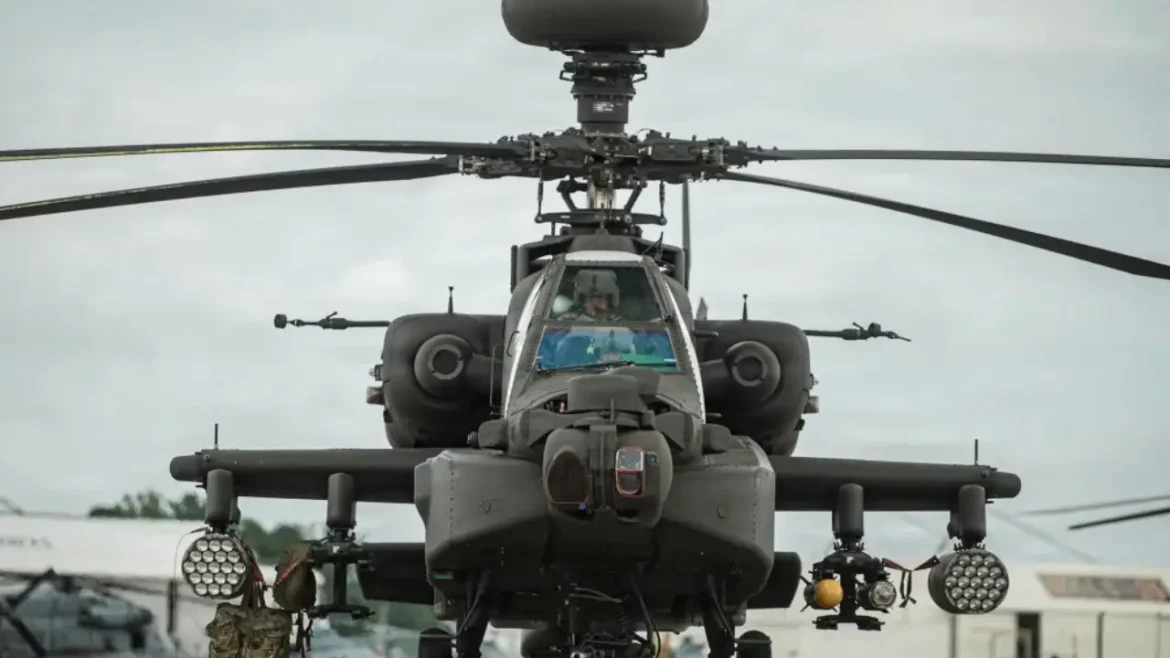
During Operation Flyswatter, the Apache used its standard electro-optical/infrared sensors and its mast-mounted AN/APG-78 Longbow radar to detect and track drones.
Moreover, thanks to network integration via Link 16 and modern data links, Apaches proved they can operate as mobile, airborne air-defense nodes — sharing target data between helicopters and command nodes to shorten sensor-to-shooter timelines.
As one pilot noted, even if only one Apache in a flight detects a drone, its data can cue the whole formation — a valuable force-multiplier in swarm or saturation attack scenarios.
Multi-Weapon Engagements
Once targets were tracked, Apaches engaged using a mix of weapons:
- Guided missiles, including AGM-179 JAGM and variants of AGM-114 Hellfire — some radar-guided, some laser-guided — depending on the engagement scenario.
- Laser-guided rockets: 70 mm Hydra rockets fitted with APKWS laser-guided rocket guidance kits. This proved particularly effective against small UAS, and reportedly three of four drones struck during the demonstration were downed using APKWS rockets.
- The Apache’s nose-mounted 30 mm chain gun, firing high-explosive dual-purpose rounds (M789) — used successfully for close-range drone kills (under ~300 meters).
According to Chief Warrant Officer 5 Daniel York, Project Manager for the Apache New Equipment Training Team, the 13-of-14 kill ratio “proves the Apache — using its current software and systems — is a lethal and adaptable solution to the drone threat.”

Wider Capability and Platform Evolution
The effectiveness demonstrated during Operation Flyswatter reflects broader enhancements being made to the Apache fleet. With its current configuration thanks to Version 6 software, the Apache is increasingly more than just a gunship — it can function as a networked, multi-role platform capable of manned-unmanned teaming, real-time data sharing, and layered mission sets that include counter-UAS, deep strike, and reconnaissance.
Indeed, recent upgrades under the U.S. defense procurement program have emphasized cyclic modernization — enabling integration of additional capabilities such as “Launched Effects” (e.g., expendable drones or rockets deployed from the Apache), advanced EW (electronic warfare) pods, and enhanced sensor suites.
Furthermore, other recent live-fire trials have shown the Apache’s ability to launch long-range guided missiles — such as the SPIKE NLOS — extending its standoff strike range to 26–32 km, a substantial growth over legacy Hellfire/JAGM reach.
This evolving arsenal and networking puts the Apache in a strong position to face modern threats — from swarming drones to peer-level adversaries — while working as part of a broader, layered air defense and strike architecture.
Strategic & Policy Implications
The success of the Apache in counter-drone drills sends a clear signal to defense planners: legacy rotary-wing assets can be adapted to meet the evolving demands of modern warfare, where unmanned systems are proliferating rapidly.
With drones increasingly used for reconnaissance, loitering munitions, and swarm attacks — often from non-state actors or in asymmetric conflict settings — having a highly mobile, flexible, and lethal airborne counter-UAS system fills a capability gap that ground-based air defenses alone may struggle to cover.
Moreover, this demonstration helps justify continued investment in attack helicopter fleets — including ongoing production runs, modernization programs, and export sales. Continuing upgrades (software, sensors, weapons) help ensure the platform remains relevant against future threats.
Finally, Apache’s role as a networked platform — interoperable via datalinks and working alongside UAVs, EW systems, and ground-based defenses — reflects the shifting nature of air operations toward integrated, multi-domain warfare.
What’s Next: Toward Formal Counter-UAS Integration
The live-fire success in Operation Flyswatter could accelerate formal adoption of counter-UAS missions for Apache units. That might include:
- Incorporation of dedicated counter-UAS tactics into standard aircrew training manuals. Indeed, Army officials have reportedly recommended expanding Apache battalion training to include a “Counter-UAS Mission Essential Task.”
- Continued upgrades to sensor suites, network integration, and weapons payloads to better handle drone swarms and fast-moving aerial threats. Future enhancements could include dual-mode rocket guidance (e.g., infrared seekers for fire-and-forget) to allow faster, more efficient engagements.
- Integration of unmanned “wingmen” — deployable drones working in concert with Apaches — to expand detection range, improve situational awareness, and reduce risk to manned helicopters.
Given the increasing complexity of air threats, this trajectory suggests that the Apache may evolve into a central node in future multi-domain air defense architectures.
In the face of proliferating drone threats — from surveillance drones to kamikaze loitering munitions — the AH-64E Apache is evolving from a conventional attack helicopter into a capable counter-UAS asset. The recent 13-of-14 drone kills during Operation Flyswatter offer concrete proof of concept, just as wider modernization and doctrinal adaptation position the Apache to remain relevant in future conflicts.