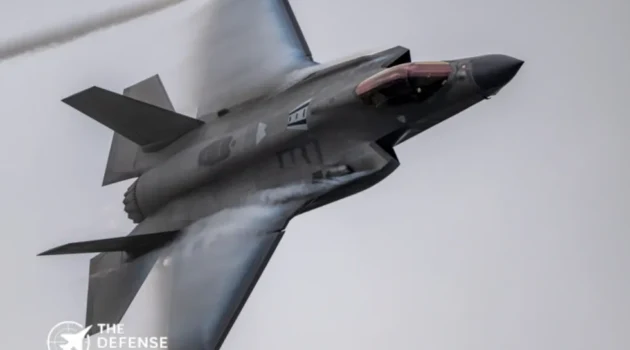
Navy Plans F-35 Mission Planning Redesign
The U.S. Navy is preparing a major redesign of the ground-based mission planning environment supporting the F-35 Lightning II, seeking industry assistance for a follow-on engineering effort that could run for five years.
The Naval Air Warfare Center Weapons Division, or NAWCWD, published a sources sought notice on October 2, 2026, for systems engineering, analysis, operational expertise and program management support for the F-35 Mission Planning Environment Integrated Product Team. The notice is part of market research and does not represent an awarded contract or a final solicitation.
The planned effort is expected to support development of a next-generation F-35 Mission Planning Environment. Navy acquisition documents place the estimated value of the future requirement above $50 million and below $100 million over 60 months.
The planning system behind an F-35 sortie
Mission planning is an important part of F-35 operations but is less visible than the aircraft’s radar, electronic warfare systems, sensors and weapons.
Before an aircraft launches, planners must prepare the information needed for a particular mission. That work involves translating operational requirements, available intelligence, threat information, routes, weapons employment considerations and other mission parameters into data that can be transferred to the aircraft.
The F-35 Mission Planning Environment provides the ground-based architecture supporting this preparation. The Navy’s requirement is therefore focused on the software, systems engineering and supporting architecture around the aircraft rather than a modification to the F-35 airframe itself.
That distinction matters. Improving the aircraft’s onboard systems is only part of increasing combat capability. The information needed to use those systems has to be prepared, secured and delivered before the aircraft enters the mission.
A five-year engineering effort
The Navy is seeking approximately 278,800 labor hours for the follow-on requirement, according to procurement information associated with the sources sought notice. The existing engineering support effort was listed at approximately 280,050 labor hours, indicating that the Navy is planning a substantial continuation of technical support rather than a small software maintenance project.
The anticipated period of performance is May 20, 2027, through May 19, 2032. The Navy’s current acquisition schedule anticipates a final request for proposals in early 2027 and a possible award in May 2027.
The acquisition remains at the planning stage. Industry responses to the sources sought notice will help the Navy refine its acquisition approach before a formal solicitation.
NAWCWD’s fiscal year 2026 long-range acquisition forecast separately lists the F-35 Mission Planning Environment requirement at more than $50 million but less than $100 million. The forecast identifies concept development, requirements development and systems engineering for the F-35 NextGen Mission Planning Environment as core elements of the work.
Why the architecture matters
The redesign is significant because the F-35 is increasingly operated as part of a wider digital combat network rather than as an isolated fighter.
F-35 mission preparation has to account for information moving between aircraft, mission planners, intelligence organizations, weapons and communications systems. Security and interoperability are consequently central engineering requirements.
The Navy’s acquisition documents identify high security requirements for the work. That reflects the sensitivity of the information and systems involved in preparing aircraft for operational missions.
The broader F-35 program is also moving toward additional software and weapons capabilities under its modernization plans. As the aircraft’s configuration changes, the ground infrastructure used to prepare missions has to keep pace.
This creates a software problem that is different from simply adding a new function to the aircraft. New weapons, sensors and mission capabilities can generate corresponding requirements for planning tools, data management, cybersecurity, testing and operational support.
Mission planning is separate from mission data reprogramming
One distinction is important when discussing the F-35’s digital architecture.
Mission planning and mission data reprogramming are related but separate functions.
Mission planning concerns preparation for a particular sortie. Mission data reprogramming, by contrast, involves developing and maintaining data that enables the aircraft to interpret and respond to specific threat environments.
The two processes interact operationally. An aircraft can have sophisticated onboard sensors and electronic warfare capabilities, but mission planners still need appropriate information and data before the aircraft enters a particular operating environment.
The Navy’s redesign effort therefore should not be interpreted as replacing the F-35’s combat systems. It is aimed at improving the ground-based environment that supports their operational use.
Distributed operations raise the planning challenge
The operational requirement becomes more demanding when aircraft operate from dispersed locations or under contested communications conditions.
A centralized planning process can be difficult to sustain when units have limited connectivity, restricted access to networks or rapidly changing mission requirements. Future air operations may require planners to work with less time and greater uncertainty while maintaining the security of sensitive mission information.
That does not mean the planned redesign will automatically solve those problems. The Navy has not publicly disclosed a complete set of future system capabilities, and the sources sought notice is not a statement that specific performance improvements have already been achieved.
The more defensible conclusion is that the Navy is investing engineering resources in the architecture that supports F-35 mission preparation as the aircraft and its operating environment become more complex.
An F-35 fleet issue, not simply a Navy issue
Although the requirement originates with the U.S. Navy, the notice refers to the F-35 program rather than restricting the effort to the Navy’s carrier-based F-35C.
That is consistent with the nature of the F-35 program, which is operated by the U.S. Air Force, Navy and Marine Corps as well as international partners.
The F-35’s value to coalition operations depends partly on the ability of different operators to exchange information and conduct missions using compatible systems and procedures. Mission planning infrastructure therefore has implications beyond individual aircraft squadrons.
The Navy’s existing acquisition planning also shows that mission planning equipment and next-generation mission planning hardware and software are already part of the wider F-35 support architecture.
What the Navy has actually committed to
The current evidence supports a more limited conclusion than some early reports suggest.
The Navy has identified a future requirement, conducted market research and forecast a five-year effort potentially worth more than $50 million but less than $100 million. It has not yet awarded the follow-on contract.
The next major milestone is the transition from market research to a formal solicitation. If the current schedule remains unchanged, the Navy expects to seek final proposals in early 2027 and could award the follow-on effort in May 2027.
For the F-35 program, the underlying issue is straightforward: combat capability increasingly depends on the software and information architecture surrounding the aircraft as much as on the aircraft itself. The planned Mission Planning Environment redesign is an effort to keep that supporting architecture aligned with the fighter’s expanding mission set.