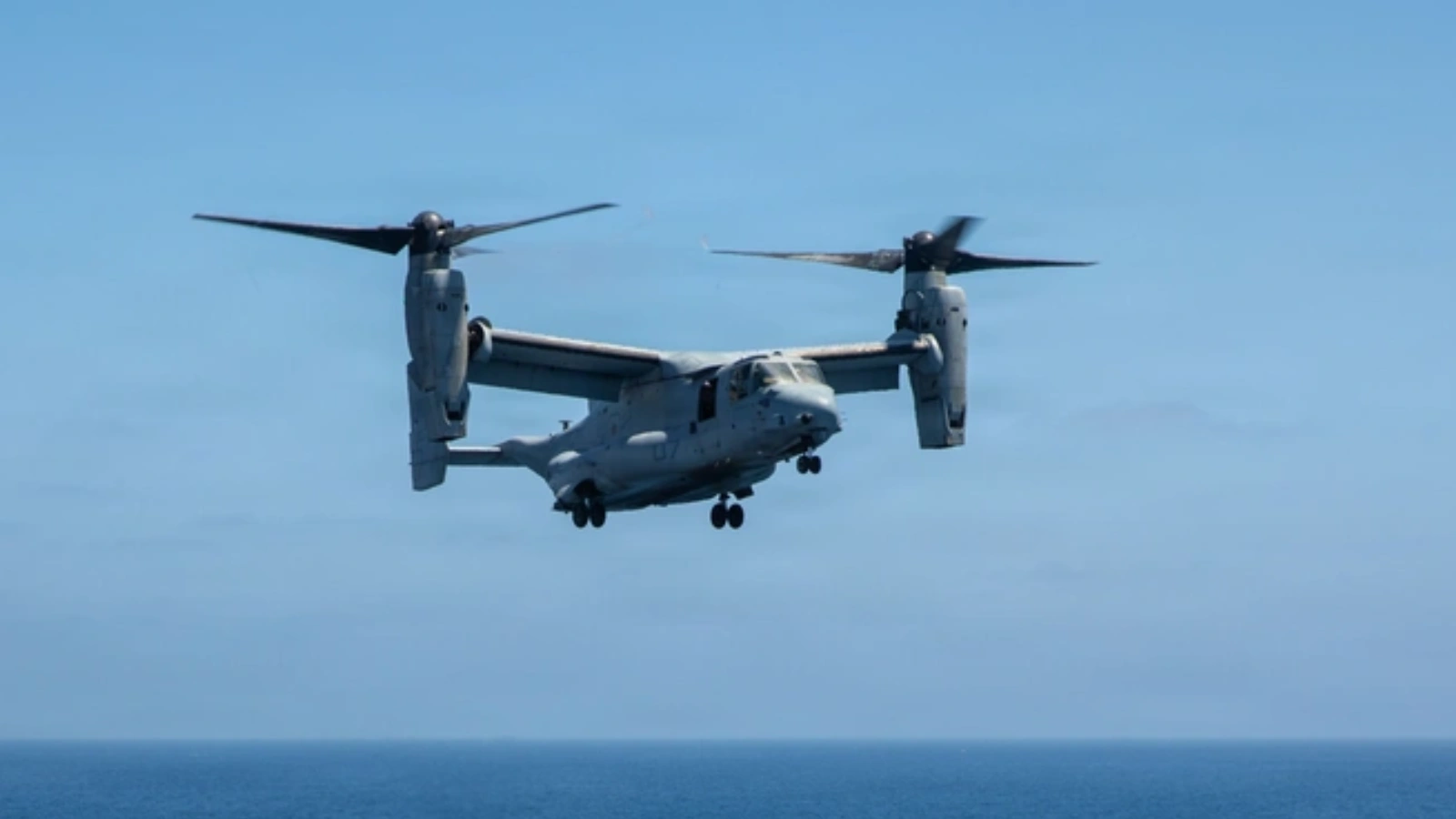
The U.S. Navy has awarded Bell Boeing Joint Project Office a $29.7 million order to provide loads and dynamics model data for the V-22 Osprey fleet as the aircraft program moves toward the end of production and a longer-term sustainment phase.
According to the U.S. Department of War contract announcement dated September 21, 2026, the $29,674,990 cost-plus-fixed-fee order, N0001926F2168, was issued against previously established basic ordering agreement N0001922G0002. Naval Air Systems Command in Patuxent River, Maryland, is the contracting activity.
Takeaways
Key facts from the contract announcement
1. $29.7 Million V-22 Data Order
The Navy awarded Bell Boeing a $29,674,990 cost-plus-fixed-fee order for loads and dynamics model data covering all V-22 variants.
2. Data Will Support Long-Term Sustainment
The technical data will support future sustainment decisions, mishap investigations, post-production sustainment and Fleet Support Team repair and maintenance activities.
The order covers all V-22 variants and is intended to preserve engineering data needed to support the aircraft after new production ends. The announcement specifically identifies sustainment decisions, mishap investigations, transition to post-production sustainment, and Fleet Support Team repair and maintenance as uses for the data.
Scope of the Bell Boeing V-22 Contract
The central deliverable is loads and dynamics model data for the V-22 fleet. These engineering models provide information used to understand how an aircraft and its structures respond to aerodynamic, inertial, mechanical and other loads during different operating conditions.
For a complex tiltrotor such as the V-22, maintaining accurate engineering data becomes particularly important as the production system transitions toward sustainment. The models can provide an engineering reference for evaluating structural conditions, investigating aircraft incidents and supporting maintenance or repair decisions.
The Navy announcement does not disclose the specific datasets, model formats, aircraft configurations or individual engineering parameters included in the order.
The work is scheduled to occur before and concurrently with V-22 production cessation. The contract therefore links engineering data preservation with the transition from active production to post-production support.
V-22 Osprey Technical and Operational Context
The V-22 is a tiltrotor aircraft that combines vertical takeoff and landing capability with the forward-flight characteristics of a turboprop aircraft. The joint program includes variants operated by the Marine Corps, Navy and Air Force Special Operations Command.
The Marine Corps MV-22B provides assault support and transport missions, while the Navy CMV-22B performs the Carrier Onboard Delivery mission and replaced the C-2A Greyhound in that role. The Air Force Special Operations Command operates the CV-22 for long-range special operations missions.
NAVAIR identifies the V-22 as a medium-lift aircraft and lists its primary function as medium-lift assault support. The service also identifies the platform as an ACAT IC program.
The engineering information covered by the new order is therefore relevant across several aircraft configurations rather than being limited to a single V-22 variant.
Operational Impact on U.S. Navy and Marine Corps V-22 Fleet
The award comes as the V-22 program moves from aircraft production toward long-term fleet support.
The Department of Defense fiscal 2026 weapons documentation states that V-22 funding supports shutdown of the MV-22 and CMV-22 production line, including material disposition, tooling and special test equipment storage. The same documentation says modification work continues to address flight-hour costs and time-on-wing availability.
Bell and Boeing had already begun describing the transition toward sustainment. In April 2025, the companies announced the completion of the Air Force CV-22 production program and said the V-22 industrial team was moving toward fleet-wide sustainment and upgrades, while MV-22 and CMV-22 production continued.
The new Navy order expands that transition into the engineering-data domain. Maintaining authoritative technical models can help the government and industry retain the information required to support aircraft already in service after the manufacturing line closes.
This is also relevant to mishap investigations. NAVAIR has previously used engineering analysis and fleet data in response to V-22 technical issues, including investigations and flight restrictions involving the proprotor gearbox system.
Contract Breakdown: Bell Boeing V-22 Award Details
Contract Value
The order is valued at $29,674,990.
The Navy will obligate $10,310,866 in fiscal 2025 procurement funds and $19,364,124 in fiscal 2026 procurement funds at the time of award. These amounts total the stated contract value.
Contractor
The contractor is Bell Boeing Joint Project Office, based in Amarillo, Texas.
The V-22 is jointly produced by Bell and Boeing, with major program activities distributed across multiple facilities. NAVAIR identifies Bell Boeing as the V-22 contractor.
Contract Type
The Navy awarded the action as a cost-plus-fixed-fee order against basic ordering agreement N0001922G0002.
A basic ordering agreement provides a contractual framework under which individual orders can be issued. The new action is the specific funded order covered by this announcement.
Work Locations
The work will be performed at:
- Ridley Park, Pennsylvania, 60%
- Fort Worth, Texas, 30%
- Amarillo, Texas, 10%
The performance locations reflect the distributed industrial structure supporting the V-22 program.
Performance Period
Work is expected to be completed in March 2030.
The duration extends beyond the anticipated end of V-22 aircraft production, reinforcing the contract’s role in the transition toward post-production engineering and sustainment.
Funding
The award uses U.S. Navy procurement funding from fiscal years 2025 and 2026.
The announcement does not identify any option value or additional funding beyond the amounts obligated at award.
Options Or Follow-On Work
The announcement does not identify options or specific follow-on contract actions.
The technical data could support future sustainment decisions, but the Navy has not publicly stated through this announcement whether additional orders will be issued for related engineering data.
Bell Boeing Defense Industrial Base and Acquisition Impact
The contract illustrates an important part of aircraft sustainment that becomes more significant as a production line approaches closure.
Ending production does not end the military requirement for an aircraft. Existing V-22s are expected to remain in service and require structural engineering, maintenance, modifications, parts support, technical assistance and investigation capabilities.
The Congressional Research Service has reported that the Department of Defense planned to close the V-22 production line in fiscal 2028, while current defense budget documents identify production-line shutdown activities.
The September 2026 award does not itself establish a new production schedule. Instead, it provides engineering data intended to support the transition described in the contract announcement.
That distinction matters for the industrial base. Once production stops, some manufacturing-specific knowledge and engineering resources can become harder to maintain. Preserving loads and dynamics models provides the government and Fleet Support Team with an established technical reference for aircraft already delivered to the services.
The Navy has also continued to fund V-22 sustainment and modernization activities. The broader program therefore represents a shift in emphasis from producing new aircraft toward maintaining and upgrading an established fleet.
Program Milestones and Next Steps
The immediate milestone is completion of the engineering-data work in March 2030.
The contract is specifically structured around the period before and concurrent with V-22 production cessation. Its stated purposes include future sustainment decisions, mishap investigations, post-production transition and Fleet Support Team maintenance and repair.
The broader V-22 program is already moving toward that post-production environment. Bell and Boeing completed the Air Force CV-22 Program of Record transition in 2025, while the Defense Department’s fiscal 2026 budget documentation provided funding for MV-22 and CMV-22 production-line shutdown activities.
The new order consequently represents an engineering-support activity tied to the long-term management of the V-22 fleet rather than a procurement of additional aircraft.