• Home
  • About
  • Defense Systems
  • Manufacturer
  • Comparisons
  • Compare 
  • Tools
TheDefenseWatch.com
  • Aerospace & Aviation
  • Military & Ordnance
  • Naval & Maritime
  • Cyber & Space Defense
  • Policy & Strategy
  • Global News
  • Tools Library
    • Smart Calculator
    • Drone Flight Time Calculator
    • Drone Range Calculator
    • Counter-Drone Jammer Effective Range Calculator
    • Counter-Battery Radar Detection Calculator
    • Artillery Fire Correction Calculator
    • Thermal Camera Detection Range Calculator
    • Missile Range & Time-of-Flight Calculator
    • Radar Detection Range Calculator
    • FPV Strike Drone Payload vs Range Calculator
    • Loitering Munition Endurance Calculator
    • Sniper Ballistic Drop & Windage Calculator
    • Bullet Drop Calculator
    • U.S. Army Combat Fitness Test (ACFT) Calculator
    • Military Pension Calculator
    • Military Retirement Calculator
    • Military Pension Calculator
    • Large Number Calculator
Font ResizerAa

TheDefenseWatch.com

The Defense Watch | U.S. & Global Defense News, Analysis & Military Updates

Search
  • Home
  • About
  • Defense Systems
  • Manufacturer
  • Comparisons
  • Compare 
  • Tools

Stay Updated

Get the latest update

Subscribe

Explore

  • Drone
  • Fighter Jets & Military Aircraft
  • Hypersonic Weapons
  • Aircraft Carriers
  • Strategic History & Missions
  • Tools Library
Home » US Air Force Moves To Fix KC-46 Tanker As Boeing Nears Long Delayed Refueling System Upgrade
Aerospace & AviationFighter Jets & Military Aircraft

US Air Force Moves To Fix KC-46 Tanker As Boeing Nears Long Delayed Refueling System Upgrade

Daniel Mercer / Defense & Aerospace Analyst
Last updated: September 7, 2026 7:20 am
Daniel Mercer / Defense & Aerospace Analyst
Share
6 Min Read
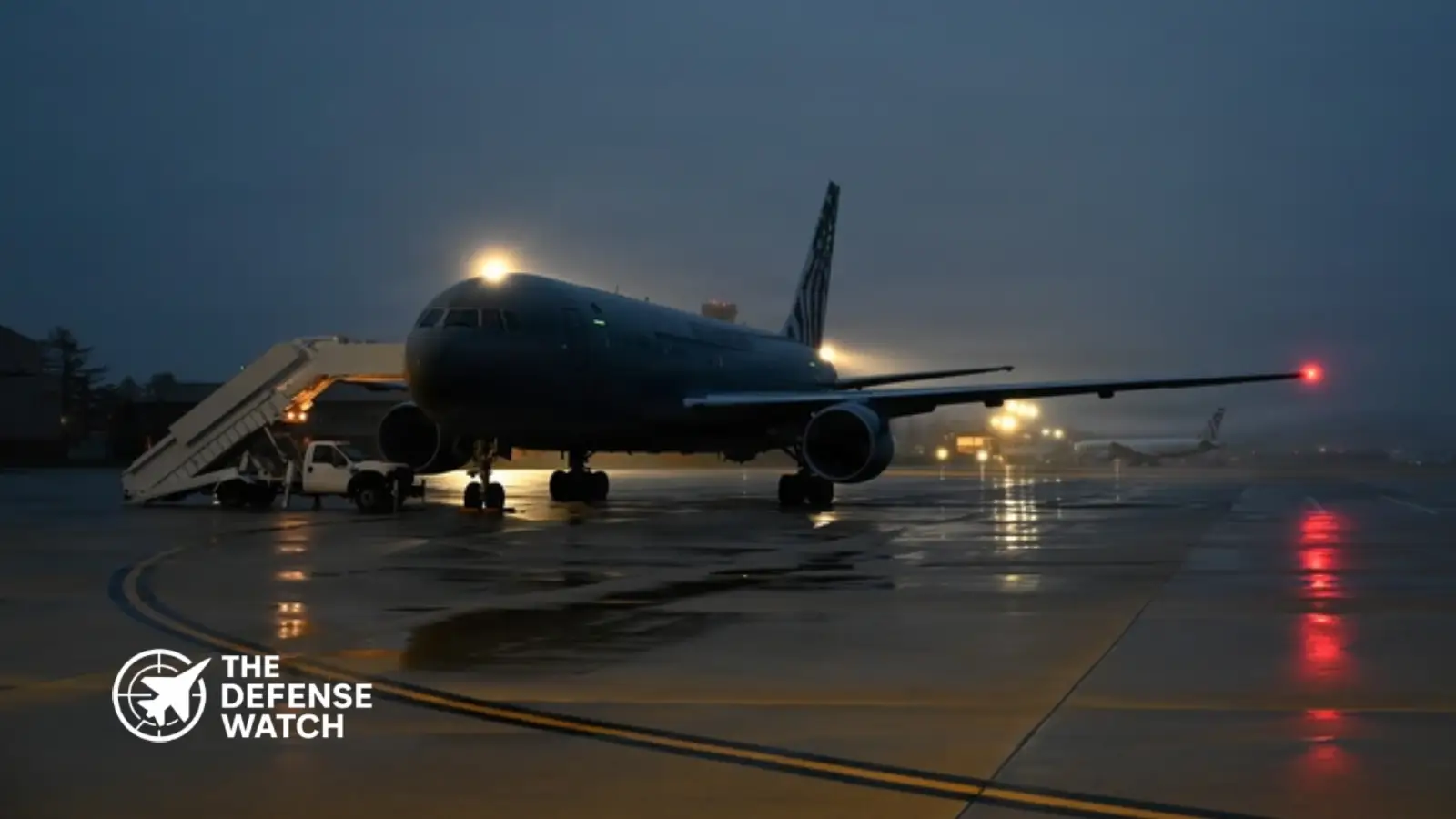
KC-46 tanker upgrade
Image : U.S. Air Force
SHARE

Executive Summary:

The U.S. Air Force says it is confident Boeing has resolved a critical flaw affecting the KC-46 Pegasus aerial refueling tanker. The upgraded Remote Vision System 2.0 has completed testing and is expected to enter production aircraft in 2028, a key milestone for one of the Air Force’s most important mobility programs.

(adsbygoogle = window.adsbygoogle || []).push({});

US Air Force Confident KC-46 Tanker Fix Is Working

The KC-46 tanker upgrade program reached a significant milestone this week as U.S. Air Force Secretary Troy Meink told lawmakers that the service believes Boeing has successfully fixed the aircraft’s troubled Remote Vision System (RVS), a critical component used during aerial refueling operations.

Contents
  • US Air Force Confident KC-46 Tanker Fix Is Working
  • A Decade-Long Challenge For Boeing
  • Why The KC-46 Matters To US Military Operations
  • Additional Orders Depend On Successful Fixes
  • Analysis: A Critical Turning Point For The KC-46

Speaking before a Senate appropriations subcommittee, Meink said the new Remote Vision System 2.0 has been tested successfully and is expected to begin entering the production line in 2028. The announcement marks one of the strongest endorsements yet from Air Force leadership regarding Boeing’s efforts to address a problem that has plagued the tanker program for years.

  • KC-46 Pegasus Aerial Refueling Aircraft

    KC-46 Pegasus Aerial Refueling Aircraft

    • Maximum Speed: Mach 0.86
    • Range: Long
    • Payload Capacity: High fuel offload and cargo
    • Crew: 3
    • View Details →
    7.2

    The KC-46 Pegasus relies on the vision system to allow boom operators to remotely guide the aircraft’s refueling boom into receiving aircraft. Deficiencies in image quality and depth perception under certain lighting conditions have limited the system’s effectiveness and delayed full operational capability.

    (adsbygoogle = window.adsbygoogle || []).push({});

    A Decade-Long Challenge For Boeing

    The KC-46 program has faced technical and schedule setbacks since its development phase. Beyond the Remote Vision System issues, Boeing and the Air Force have worked through problems involving the refueling boom, fuel systems, and production quality concerns.

    The aircraft, derived from the commercial Boeing 767 platform, was selected to replace portions of the aging KC-135 Stratotanker fleet. While the tanker has entered operational service and supports missions worldwide, unresolved deficiencies have prevented the program from fully meeting all Air Force expectations.

    • KC-135 Air Refueling Tanker

      KC-135 Air Refueling Tanker

      • Maximum Speed: 530 mph
      • Range: 1500 miles with refueling mission
      • Payload Capacity: 90000 lb fuel
      • Crew: 3 to 4
      • View Details →
      6.6

      The latest timeline remains well behind original plans. Air Force officials had initially expected the upgraded vision system years earlier, making the anticipated 2028 production integration roughly five years later than first projected.

      (adsbygoogle = window.adsbygoogle || []).push({});

      Why The KC-46 Matters To US Military Operations

      Aerial refueling aircraft are among the most strategically important assets in the U.S. military inventory. They extend the range of fighters, bombers, intelligence aircraft, and transport fleets, enabling global power projection and sustained operations across multiple theaters.

      The importance of tanker fleets has become increasingly apparent as the Pentagon focuses on long-range operations in the Indo-Pacific and maintains readiness across Europe and the Middle East. Modern air campaigns depend heavily on reliable aerial refueling capabilities to support extended missions far from established bases.

      From an operational perspective, resolving the KC-46’s deficiencies is about more than fixing a single aircraft. It is about ensuring the Air Force can field a modern tanker force capable of supporting future high-end conflicts where range, endurance, and rapid deployment are critical factors.

      • KC-46 Pegasus Aerial Refueling Aircraft

        KC-46 Pegasus Aerial Refueling Aircraft

        • Maximum Speed: Mach 0.86
        • Range: Long
        • Payload Capacity: High fuel offload and cargo
        • Crew: 3
        • View Details →
        7.2

        This broader strategic role explains why Air Force leaders continue to invest heavily in the program despite years of technical challenges.

        (adsbygoogle = window.adsbygoogle || []).push({});

        Additional Orders Depend On Successful Fixes

        The Air Force has already ordered 188 KC-46 tankers and received more than 100 aircraft. However, future procurement plans remain tied to Boeing’s ability to fully resolve outstanding deficiencies.

        Earlier this year, Air Force Vice Chief of Staff Gen. John Lamontagne stated that the service would not move forward with a potential follow-on order for an additional 75 aircraft until key issues are corrected.

        That position makes the successful testing of RVS 2.0 particularly important. If the upgraded system performs as expected during further validation and fleet integration, it could remove one of the largest obstacles standing between Boeing and future tanker contracts.

        The Air Force and Boeing recently announced a joint readiness improvement plan focused on accelerating upgrades, improving aircraft availability, and speeding installation of the new vision system across the fleet. Officials believe the effort could significantly improve tanker readiness by the end of the decade.

        (adsbygoogle = window.adsbygoogle || []).push({});

        Analysis: A Critical Turning Point For The KC-46

        The Air Force’s confidence in the upgraded Remote Vision System represents an important turning point for a program that has often been defined by technical setbacks rather than operational achievements.

        While successful testing does not eliminate all remaining challenges, it signals that one of the aircraft’s most persistent deficiencies may finally be nearing resolution. The next phase, integrating the system into production aircraft and retrofitting the existing fleet, will determine whether Boeing can fully restore confidence in the KC-46 program.

        • KC-46 Pegasus Aerial Refueling Aircraft

          KC-46 Pegasus Aerial Refueling Aircraft

          • Maximum Speed: Mach 0.86
          • Range: Long
          • Payload Capacity: High fuel offload and cargo
          • Crew: 3
          • View Details →
          7.2

          Retrofitting aircraft already in service is expected to take several years, meaning the benefits of the upgrade will be realized gradually rather than immediately. Nevertheless, the Air Force’s public endorsement of the fix suggests that program leaders believe the effort is finally moving in the right direction.

          For Boeing, which has absorbed more than $7 billion in losses on the fixed-price tanker contract, a successful RVS 2.0 rollout could help stabilize one of its most challenging defense programs and support future tanker production opportunities.

TAGGED:Boeing DefenseKC-46 Pegasusus air force
Share This Article
Facebook Copy Link Print
ByDaniel Mercer / Defense & Aerospace Analyst
Follow:
Daniel Mercer is a defense and aerospace analyst at TheDefenseWatch.com covering military aviation, aerospace technology, unmanned systems, air warfare, and defense procurement. His reporting uses official documents, government and military statements, company announcements, and other public sources.
Leave a Comment

Leave a Reply Cancel reply

Your email address will not be published. Required fields are marked *

Latest Defense Systems

  • B-25 Mitchell Bomber B-25 Mitchell Bomber
  • F-100 Super Sabre F-100 Super Sabre
  • North American F-86 Sabre North American F-86 Sabre
  • North American XB-70 Valkyrie North American XB-70 Valkyrie
  • Northrop YF-23 Fighter Northrop YF-23 Fighter
  • P-51 Mustang Fighter Aircraft P-51 Mustang Fighter Aircraft
  • Rafale F5 Fighter Rafale F5 Fighter
  • Tomahawk Block V Missile Tomahawk Block V Missile
  • Tomahawk Block IV Missile Tomahawk Block IV Missile

Recent Compares

  • J-10C vs JF-17 Thunder: Which Fighter Is More Capable? J-10C vs JF-17 Thunder: Which Fighter Is More Capable? View Comparison →
  • Tejas vs Gripen: Key Differences and Capabilities Tejas vs Gripen: Key Differences and Capabilities View Comparison →
  • Tejas vs MiG-21 Bison: How India Replaced Its Iconic Supersonic Fighter Tejas vs MiG-21 Bison: How India Replaced Its Iconic Supersonic Fighter View Comparison →
  • F-35 vs F-16: Stealth, Sensors and Combat Roles F-35 vs F-16: Stealth, Sensors and Combat Roles View Comparison →
  • Tejas Fighter Jet vs F-16 Fighting Falcon: Capability Compared Tejas Fighter Jet vs F-16 Fighting Falcon: Capability Compared View Comparison →
  • Rafale Fighter Jet vs F-16 Fighting Falcon : Which Fighter Has the Edge? Rafale Fighter Jet vs F-16 Fighting Falcon : Which Fighter Has the Edge? View Comparison →
  • Su-57 Fighter Jet vs J-20 Fighter Jet: Stealth and Air Combat Compared Su-57 Fighter Jet vs J-20 Fighter Jet: Stealth and Air Combat Compared View Comparison →
  • Mirage 2000 vs Tejas Mk1A: Legacy Combat Power vs Indigenous Modernization Mirage 2000 vs Tejas Mk1A: Legacy Combat Power vs Indigenous Modernization View Comparison →
  • Rafale Fighter Jet vs F-22 Raptor: Which Air Dominance Fighter Has the Edge? Rafale Fighter Jet vs F-22 Raptor: Which Air Dominance Fighter Has the Edge? View Comparison →
  • Tejas Fighter Jet vs. Rafale Fighter Jet: India’s Indigenous Fighter Meets France’s Proven Multirole Combat Aircraft Tejas Fighter Jet vs. Rafale Fighter Jet: India’s Indigenous Fighter Meets France’s Proven Multirole Combat Aircraft View Comparison →

Recent Posts

  • Pratt & Whitney Begins $100 Million Polish Expansion for F-35 Engine Parts
  • Northrop Grumman Wins $43.9 Million Contract for Trident II Rocket Motor Facilities
  • Ukraine Drone Strikes Disrupt Russian Data Centers, Raising Questions About AI Infrastructure Security
  • Lockheed Martin Wins $114.6 Million Contract to Redesign F-35 Navigation Systems
  • Project Agincourt Pushes Pentagon to Speed Up Autonomous Weapons Fielding

You Might Also Like

F-22 Raptor controls YFQ-44A Fury
Aerospace & AviationDrones & UAVsFighter Jets & Military Aircraft

F-22 Raptor Directs YFQ-44A Fury Drone in First Airborne Combat Simulation

October 17, 2026
6th generation fighter jets 2026
Aerospace & AviationFighter Jets & Military AircraftStealth Technology

The 6th Generation Fighter Jet Race Is Now a Three-Way Sprint — And the Gaps Are Widening Fast

September 8, 2026
E-130J Phoenix II training systems
Aerospace & AviationFighter Jets & Military Aircraft

Lockheed Martin Secures Training Systems Deal For E-130J Phoenix II Aircraft

September 12, 2026
Draken Sting training system
Aerospace & AviationFighter Jets & Military Aircraft

Draken Deploys Sting and Phantom Sky Training System Together for First Time

October 15, 2026

Logo

Copyright © 2026 TheDefenseWatch.com

Helpful Links

  • Home
  • About Us
  • Privacy Policy
  • Terms of Use / Disclaimer
  • U.S. Privacy Notice – CCPA Compliance

Defense Systems

  • Defense Systems
  • Comparisons 
  • Manufacturer
  • Tactical Calculators

Popuplar

Which 5 Air Forces Possess the Costliest Fighter Jet Fleets in the World
Evolving Strategic Value: Carrier Strike Groups in the Indo-Pacific’s Future Security Architecture
Autonomous Weapon Systems Spark U.S. Ethics Debate Amid Rapid Military AI Integration

We report on developments involving military forces, governments, defense companies, research organizations, and security institutions around the world. 

Welcome Back!

Sign in to your account

Username or Email Address
Password

Lost your password?