

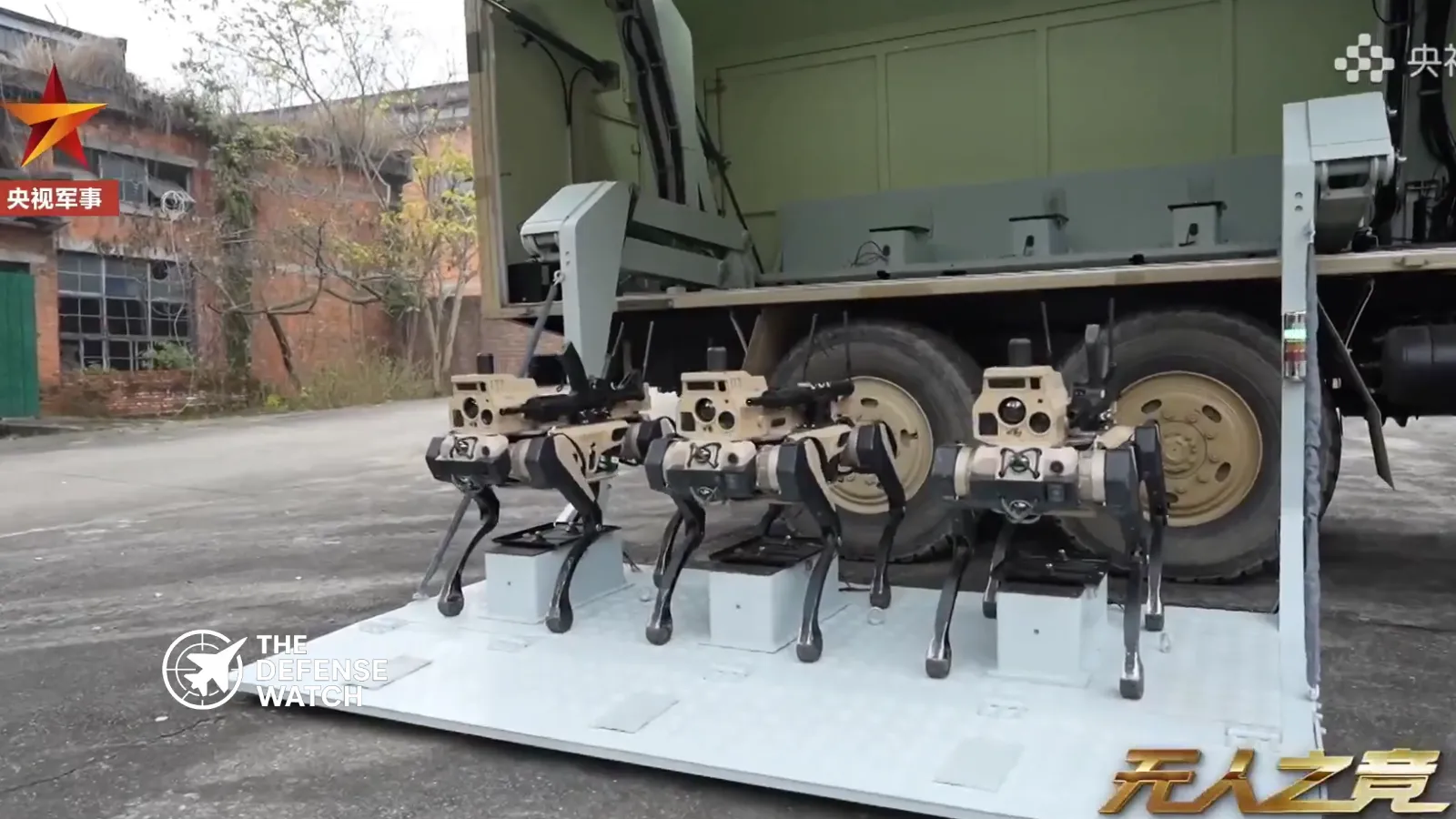
- ► China reveals multi-role robotic wolf pack designed for urban combat and reconnaissance missions.
- ► System includes three variants: reconnaissance, strike, and logistics support platforms.
- ► Robots integrate with aerial drones via shared AI network and real-time mapping systems.
- ► Human operators remain in the loop, authorizing all weapon engagements.
- ► Development signals accelerating shift toward AI-enabled infantry-machine teaming.
China Robot Wolf Pack System Targets Urban Warfare Dominance
China’s robot wolf pack system marks a new phase in military robotics, combining autonomous mobility, modular weapons, and coordinated swarm tactics for urban warfare environments.
Developed by the China Ordnance Automation Research Institute, the system consists of quadruped robotic platforms designed to operate in dense, complex terrain such as collapsed structures and contested city blocks. The unveiling reflects broader efforts by the People’s Liberation Army to integrate artificial intelligence into frontline operations.
According to Chinese state-affiliated defense reporting and technical disclosures, the robots are built to support reconnaissance, precision strike, and logistics functions within a unified network.
Multi-Role Design Enables Coordinated Combat Functions
The robot wolf pack is structured around three specialized variants, each tailored to a specific battlefield role.
The reconnaissance unit, often referred to as the Shadow variant, is optimized for forward scouting. It uses onboard sensors and mapping tools to identify threats and relay data in real time.
The strike variant, described as Bloody Battle, is configured for direct engagement. It can carry modular payloads including small arms, grenade systems, and lightweight guided munitions. The use of a modular architecture allows operators to adapt loadouts based on mission requirements.
A third configuration, known as Polar, supports logistics. This platform is designed to transport supplies, ammunition, or other mission-critical equipment across uneven terrain.
This division of labor mirrors emerging doctrines in unmanned systems, where distributed roles enhance survivability and mission flexibility.
Mobility And Payload Reflect Urban Combat Requirements
Engineers behind the China robot wolf pack system have focused on mobility in constrained environments. Each unit features 12 degrees of freedom, allowing movement patterns that resemble biological quadrupeds.
The robots reportedly reach speeds of up to 15 kilometers per hour while maintaining stability over obstacles up to 30 centimeters in height. This capability is particularly relevant in urban warfare, where debris and vertical obstacles can limit conventional vehicles.
Payload capacity has also been increased to approximately 25 kilograms. This enables the integration of weapons systems and sensor packages without significantly reducing mobility.
Such specifications align with global trends in military robotics, where endurance, payload, and terrain adaptability are key performance factors.
AI Networking And Drone Integration Expand Operational Reach
A defining feature of the system is its integration into a broader network that includes aerial drones. Using simultaneous localization and mapping, or SLAM, the robots generate real-time 3D maps of their surroundings.
These maps are shared across the network, allowing both ground units and drones to maintain a common operational picture. This creates what analysts describe as an air-ground coordination layer, enabling synchronized surveillance and targeting.
The China robot wolf pack system also uses a shared control architecture, sometimes referred to as a shared-brain network. This allows multiple units to coordinate movement and task allocation without requiring constant manual input.
While autonomy plays a role in navigation and target detection, human operators remain responsible for engagement decisions. Control interfaces include voice commands, wearable systems, and handheld devices.
Operational Implications For Modern Infantry Units
The introduction of robotic swarms into urban combat scenarios could significantly alter infantry tactics. By deploying unmanned systems for high-risk tasks such as building entry or reconnaissance in contested zones, forces can reduce exposure of personnel.
At the same time, the reliance on networked systems introduces vulnerabilities. Electronic warfare, signal disruption, and cyber threats remain critical concerns for any AI-enabled platform.
Western defense analysts have noted similar developments in U.S. and allied programs, including efforts to field robotic combat vehicles and autonomous support systems. However, the level of integration demonstrated in the China robot wolf pack system suggests a focus on swarm coordination at the tactical level.
This reflects a broader shift toward distributed operations, where multiple smaller systems operate collaboratively rather than relying on single high-value platforms.
Strategic Context And Global Competition
China’s investment in robotic systems is part of a wider modernization effort aimed at enhancing battlefield awareness and decision speed. The People’s Liberation Army has identified intelligentized warfare as a key objective, emphasizing AI, autonomy, and data integration.
The unveiling of the robot wolf pack system underscores this direction, particularly in the context of urban warfare, which remains a central challenge in modern conflicts.
For the United States and its allies, the development highlights the need to accelerate countermeasures and maintain parity in autonomous systems. This includes both offensive capabilities and defenses against unmanned swarms.
