

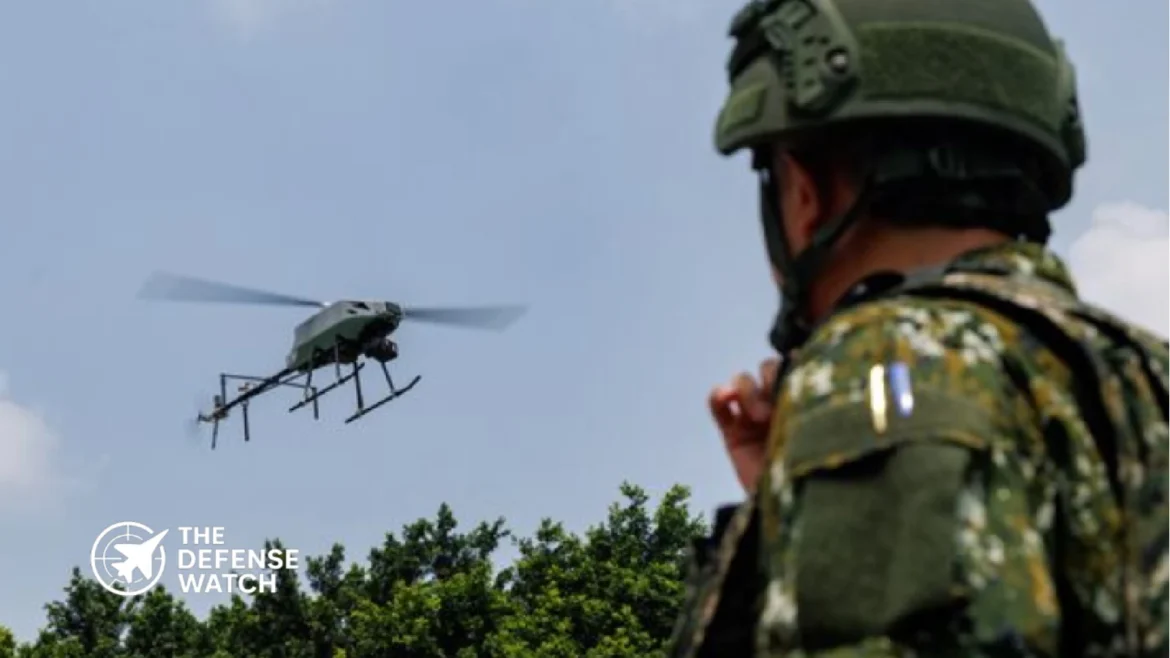
Taiwan’s Legislative Yuan has approved FY2026 funding for a government program designed to expand the island’s unmanned systems industry, giving Taipei additional resources to develop domestic drone technologies, testing infrastructure and supply-chain capacity. Taiwan’s Ministry of Economic Affairs (MOEA) said the allocation forms part of a broader NT$63.4 billion, approximately US$2 billion, drone-related funding package that combines industrial-development spending with unmanned systems procurement across government agencies.
Takeaways
Taiwan expands state-backed investment in unmanned systems and domestic drone production
1. NT$63.4 Billion Drone Funding Package
Taiwan’s FY2026 budget includes a broader NT$63.4 billion package connected to drones and unmanned systems across government programs and procurement activities.
2. NT$8.3 Billion For Industry Development
About NT$8.3 billion has been approved for FY2026 under the six-year Unmanned Vehicle Industry Development Integrated Plan, which runs from 2025 through 2030.
3. Focus On Domestic Technology
The program supports unmanned platforms and key subsystems, including research and development, testing, electromagnetic compatibility and industrial infrastructure.
4. Testing Infrastructure Expands
Taiwan plans an electromagnetic compatibility and comprehensive testing laboratory in Taichung, while the Asia UAV AI Innovation Application R&D Center in Chiayi is also being developed.
5. Defense And Industrial Policy Converge
The strategy links military demand with Taiwan’s wider ICT, semiconductor and precision-manufacturing base to create a more resilient non-Chinese, or democratic, drone supply chain.
The approval comes as Taiwan increasingly treats unmanned systems as both a military capability and an industrial-security requirement. The MOEA’s six-year Unmanned Vehicle Industry Development Integrated Plan runs from 2025 through 2030 and carries a planned budget of about NT$44.2 billion. Approximately NT$8.3 billion has been approved for FY2026, with funding for later years subject to Taiwan’s normal annual budget process.
Strategic Context: Building A Drone Ecosystem, Not Just Buying Aircraft
The significance of the funding extends beyond the number of aircraft Taiwan may ultimately procure. The industrial plan is structured around market development, technology advancement, operating environments and regulatory frameworks. That approach addresses a central weakness exposed by recent conflicts: an effective unmanned warfare capability depends on the availability of complete ecosystems, including airframes, flight-control systems, communications, navigation, sensors, batteries, software, maintenance and testing capacity.
Taiwan’s geography and military posture make this particularly important. A large-scale contingency in the Taiwan Strait would place pressure on conventional platforms and could create sustained demand for relatively inexpensive unmanned systems performing surveillance, targeting, communications relay, logistics and strike missions. Taiwan’s ability to replenish those systems domestically would reduce dependence on vulnerable external supply lines and allow production to continue even if access to imported equipment became constrained.
The policy also reflects lessons from Ukraine, where inexpensive drones have become central to reconnaissance, artillery targeting, electronic warfare and precision attack. Taiwan’s objective is not simply to replicate individual Ukrainian systems, but to establish an industrial base capable of rapidly adapting designs and producing large quantities of platforms and subsystems.
Taiwan’s broader industrial base gives the program a foundation that differs from many emerging drone producers. The island already has extensive capabilities in electronics manufacturing, semiconductors, communications equipment and precision manufacturing. The government is attempting to connect those sectors with aerospace companies, research institutions and defense requirements.
Contract Breakdown & Financial Allocation
FY2026 Industry Development Funding
The principal industrial-development allocation is approximately NT$8.3 billion for FY2026 under the Unmanned Vehicle Industry Development Integrated Plan.
Key characteristics include:
- Program duration: 2025 to 2030
- Planned program budget: Approximately NT$44.2 billion
- FY2026 approved allocation: Approximately NT$8.3 billion
- Broader FY2026 drone-related package: Approximately NT$63.4 billion
- Primary coordinating authority: Taiwan Ministry of Economic Affairs
- Core objectives: Industrial development, defense self-reliance, technology advancement and supply-chain resilience
The NT$63.4 billion figure should not be treated as a single defense procurement contract. It combines different government funding streams, including industrial-development activities and unmanned systems procurement across ministries.
Industrial Technology And Testing
The program supports research and development by domestic companies working on unmanned platforms and critical subsystems. The MOEA has identified companies including Aerospace Industrial Development Corporation, Thunder Tiger, Tianwu and Ability Enterprise as participants receiving research and development support.
Taiwan is also investing in infrastructure required to turn prototype systems into repeatable production and certifiable military equipment.
Planned and existing infrastructure includes:
- Taichung: An unmanned aircraft electromagnetic compatibility, or EMC, and comprehensive testing laboratory.
- Chiayi: The Asia UAV AI Innovation Application R&D Center.
- Testing and validation: Facilities intended to support technical evaluation and system development.
- Industrial support: Research assistance for unmanned platforms and key subsystems.
EMC testing is particularly relevant for military UAV development because densely packed avionics, radios, navigation equipment, electronic warfare systems and payloads must operate without unacceptable electromagnetic interference. Formal testing also helps companies move from prototype development toward repeatable production and international certification.
Geographic Allocation
Publicly available information does not provide a percentage breakdown of the NT$44.2 billion program by Taiwanese region. However, the government’s industrial strategy identifies multiple geographic nodes, including Chiayi for unmanned systems development and Taichung for testing infrastructure. Separate government-supported infrastructure has also been associated with southern Taiwan.
The geographic approach is significant because it spreads unmanned-system capabilities across industrial, research and testing centers rather than concentrating the entire ecosystem around a single production site.
Defense Procurement Is A Separate Funding Stream
Taiwan’s industrial development program should also be distinguished from the separate special-budget effort proposed for indigenous defense unmanned systems.
In June, the Executive Yuan proposed up to NT$210 billion, approximately US$6.7 billion, from August 2026 through December 2031 for indigenous unmanned defense systems. That proposal covered coastal surveillance drones, coastal attack drones and small unmanned surface vessels.
The distinction matters because the NT$210 billion initiative is primarily a defense procurement mechanism, while the NT$44.2 billion integrated industrial plan is designed to develop the wider industrial ecosystem.
Recent reporting also indicates that Taiwan’s legislature approved a broader NT$63.4 billion drone-related package in the FY2026 budget. The figures therefore represent overlapping but distinct policy and procurement streams rather than a single NT$63.4 billion contract awarded to one contractor.
Industry Impact & Acquisition Insight
Taiwan is effectively using government demand as an anchor customer for an emerging unmanned systems sector. Rather than relying exclusively on conventional defense procurement, the model combines industrial research subsidies, government purchases, testing infrastructure and international certification. This can reduce the technology gap between civilian commercial drones and military-qualified systems, while giving domestic companies a pathway into allied markets. The MOEA has reported that Taiwan’s drone industry generated approximately NT$12.9 billion in output in 2025, more than 2.5 times the previous year’s level, while finished-drone exports reached about NT$2.95 billion. The government has set a 2030 output target above NT$40 billion.
The acquisition model also places greater emphasis on supply-chain security. Taiwan’s government has described the objective as building a democratic or non-Chinese supply chain, while recent policy initiatives have focused on international certification and cooperation with the United States and other partners. Taiwan has also expanded cooperation with U.S. and Japanese organizations to improve market access and technical validation.
For defense planners, the most important measure of success will therefore not be the number of drones purchased in FY2026. It will be whether Taiwan can establish a production system capable of rapidly replacing combat losses, introduce new designs without lengthy procurement cycles, secure critical electronic components and maintain communications and navigation capabilities under contested conditions.
That requirement is especially important in a Taiwan Strait contingency, where the ability to replenish attritable systems could become as important as the performance of individual platforms.