
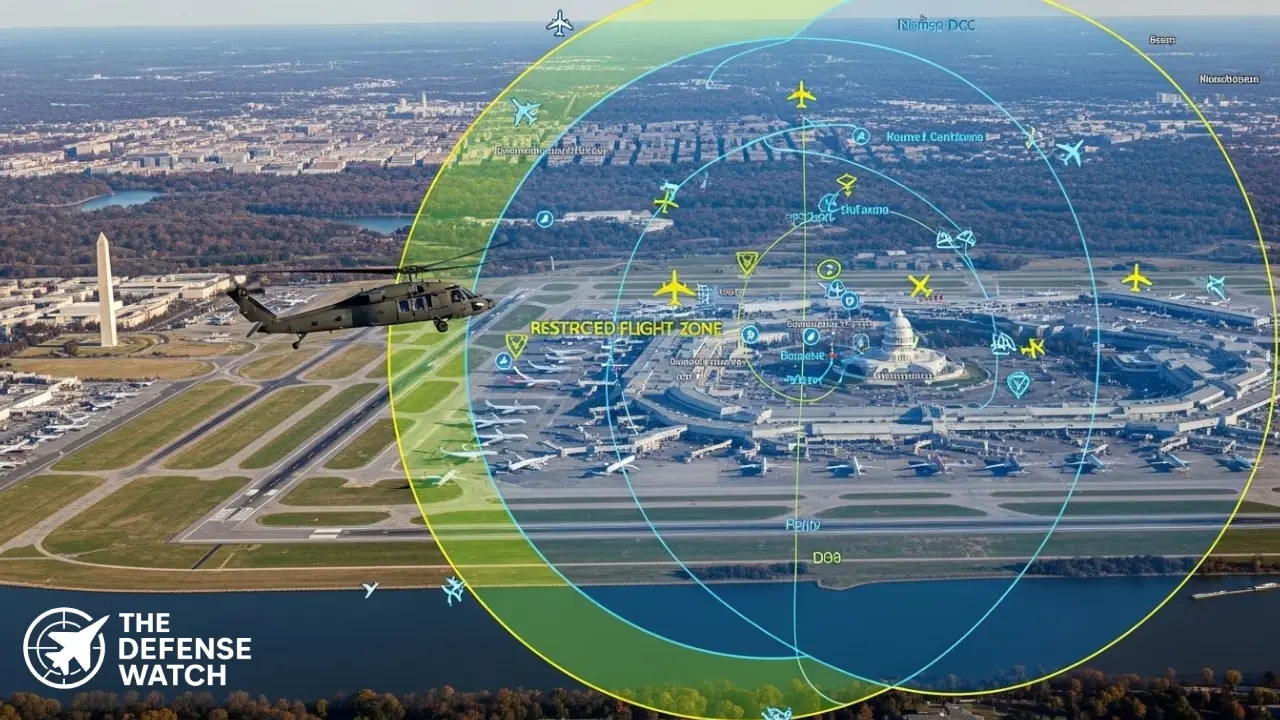
Congress is considering a major change to how the US military operates helicopters near Washington, D.C. A new provision in the annual defense policy would require military helicopters — especially those flying near Ronald Reagan Washington National Airport (DCA) — to broadcast safety alerts to help prevent collisions with commercial aircraft.
The move comes after a tragic mid-air collision on January 29, 2025, in which a US Army UH-60 Black Hawk helicopter lacking a key safety system collided with an American Airlines regional jet, killing all 67 people aboard both aircraft.
Why It Matters
Mixed traffic of helicopters and commercial planes around DCA has long posed safety risks. From October 2021 to December 2024, data shows more than 15,000 encounters in which helicopters and jets came dangerously close — including 85 incidents judged as “close calls” with vertical separation under 200 feet.
In many of these cases, commercial pilots received automated collision alerts from their onboard traffic systems, prompting evasive maneuvers or aborted landings.
After the January crash, the Federal Aviation Administration (FAA) imposed significant route restrictions. That included shutting down a key helicopter route used for decades and limiting helicopter operations when certain runways are in use.
Even so, the concern remains that some military helicopters still fly without transmitting position data, because of exceptions related to sensitive missions.
What the Legislation Proposes
The draft legislation would:
- Require military helicopters flying near DCA to broadcast position alerts — unless the Department of Defense determines a waiver is needed after a formal risk assessment.
- Mandate that the Pentagon report all past and future near-miss incidents involving military and commercial aircraft over the last decade.
- Force safety reviews at major airports and a safety-coordination audit by the U.S. Army Inspector General for military flight operations near civilian airspace.
In effect, the measure aims to close a gap that allowed military helicopters to operate near commercial flights without transmitting their location.
The legislation would not necessarily eliminate all exceptions. Waivers might be permitted in national-security scenarios or where officials deem there is no risk to commercial air traffic.
Context and Previous Actions
Following the crash in January, the National Transportation Safety Board (NTSB) issued urgent recommendations asking the FAA to permanently ban helicopter traffic over certain zones near DCA when some runways are in use. The board called the situation “an intolerable risk to aviation safety.”
In March the FAA announced a permanent closure of the specific helicopter route involved in the accident, and limited mixed traffic of helicopters and fixed-wing aircraft in high-risk areas.
By June, the FAA published updated charts reducing the size of helicopter zones near DCA and adding a new transition route south of the airport, designed to keep helicopters and airliners safer. The changes also formalized the use of automatic position-broadcasting (ADS-B Out) for all aircraft in the restricted zones, with few exceptions.
Still, some military helicopters continued flying with transponders disabled under the claim of sensitive missions. The Army’s head of aviation acknowledged that after the crash, helicopters were still “flying over the nation’s capital” without broadcasting position data because the missions were deemed sensitive.
That reality triggered strong criticism from some lawmakers. For example, Eleanor Holmes Norton, DC’s non-voting delegate to Congress, urged that helicopters near DCA be required to use ADS-B except in narrow security-related exceptions.
What Could Change
If Congress approves the new defense-policy provision, nearly all military helicopters flying near DCA — including training flights or VIP transport — would need to broadcast their positions to surrounding air traffic and controllers. That would make them visible to other aircraft and reduce the likelihood of mid-air collisions.
Defense officials would also have to provide more transparency about past near-misses and conduct safety audits. That information could inform broader changes in how military and civilian flights are coordinated nationwide around busy airports.
However, the bill leaves open the possibility of waivers for certain missions. Some national-security flights or sensitive operations might still bypass the broadcasting requirement, if the Pentagon deems them necessary.
What Comes Next
The new defense policy is now under consideration in Congress. If passed, it could mark a major shift in how the military integrates into civilian airspace around busy airports such as DCA.
Beyond the Capitol airspace, the change could lead to broader adoption of similar safety requirements in other cities where military and commercial air traffic overlap.
Get real time update about this post category directly on your device, subscribe now.

4 comments
[…] contact with civil air traffic control. The UK position has been that these missions are focused on aviation safety, helping to re-route civilian flights and maintain safe airspace around one of Europe’s busiest […]
[…] Aviation safety advisories from European and U.S. regulators […]
[…] is complete and ready for formal signature. Once signed, the agreement would be sent to the US Congress and the Ukrainian parliament for ratification, moving it into a legally binding […]
[…] Sources familiar with the negotiations say Saudi Arabia has sought up to 48 F-35 jets. The potential agreement has cleared key Pentagon review stages but still requires formal approval from the White House and the US Congress. […]