
UK Carrier Drone Plan Advances Without Catapults
The UK carrier drone plan has moved forward under a revised approach that drops the need for catapults and arrestor systems, the UK Ministry of Defence confirmed in a written statement on February 11, 2026.
In responses to parliamentary questions, Defence Minister Luke Pollard said the previously separate Royal Navy programmes Project VIXEN and Project ARK ROYAL have been folded into a new initiative, Project VANQUISH, under the broader Maritime Aviation Transformation Strategy (MATX).
Shift To STOL Carrier Drones
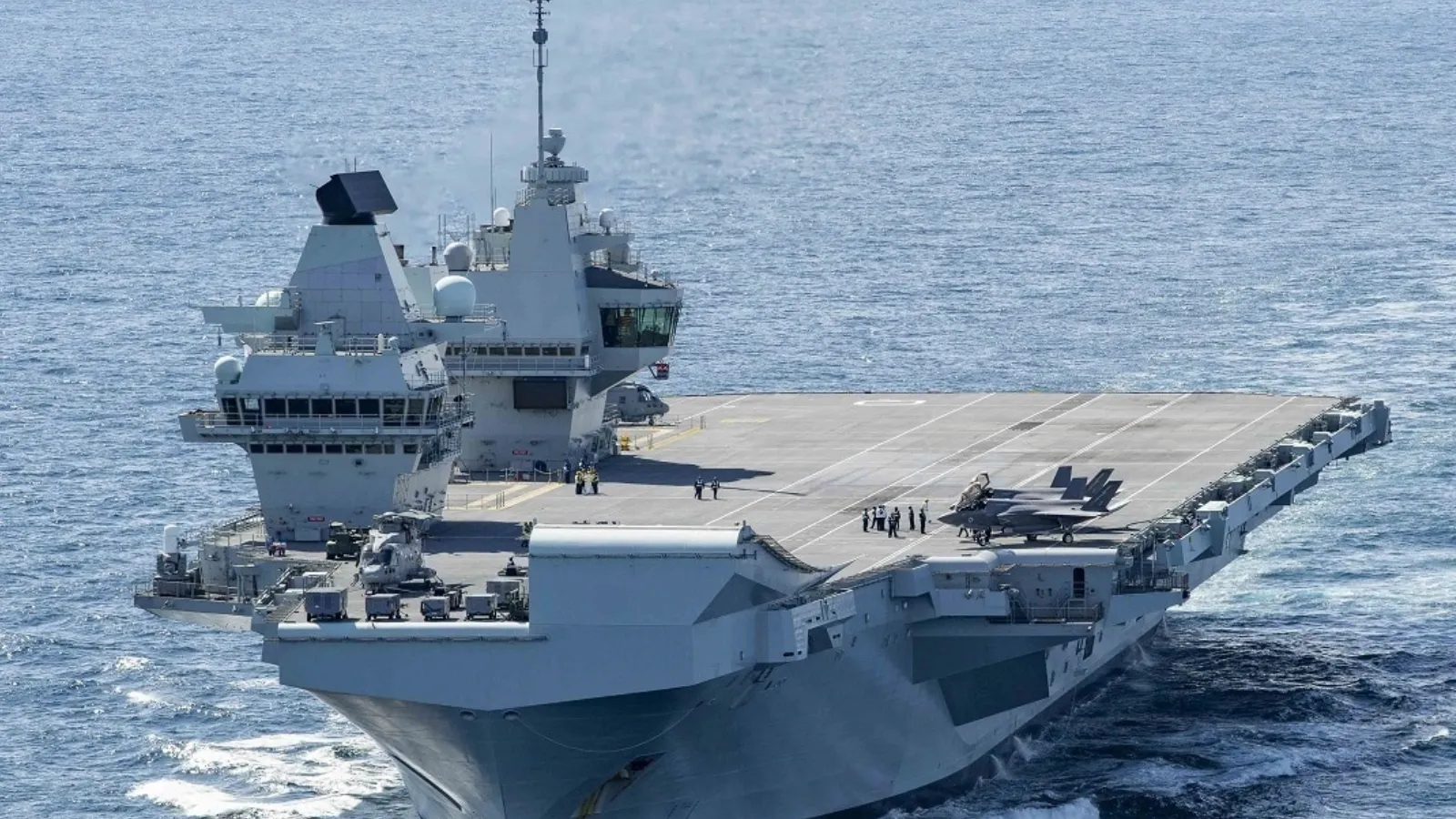
Project VANQUISH is designed to develop and demonstrate a jet-powered, short-takeoff and landing (STOL) autonomous fixed-wing drone that can operate from the Royal Navy’s Queen Elizabeth class aircraft carriers without catapults or arrestor gear. This approach leverages the carriers’ existing ski-jump design.
The UK confirmed the shift away from assisted launch and recovery equipment (ALRE) in the House of Commons. According to Pollard, the project will generate evidence to support future uncrewed fixed-wing aircraft operations aboard carriers with minimal structural modifications.
That strategy aligns with recent UK Ministry of Defence documentation seeking industry input on a fixed-wing STOL Autonomous Collaborative Platform (ACP) capable of ISR, strike, and other missions, while complementing the Royal Navy’s F-35B Lightning aircraft in a hybrid air wing.
From VIXEN To VANQUISH
The move marks a change from earlier plans such as Project VIXEN and Project ARK ROYAL. Those efforts had explored broader carrier modifications including catapult-assisted takeoff and arrested recovery concepts for larger uncrewed aircraft. Those programmes have now been discontinued.
Under the new plan, the focus is on a hybrid air wing that mixes crewed and uncrewed aircraft. The Royal Navy’s current carriers use a ski-jump ramp and short takeoff vertical landing (STOVL) design for F-35B jets, a setup that limits the types of fixed-wing unmanned assets that can be operated without additional launch systems.
Operational Context
The Queen Elizabeth class carriers, HMS Queen Elizabeth and HMS Prince of Wales, do not have catapult-assisted launch or arrested recovery systems. That constraint has shaped UK carrier aviation planning for years. The ships were commissioned with a ski-jump ramp to support STOVL operations for F-35Bs.
UK planners had considered retrofitting catapults and arrestor gear to expand the carriers’ capabilities. Those options are now being de-emphasized in favor of drones that operate within the existing STOL envelope.
Earlier industrial proposals, including fixed-wing unmanned combat aerial vehicles designed for catapult launch, were featured at international air shows and in defence reporting. Those concepts highlighted the potential capability growth that catapults could provide but also underscored the integration challenges.
AVAILABILITY AND NEXT STEPS
Officials have issued a Request for Information (RFI) to industry as part of Project VANQUISH to inform future requirements and potential demonstrations. The RFI seeks unmanned STOL platforms capable of autonomous operations from carrier decks without the need for traditional launch and recovery infrastructure.
Responses to the RFI are due by late 2025, with contract and demonstration phases expected to run into late 2027. This early-stage effort will inform broader decisions under the UK Defence Investment Plan.
Strategic Importance
Developing carrier-based drones that operate without significant modification to existing carriers reflects a push across several navies to integrate unmanned systems into air wings. Unmanned platforms can extend surveillance, strike, and support capabilities while reducing risk to human pilots.
For the Royal Navy, the strategy under MATX aims to balance current operational needs with future capability growth, leveraging autonomous systems to supplement manned aircraft in a contested environment.
Get real time update about this post category directly on your device, subscribe now.
