
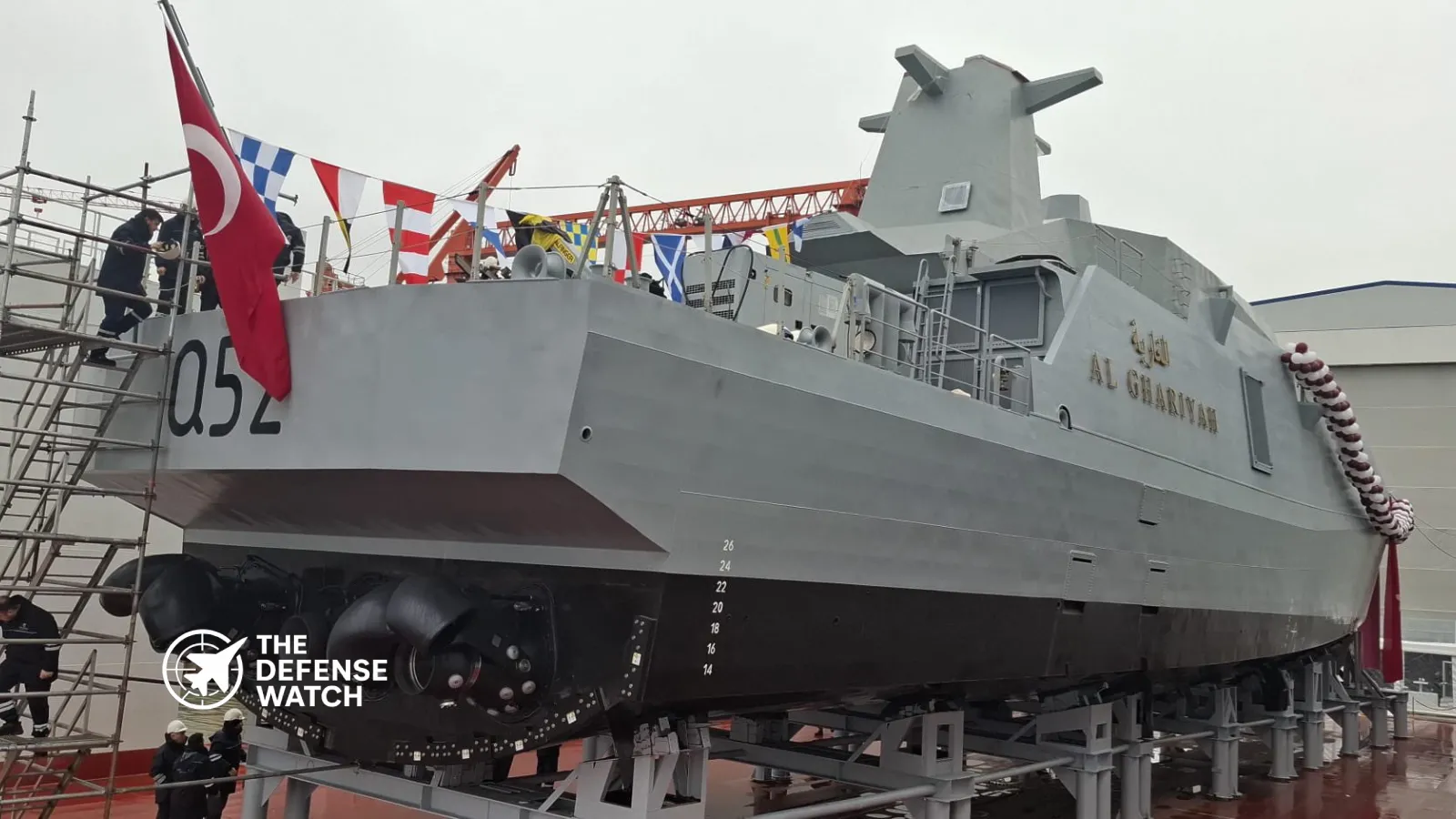
Qatar’s Second Guided Missile Fast Attack Craft Launched
The second guided missile fast attack craft built by DEARSAN Gemi İnşaat Sanayi A.Ş. for the Qatar Armed Forces was launched into the sea on February 14, 2026.
The vessel, designated Q52 Al Ghariyah, entered the water during a ceremony held at Dearsan Shipyard in Türkiye. The launch marks another milestone in the bilateral naval cooperation agreement covering two 50 meter guided missile fast attack craft.
The program forms part of Qatar’s broader naval modernization efforts aimed at strengthening coastal defense and maritime security capabilities in the Persian Gulf region.
Contract Background And Program Scope
The contract between DEARSAN and the Qatar Armed Forces calls for the construction of two 50 meter guided missile fast attack craft. The agreement reflects Doha’s continued investment in fast, heavily armed surface combatants capable of operating in littoral and near shore environments.
Fast attack craft play a critical role in regional maritime security. Their compact size, high speed, and missile armament make them effective platforms for coastal defense, anti surface warfare, and deterrence missions.
The launch of Q52 Al Ghariyah follows the completion of hull construction and outfitting phases. The vessel will now enter the fitting out, systems integration, and sea trials phase before delivery.
Platform Capabilities And Operational Role
While detailed technical specifications have not been publicly disclosed, 50 meter class guided missile fast attack craft typically feature:
- High speed propulsion systems for rapid response operations
- Advanced radar and combat management systems
- Anti ship missile launchers
- Naval gun systems for surface engagements
- Integrated communications and electronic warfare suites
Such vessels are designed to operate in confined maritime environments, including chokepoints and coastal waters. For Qatar, this capability is particularly relevant given the strategic importance of Gulf shipping lanes and offshore energy infrastructure.
The addition of Q52 Al Ghariyah strengthens Qatar’s ability to conduct maritime patrol, deterrence missions, and rapid response operations.
Qatar’s Expanding Naval Modernization Efforts
Qatar has steadily expanded its naval forces over the past decade. The modernization drive includes investments in offshore patrol vessels, corvettes, amphibious platforms, and fast attack craft.
The country’s naval development strategy aligns with broader Gulf trends, where regional states are enhancing maritime security to protect energy exports, territorial waters, and strategic sea lines of communication.
Türkiye has emerged as a significant defense partner for Qatar across land, air, and naval domains. Turkish defense firms have secured multiple contracts in shipbuilding, armored vehicles, and training programs.
The guided missile fast attack craft program further deepens that cooperation.
Regional Maritime Security Context
The Persian Gulf remains one of the world’s most strategically sensitive maritime regions. Commercial shipping, oil and gas exports, and naval operations converge in relatively narrow waters.
Fast attack craft are widely used by Gulf states due to their cost effectiveness and operational flexibility. Compared to larger frigates or destroyers, these vessels offer:
- Lower operating costs
- Faster deployment cycles
- Enhanced maneuverability in shallow waters
- Strong missile strike capability relative to size
For smaller navies, missile armed fast attack craft provide a credible deterrent against larger surface combatants operating near national waters.
Industrial And Strategic Significance For DEARSAN
For DEARSAN, the launch of Q52 Al Ghariyah reinforces its position as an export focused naval shipbuilder. Turkish shipyards have expanded their footprint in Africa, the Middle East, and Asia over the past decade.
Export programs such as this one demonstrate Türkiye’s growing role in the global naval defense market. The country’s shipbuilding sector has focused on modular construction, competitive pricing, and tailored designs for regional requirements.
The successful launch of the second vessel suggests the program remains on schedule.
What Comes Next
Following launch, Q52 Al Ghariyah will undergo harbor acceptance tests and sea trials. These phases validate propulsion performance, navigation systems, combat systems integration, and weapons functionality.
Once trials are completed, the vessel will be formally delivered to the Qatar Armed Forces and integrated into operational service.
Delivery timelines have not been publicly detailed, but launch typically precedes commissioning by several months.
Strategic Outlook
The launch of Qatar’s second guided missile fast attack craft underscores Doha’s continued emphasis on maritime defense.
In a region where naval capabilities are closely watched, incremental additions such as Q52 Al Ghariyah contribute to layered coastal defense and deterrence architecture.
As Gulf states modernize their fleets, fast attack craft remain a central element of naval force structure due to their speed, flexibility, and strike capacity.
Get real time update about this post category directly on your device, subscribe now.
