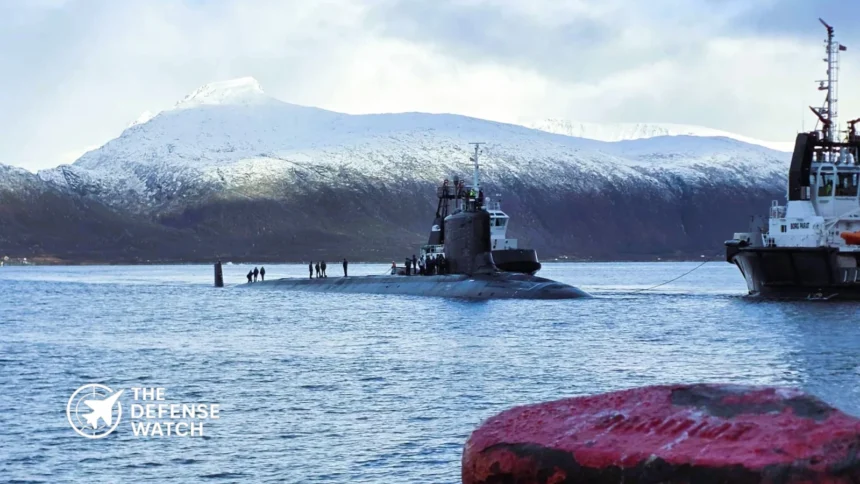
The U.S. Navy’s Virginia-class attack submarine USS Oregon (SSN 793) arrived at the Port of Grøtsund near Tromsø, Norway, on October 6, 2026, for a scheduled port visit. The stop supports routine naval operations in northern Europe and the Arctic region, according to reporting published by defense industry outlets citing U.S. Navy information.
The visit places an American nuclear-powered attack submarine at a Norwegian logistics hub in the High North, a region that connects the North Atlantic with Arctic waters. It also follows the USS Delaware’s visit to the same port in September, demonstrating continued U.S. submarine activity in northern Europe.
Grøtsund supports allied naval operations
Grøtsund, near Tromsø in northern Norway, provides logistical support for visiting naval vessels. Reported services include replenishment, routine maintenance and crew rest, allowing allied ships to sustain operations without returning to their home ports.
For submarines operating across northern European waters, access to allied port facilities can support deployment schedules and sustainment requirements. Such visits also give U.S. and Norwegian authorities opportunities to maintain working relationships and coordinate support for naval forces operating in the region.
The port call should not, by itself, be interpreted as evidence of a new combat mission or a change in the submarine’s operational tasking. The available reporting identifies the visit as scheduled and routine. It does not establish that USS Oregon conducted a specific Arctic patrol, tracked a Russian submarine or participated in a classified operation during the stop.
What USS Oregon brings to the region
USS Oregon is a Virginia-class nuclear-powered fast-attack submarine commissioned by the U.S. Navy on May 28, 2022. It is the 20th submarine of its class and the second Block IV boat.
The Virginia class is designed for multiple missions, including anti-submarine warfare, anti-surface warfare, land-attack missions, special operations support, intelligence collection, surveillance and reconnaissance, and mine warfare. These roles make the class an important part of the U.S. Navy’s undersea force.
Nuclear propulsion supports sustained underwater operations without the need for conventional fuel stops. However, the Navy has not publicly disclosed the specific mission profile, patrol area or operational objectives associated with USS Oregon’s Norwegian port call.
The submarine’s presence also does not independently establish which sensors, weapons or mission systems were used during its deployment. Those details should not be inferred from the port visit alone.
Why the High North matters to NATO
The waters around Norway occupy an important position in NATO’s northern defense geography. They connect the Norwegian Sea and the North Atlantic with the wider Arctic region, making maritime awareness and undersea operations relevant to allied security planning.
Submarines can contribute to this effort through surveillance, intelligence gathering, sea control and anti-submarine warfare. Their ability to operate covertly makes them useful for monitoring maritime activity, although the exact activities of an individual submarine generally remain undisclosed.
Norway’s geographic position and NATO membership make it an important partner for U.S. naval forces operating in northern Europe. Port access and logistical support can help maintain a sustained allied presence without requiring every deployment to be supported exclusively from distant bases.
The strategic significance of USS Oregon’s visit is therefore best understood in the context of established U.S.-Norwegian defense cooperation and routine naval operations, rather than as proof of an immediate military escalation.
A pattern of submarine visits
USS Oregon’s arrival follows the USS Delaware (SSN 791), another Virginia-class attack submarine, which visited Grøtsund in September 2026. The U.S. Navy reported that Delaware’s visit was routine and that the submarine concluded its port call on September 7.
The two visits demonstrate that Grøtsund is being used to support U.S. submarine activity in northern Europe. They do not, on their own, establish a permanent forward-deployment arrangement or a change in the number of submarines assigned to the region.
For now, the publicly available information supports a straightforward conclusion: USS Oregon’s port call is part of routine U.S. Navy activity in northern European waters. Its broader significance lies in the continued use of Norwegian facilities to support allied naval operations in a strategically important region.