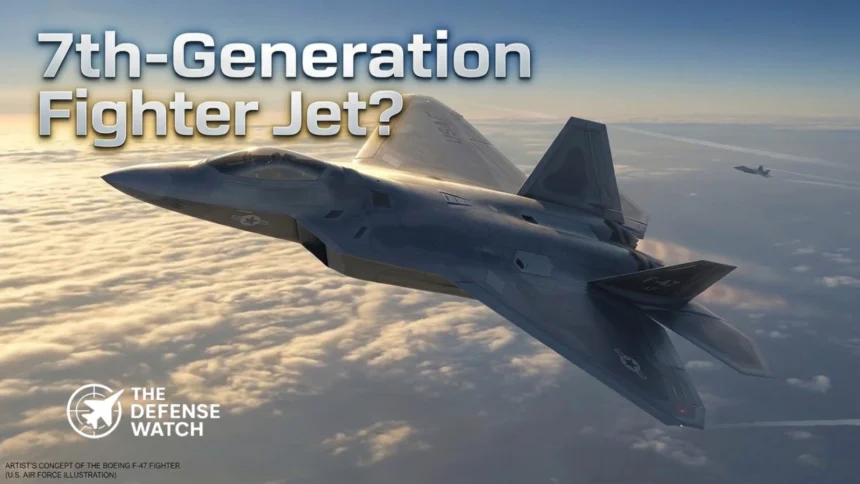
The United States has announced no seventh-generation fighter jet program. The contract announcements, congressional documents and budget reporting reviewed for this article point to sixth-generation work, led by the Air Force’s Boeing F-47 and the Navy’s F/A-XX, neither of which is yet in service.
Could Washington plan one? Nothing prevents the Pentagon from starting concept research on whatever follows these aircraft. A funded program, however, would need a defined requirement, money from Congress and a development path, and none has been made public for a seventh-generation design.
Where the generation count stands
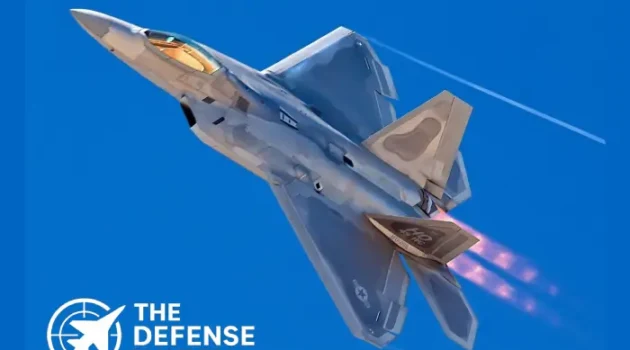
Fighter “generations” are a shorthand rather than an engineering standard. The Congressional Research Service (CRS) notes that some observers regard the F-22 and F-35 as fifth-generation aircraft, a group broadly associated with stealth, advanced sensors and integrated avionics. In a September 2026 report, it described the F-47 as an aircraft “some have described as a sixth-generation fighter.”
The Pentagon and Boeing use the label without that qualification. When the Air Force awarded Boeing the F-47 engineering and manufacturing development (EMD) contract on March 21, 2025, the program was presented as the first sixth-generation fighter. The service said X-planes flown over the previous five years had laid its foundation.
EMD covers maturing, integrating and testing the design. According to the Air Force, this phase will produce a small number of test aircraft, and the contract includes options for low-rate initial production.
The Navy followed on Sept. 29, 2026, selecting Boeing for the F/A-XX. The Pentagon valued the full-scale development phase at more than $20 billion. The aircraft is intended to augment and eventually replace the F/A-18E/F Super Hornet and EA-18G Growler beginning in the 2030s, operating alongside the F-35C.
The F-47 schedule comes first
The Air Force is targeting a first F-47 flight in 2028. Gen. Dale White, who oversees the program, said in February 2026 that it remained on schedule and that Boeing was building the first airframe.
A first flight is not operational service. Rep. Rob Wittman, who chairs the House Armed Services subcommittee on tactical air and land forces, said in March that neither the F-47 nor the F/A-XX would be available until the mid-2030s. That is a lawmaker’s assessment; the Air Force has spoken of fielding the F-47 in the early 2030s.
Published performance goals are limited. The Air Force has said the F-47 will have a combat radius of more than 1,000 nautical miles, fly faster than Mach 2 and be bought in quantities of at least 185. These are program objectives that have not been demonstrated publicly in flight test, and much of the design remains classified.
The engine is on a different clock
The adaptive engines developed for this generation will not be ready when the F-47 is due to fly. Under the Next Generation Adaptive Propulsion (NGAP) program, GE Aerospace is working on the XA102 and Pratt & Whitney on the XA103. Adaptive-cycle engines alter airflow in flight to favor either thrust or fuel efficiency.
In July, John Sneden, the Air Force’s propulsion acquisition executive, said the service was preparing for possible NGAP integration around 2030. He did not commit to which aircraft would fly the engine first. TWZ reported that, if both schedules hold, the F-47 would have to begin flying with a different powerplant. The Air Force has not publicly identified one.
What the budget shows
Air Force budget documents released in April project F-47 research and development spending to peak in fiscal 2028. Figures below are in billions of dollars and include requests and projections, not guaranteed appropriations.
Fiscal year 2026 2027 2028 2029 2030 2031 F-47 R&D 3.45 5.04 5.25 4.12 3.29 2.95 NGAP R&D 0.33 0.51 0.91 0.87 0.30 0.30 The F-47 line totals about $24.1 billion across those six years. It is not a full program cost: it excludes later years and aircraft procurement.
Heather Penney of the Mitchell Institute for Aerospace Studies told Air & Space Forces Magazine that the profile suggests the hardest development work on both efforts could be largely complete around 2029. That is an analyst’s reading of projections that Congress can change.
Congress is already weighing changes. The House Appropriations Committee’s June summary backed $5 billion for the F-47 and $915 million for the F/A-XX. On Nov. 16, the Senate Appropriations Committee released a bill that would cut $603 million from the F-47 request, leaving about $4.4 billion.
The same Senate bill would reduce several funding lines for Collaborative Combat Aircraft (CCA), the uncrewed “wingmen” meant to operate with crewed fighters. Neither committee position is final. As of Nov. 25, lawmakers were considering another stopgap measure to hold funding at fiscal 2026 levels.
Near-term pressures compete for the same money
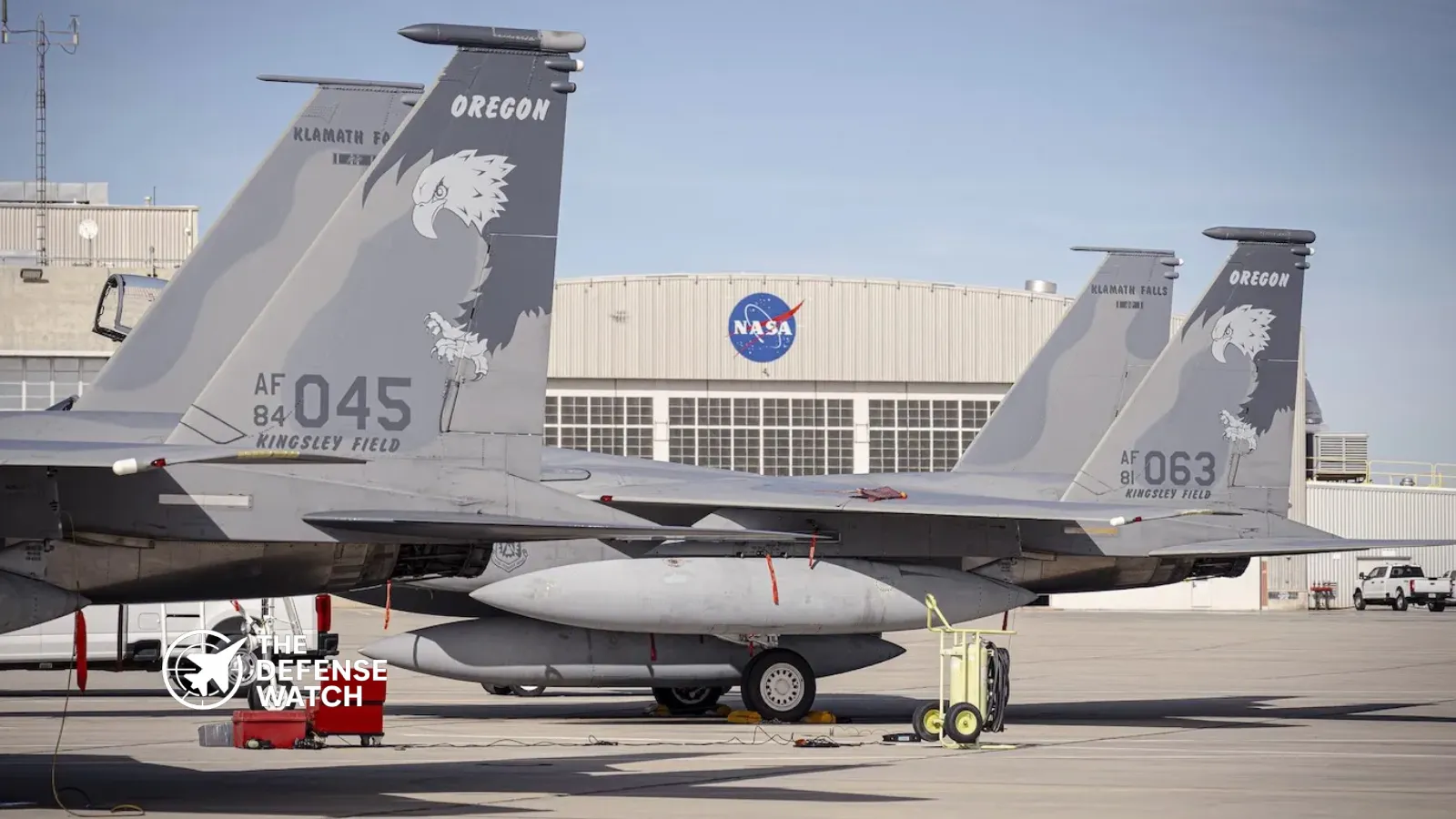
The Air Force’s immediate problem is the number and age of its fighters. CRS reported that the service told Congress in May it had 1,098 fighters and was below a statutory requirement of 1,145 primary mission aircraft. The two figures sit within a disputed accounting picture, because the service has proposed a broader method of counting its inventory.
An Air Force force-structure report calls for 1,558 combat-coded crewed fighters by 2035. Reaching it depends on F-35 and F-15EX production as well as the F-47, and CRS has asked how reliable the new fighter’s development timeline is, citing delays and overruns on the F-22 and F-35.
The Navy has its own sequencing task. Acting Navy Secretary Hung Cao told lawmakers in November that the service was in preliminary talks with Boeing on the cost of low-rate initial production, with the aim of accelerating F/A-XX. Boeing now holds both crewed sixth-generation development programs, which makes its engineering workforce and production capacity a shared factor.
China adds urgency, though to the sixth-generation contest. The Pentagon’s latest annual report on Chinese military power says China began testing two sixth-generation aircraft designs in December 2024. Observers commonly call them the J-36 and J-50. Public test flights do not establish when either will enter service or what it can do.
What could define a seventh generation?
No agreed definition exists. Online descriptions often list pilotless flight, hypersonic speed, quantum radar, directed-energy weapons or operations at the edge of space. These are speculative features, not published U.S. requirements for any fighter.
Our assessment is that several of the ideas attached to a future generation may arrive piece by piece. Autonomy is being pursued through CCAs, adaptive propulsion through NGAP, and open mission systems are part of Boeing’s description of the F/A-XX. The Air Force says CCAs are intended to augment crewed fighters, not replace them.
That leaves an open design question: whether the successor to today’s programs will be a single crewed aircraft at all. A future requirement could spread sensors and weapons across several crewed and uncrewed platforms. Public information does not show that the Pentagon has made that choice.
History also argues for patience. The Air Force selected the F-22 design in 1991 and the fighter entered service in 2005. The Joint Strike Fighter development contract came in 2001, and the first F-35 variant reached initial operational capability in 2015. Those intervals do not predict the F-47’s schedule, but they show why a contract or first flight should not be mistaken for a usable combat force.
Signals that would change the answer
A real seventh-generation effort would likely leave a public trail, although classified research might not. Indicators would include a budget line for a successor aircraft, requests to industry for concepts, congressional report language or an official statement of requirements.
Until then, claims that the United States is building or testing a seventh-generation fighter are unsupported by the public record reviewed here. The dated milestones belong to the current generation: a final fiscal 2027 funding decision, the F-47’s planned 2028 flight and NGAP integration work around 2030.

Enjoying our coverage?
Make The Defense Watch a preferred source on Google to see more of our geopolitical and defense insights when relevant to you.