
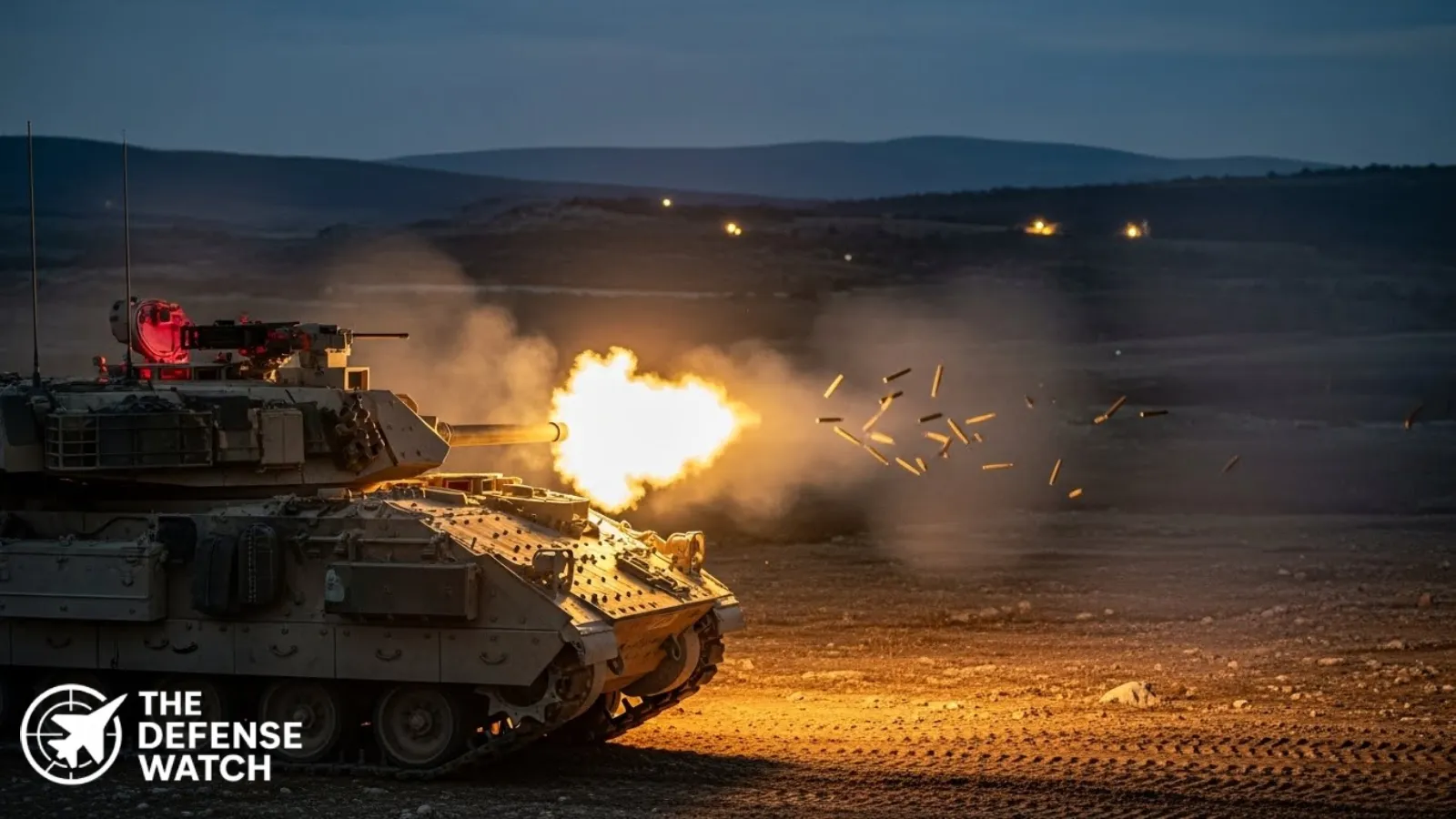
The exercise at Novo Selo, Bulgaria
On December 5, 2025, soldiers from Bravo Company, 1st Battalion, 16th Infantry Regiment, 1st Armored Brigade Combat Team, 1st Infantry Division of the U.S. Army carried out a platoon-level live-fire exercise at the Novo Selo Training Area in Bulgaria. The central platform was the M2A3 Bradley Infantry Fighting Vehicle. The exercise forms part of rotating U.S. heavy armour presence in Bulgaria and supports NATO’s effort to maintain a credible mechanized force along its eastern flank.
Background — Why Bulgaria matters for NATO’s eastern flank
Since 2022, the security landscape in Eastern Europe has shifted significantly following Russia’s large-scale invasion of Ukraine. In response, the alliance has bolstered its eastern and south-eastern flank by deploying multinational battlegroups to several member states — including Bulgaria — to deter aggression and reassure neighboring allies.
The Novo Selo Training Area provides wide manoeuvre corridors and dedicated armored ranges that allow forces to rehearse combined arms operations under conditions similar to those found in parts of eastern Bulgaria and the wider Black Sea region.
The M2A3 Bradley — Capabilities and role in the exercise
The M2A3 Bradley is a tracked infantry fighting vehicle combining mobility, protection and firepower. Its armament includes a 25 mm Bushmaster automatic cannon, a coaxial 7.62 mm machine gun, and a twin-tube TOW anti-tank missile launcher. The A3 configuration integrates a digital architecture with thermal imagers, a commander’s independent viewer and battle-management systems to provide real-time situational awareness and improve interoperability at platoon and higher levels.
During the exercise, crews practiced detecting and engaging targets, repositioning between firing positions, and coordinating with dismounted infantry elements — simulating how infantry would clear terrain once covered by Bradley-mounted weapons and sensors.
Strategic significance — Training, deterrence and interoperability
Beyond pure training, the live-fire exercise at Novo Selo carries a strategic dimension. Regular rotations of U.S. heavy units through Bulgaria help ensure that NATO maintains a ready and deployable mechanized capability near the Black Sea.
Moreover, the exercise reflects lessons drawn from recent combat operations involving mechanized units, particularly those of allies or partner nations. For instance, vehicles from the same M2-series are currently in service with Ukrainian armored formations — fighting alongside drones, under artillery threat, and in terrain shaped by mines and fortifications. By using the same vehicle type, NATO forces in Bulgaria can align procedures, simplify logistics, and improve interoperability across the wider theatre.
In NATO’s combined arms framework, the Bradley provides a critical link between infantry, mobility, and fire support. The platform’s balance of protection, mobility and firepower makes it well suited to respond quickly to emergent threats, reinforce allied positions, or support allied operations in a contested region.
What’s next — Sustaining readiness amid a volatile landscape
The December 5 operation is likely not a one-off event. As rotational deployments continue and NATO remains focused on deterrence and rapid response, similar exercises involving heavy armour are expected to recur.
For defence analysts, the use of M2A3 Bradley vehicles in Bulgaria signals the alliance’s intent to keep short-notice, mechanised reinforcements close to the Black Sea region. It underscores a shift from static defence postures toward flexible, networked, and mobile operations that can respond to evolving threats.
In a region where political signalling and military readiness intersect, the presence of Bradley units in Bulgaria — and continued training — will remain a key element in NATO’s deterrence strategy.
Get real time update about this post category directly on your device, subscribe now.

9 comments
[…] Poland is a key NATO ally with British forces already deployed there and integrated into air policing missions. Enhanced cooperation on air and missile defence seeks to reinforce shared readiness and deterrence on NATO’s eastern flank. […]
[…] Command at Aberdeen Proving Ground, Maryland, and is part of a broader U.S. FMS package tied to Bulgaria’s acquisition of nearly 200 U.S.-built Stryker armored vehicles to replace older Soviet-era platforms and boost alliance […]
[…] that ongoing geopolitical shocks, including the war in Ukraine and broader instability along NATO’s eastern flank, could now force European leaders to reconsider the […]
[…] as vital to maintaining the RAF’s air defence strength in the face of evolving threats along NATO’s eastern flank. The investment also supports skilled jobs across the UK defence industrial base, with an estimated […]
[…] reflects heightened concern over regional security. Reinforcements along the alliance’s eastern flank, including multinational battlegroups and rotational forces in Estonia, Latvia, Lithuania, and […]
[…] is particularly important on NATO’s eastern flank, where intelligence sharing and early warning are central to alliance deterrence posture. The […]
[…] Türkiye’s participation through a forward deployed maritime task force reflects its dual role as both a regional naval power and a key contributor to NATO’s southern and eastern flanks. […]
[…] Publishing imagery of certification activity highlights visible readiness of U.S. artillery units in Europe. It underscores artillery fundamentals and the integration of advanced rocket systems at a time of sustained tension along NATO’s eastern flank. […]
[…] NATO’s eastern flank has seen increased military activity and defense posture adjustments across multiple member states. Armed drones provide flexible response options for various contingencies, from border surveillance to crisis response operations. […]