
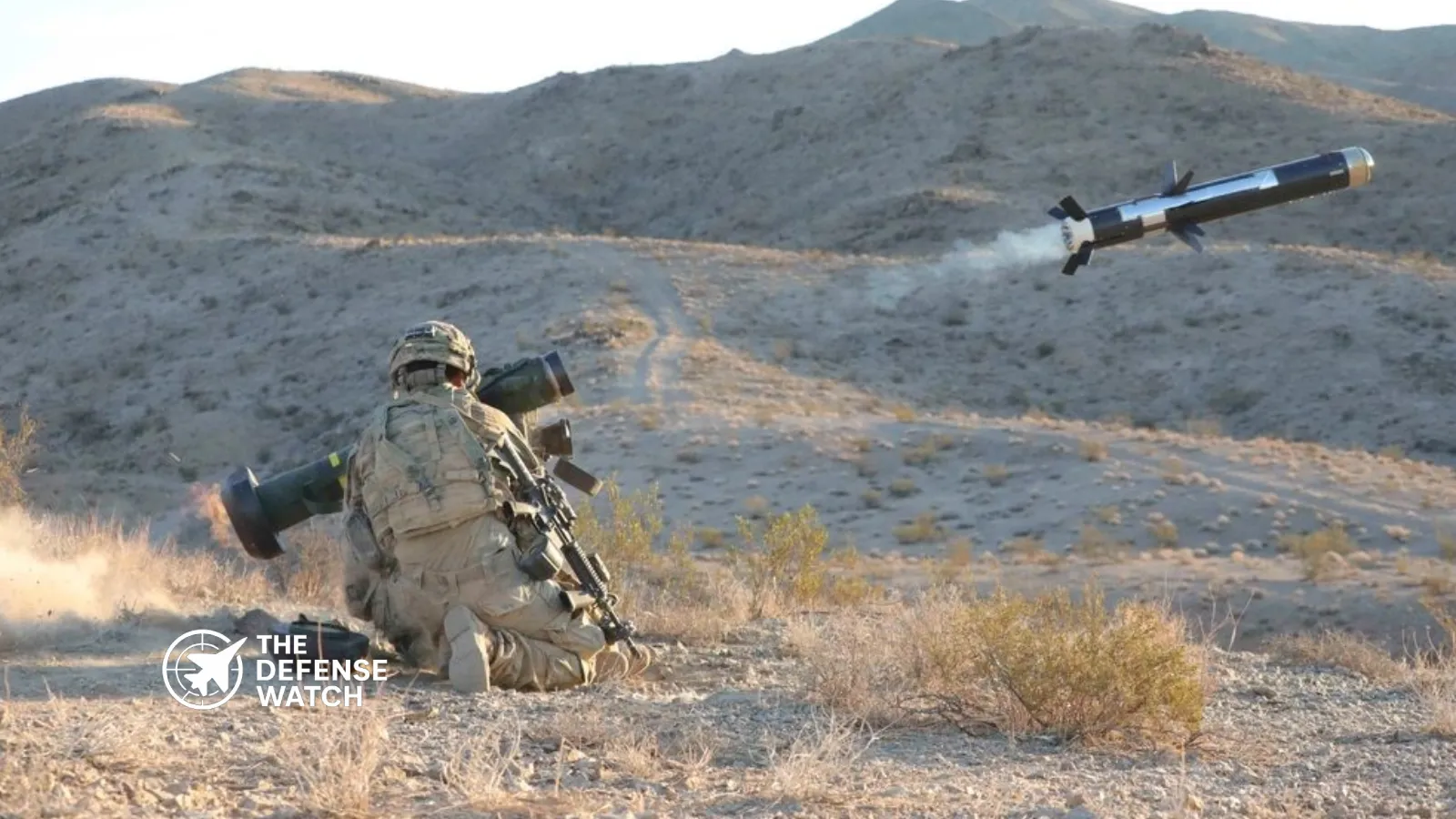
- The Javelin Joint Venture — a partnership between Lockheed Martin and Raytheon — is executing a structured production ramp targeted for completion later in 2026, following 8–10 months of coordinated supplier preparation.
- The Javelin supply chain spans nearly 100 part-level suppliers and 25 major subcontractors, covering propulsion, guidance electronics, and critical subcomponents.
- AI-driven demand forecasting tools are being deployed across key suppliers, shifting planning from reactive order management to a shared demand horizon model.
- The program is pursuing dual-source qualification for high-risk components to guard against single-point supply failures tied to export restrictions or raw material scarcity.
- Lead-time targets aim to keep all essential parts under 52 weeks, with on-hand stock of energetic and high-value items maintained as a buffer against supplier capacity fluctuations.
Javelin Missile Production Ramp Targets Full-Rate Output as Demand Strains Western Arsenal Capacity
The Javelin missile production ramp is entering its most critical phase, with Lockheed Martin and Raytheon completing the foundational supplier investment needed to sustain accelerated manufacturing output later in 2026. The effort, disclosed by the Javelin Joint Venture (JJV) on March 26, reflects a deliberate, multi-year industrial campaign to transform a mature but conservatively scaled production base into one capable of meeting persistent wartime-level demand.
The Big Picture
Russia’s invasion of Ukraine shattered long-held assumptions about Western munitions stockpiles and production capacity. The Javelin — the premier man-portable, fire-and-forget anti-tank guided missile in the U.S. and allied arsenals — emerged as a signature weapon of the conflict. Thousands of systems were transferred to Ukraine, drawing down U.S. Army and allied inventories far faster than existing production lines could replenish them.
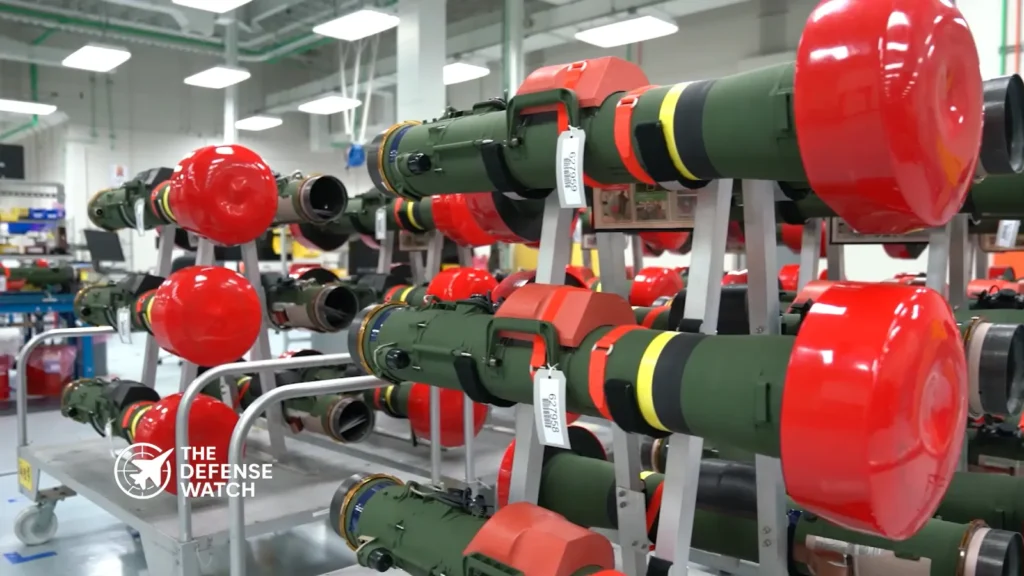
That inventory depletion triggered urgent calls from the Pentagon and Capitol Hill to accelerate missile production across the board. The Javelin ramp is part of that broader push, one that spans dozens of programs and reflects a fundamental reckoning: the U.S. defense industrial base had optimized for cost efficiency and steady-state procurement, not the surge demands of peer or near-peer conflict.
What’s Happening
Lockheed Martin announced on March 26, 2026, that the Javelin supply chain has completed its non-recurring engineering (NRE) work, including additional tooling, test sets, and in some cases expanded floor space, creating the foundation for a full production ramp expected to begin later this year.
The effort engaged nearly 100 part-level suppliers and 25 major subcontractors, each spending eight to ten months completing required updates to achieve the increased production output.
Rich Liccion, vice president and Lockheed Martin Javelin program director, stated that early supplier engagement and strategic capacity investment allowed the program to increase production while maintaining the quality standards expected by global customers.
Jenna Hunt Frazier, JJV president and Javelin program director at Raytheon, noted that the program is adopting advanced technologies including automation and AI-driven forecasting to enhance efficiency and build a future-ready supply chain.
The ramp applies across the full Javelin industrial ecosystem — from propulsion hardware suppliers to guidance electronics manufacturers to smaller component vendors. Each element of that chain had to grow in parallel, since a bottleneck at any tier can halt final assembly regardless of how much capacity exists elsewhere.
Why It Matters
The Javelin production ramp represents more than a manufacturing milestone. It signals that the U.S. defense industrial base is beginning to execute — not just plan — the transition to higher-rate production that senior Pentagon officials have been demanding since 2022.
AI forecasting tools deployed across key suppliers now give those vendors real-time insight into the program’s demand profile, shifting planning discussions from reactive order management to a shared demand horizon model. That shift is strategically significant. Traditional defense procurement often kept suppliers operating in information silos, receiving purchase orders with little forward visibility. Moving to a shared demand horizon enables suppliers to plan capital expenditures, workforce hiring, and material procurement months earlier — compressing lead times and reducing the risk of cascading delays.
The ramp has also generated interest in automation upgrades across the supplier base, with capital funding being routed into staging facilities and refined production line layouts to lift throughput while improving yield.
These investments point toward a structural improvement in production efficiency, not just a temporary surge. That distinction matters: temporary surges are vulnerable to reversal when budget pressures return, while structural improvements alter the baseline capacity of the industrial base.
Strategic Implications
The Javelin is fielded by more than 20 nations and remains the dominant close-combat anti-armor system in NATO and allied arsenals. Its production rate directly affects the readiness posture of U.S. ground forces and the capacity to support partner nations in contested environments.
Sustaining a credible Javelin stockpile is not merely a logistics question — it is a deterrence signal. Adversaries planning armored offensives factor in the availability of effective anti-armor munitions when assessing the cost of military action. A demonstrated U.S. and allied ability to produce and sustain Javelin inventories at high rates degrades that calculus.
To guard against supply chain fragility, the JJV is pursuing dual-source qualification for higher-risk components, which guards against single-point failures triggered by export limitations or raw material scarcity. This is a direct response to the supply chain lessons of recent years, when over-reliance on single suppliers — sometimes in geopolitically sensitive locations — proved to be an operational liability.
The lead-time target of under 52 weeks for all essential parts is equally important. A 12-month or longer lead time on a critical component effectively means that today’s procurement decisions determine production output a year from now. Compressing that window gives program managers and DoD planners significantly more flexibility to respond to emerging demand.
Competitor View
Russia and China have closely monitored the degradation of Western munitions stockpiles since 2022. Russian military planners, in particular, observed that sustained high-intensity conflict rapidly exhausted anti-tank guided missile reserves that NATO planners had considered adequate. That observation reinforced a Russian assumption that Western democracies lack the industrial endurance for prolonged high-tempo conflict.
The Javelin production ramp directly challenges that assumption. A demonstrated capacity to surge missile output and replenish inventories at scale narrows the window in which an adversary could exploit a munitions deficit. China’s defense planners, watching closely as they model potential contingencies in the Indo-Pacific, will note whether the U.S. industrial base can actually deliver on announced production increases — or whether those announcements remain aspirational.
Iran and its regional proxies, which have faced Javelin-equipped adversaries and supported forces engaged by Javelin users, also track Western missile production capacity as an input to their own operational planning.
What to Watch Next
The JJV has indicated that the accelerated production rate is targeted for achievement later in 2026. Several milestones will determine whether that target is met on schedule.
First, the transition from NRE completion to sustained rate production requires that all 100-plus suppliers begin delivering subcomponents at increased volumes without quality escapes or schedule slippage. Any tier-two or tier-three supplier bottleneck could ripple upstream and compress final assembly throughput.
Second, the effectiveness of AI-driven demand forecasting tools will be tested as actual orders flow against projected demand profiles. If those tools perform as intended, they should reduce the order-versus-forecast friction that has historically caused inefficiency and reactive procurement across the defense supply base.
Third, dual-source qualification for high-risk components — a critical resilience measure — requires time, testing, and investment. Progress on that effort will be a key indicator of the JJV’s long-term supply chain health.
Finally, future Javelin model variants will stress the supply chain in new ways. A production base configured for a current variant may require additional NRE investment to accommodate design changes. How the JJV manages that transition will test whether the current ramp investment has built genuine adaptability or simply expanded capacity for a fixed configuration.
Capability Gap
The Javelin ramp addresses a documented and publicly acknowledged shortfall in U.S. and allied anti-armor munitions inventories. Beyond replenishing stocks depleted by Ukraine transfers, it also fills a longer-term gap: the U.S. defense industrial base had not designed its missile production infrastructure for sustained high-tempo conflict.
Realistic limitations remain. Even with the ramp, Javelin production competes for supplier capacity with other high-volume programs, as the JJV itself acknowledged. Suppliers supporting multiple defense programs simultaneously face collective bandwidth constraints that no single program can fully resolve. The broader challenge — rationalizing and expanding the defense industrial base across dozens of programs — exceeds what any individual production ramp can accomplish.
Additionally, raw material availability and export control dynamics for certain electronic components remain structural risks. Dual-sourcing mitigates but does not eliminate those vulnerabilities, particularly for advanced guidance components that depend on specialized materials or manufacturing processes with limited global supply.
The Bottom Line
The Javelin Joint Venture’s supply chain overhaul represents the most concrete evidence yet that the U.S. defense industrial base is translating post-Ukraine urgency into actual production capacity — a development with direct implications for NATO readiness, allied deterrence, and adversary planning calculations.
Get real time update about this post category directly on your device, subscribe now.
