
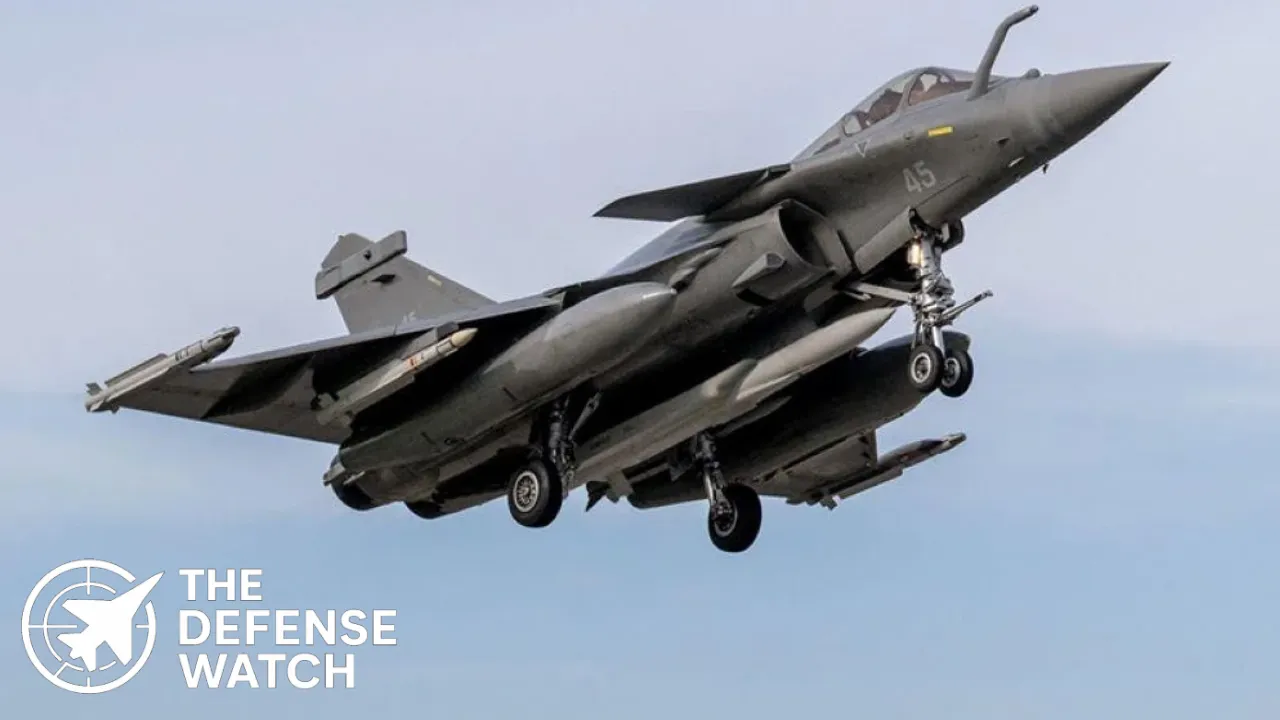
France has for the first time publicly released detailed images of its upgraded nuclear‐armed air‑launched cruise missile, the ASMPA‑R, confirming both its operational status and its deployment on carrier‑capable aircraft. The images were published by the Ministry of the Armed Forces on 13 November 2025, following what was described as the second evaluation firing of the weapon.
Background
The ASMPA‑R (Air‑Sol Moyenne Portée Amélioré Rénové) is the newest version of the ASMP family of medium‐range, supersonic, nuclear‐capable cruise missiles developed by France for its airborne strike leg of deterrence. The original ASMP entered service in the mid‑1980s; the ASMP‑A upgrade entered service in 2009‑10. The ASMPA‑R program was launched around 2016 to replace obsolescent components, extend range, improve penetration and ensure continuity of France’s airborne nuclear strike capability to beyond 2030.
Details of the Display and Entry into Service
According to the Aviation Week coverage, France published the first full image of the ASMPA‑R on 13 November 2025, with the weapon visible on the centerline hardpoint of a naval variant of the Dassault Rafale M. The missile is described as having undergone a “successful” second firing, following its entry into service with the French Naval Nuclear Aviation Force (FANu) on 10 November 2025.
Public reporting indicates that the ASMPA‑R retains a ramjet architecture, with dual air‑intakes along the body, enabling sustained supersonic flight at speeds around Mach 3. The upgraded missile reportedly has a range of roughly 600 kilometres (about 372 miles), compared to approximately 500 km for the ASMP‑A. The warhead is understood to be the Tête Nucléaire Aéroportée (TNA) design, with variable yield settings between 100 and 300 kilotons. While France has not officially confirmed warhead specifics for the R variant, open‑source reports treat the warhead as unchanged but modernized.
Officials described the evaluation firing as part of a sortie that “represented a nuclear raid”, and images released show the Rafale M carrying the missile, external fuel tanks and air‑to‑air self-defense missiles (Mica RF/EM, Mica IR, Meteor) alongside the nuclear weapon mount.
Strategic and Doctrinal Implications
The airborne leg of France’s nuclear deterrent has for decades been based on the ASMP family, carried by air‑launched platforms such as the Rafale. The ASMPA‑R strengthens that leg by extending the range, improving penetration capability and expanding deployment to naval‑aviation platforms, thereby increasing flexibility and survivability of the strike option.
By equipping the fan of platforms including the Rafale M (navy) and Rafale (air force), France avoids sole reliance on land‑based missiles for deterrence, thereby enhancing redundancy and lessening vulnerability to pre‑emptive attack. The introduction of ASMPA‑R also aligns with France’s 2024‑2030 Military Programming Law (LPM), which emphasizes modernizing the airborne component.
Expert or Policy Perspective
While no direct quotes from named analysts were available in the sources, commentary from specialist outlets observes that the ASMPA‑R offers a moderate but meaningful upgrade rather than a radical leap. Its supersonic speed distinguishes it from many sub‑sonic Western cruise missiles, but its range remains shorter than emerging hypersonic or long‑range systems. From a policy perspective, the move underscores France’s commitment to strategic autonomy and to maintaining credible deterrence through diversified launch platforms — including from sea by carrier‑borne aircraft.
What’s Next
With the ASMPA‑R now public and fielded with the French Navy’s FANu and already in service with the French Air and Space Force (FAS) since 2023, the next step in French airborne nuclear deterrence is the development of the fourth‑generation air‑launched nuclear cruise missile, the ASN4G, expected to enter service around 2035 and to employ scramjet propulsion for hypersonic speeds. The publication of ASMPA‑R imagery may also signal that France is prepared to push further transparency in its deterrence posture.
Closing
The unveiling of the ASMPA‑R marks a notable step in France’s nuclear modernization — revealing for the first time the missile’s full outward appearance and confirming its deployment on naval strike aircraft. In extending range, improving mobility and expanding platform reach, the ASMPA‑R serves to bolster the airborne leg of France’s deterrent. As France moves toward its next‑generation system, the publication of this upgrade underscores that the country intends to maintain credible, flexible nuclear strike options well into the coming decades.
Get real time update about this post category directly on your device, subscribe now.
