

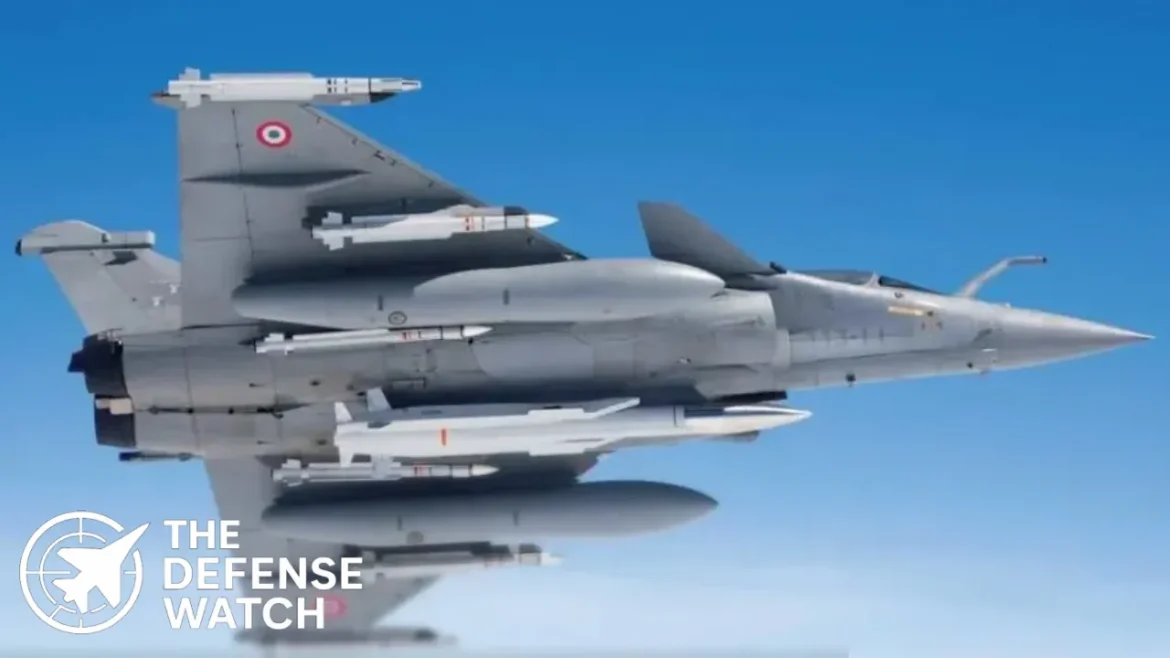
France Conducts Successful ASMPA-R Missile Test from Rafale-M
France has publicly unveiled images of its advanced nuclear-capable medium-range cruise missile, the Air-Sol Moyenne Portée-Renove (ASMPA-R), following a successful test launch from the Dassault Rafale-M naval fighter jet. This marks a significant milestone for France’s Naval Nuclear Aviation Force (FANU) and reinforces its strategic nuclear capabilities.
According to the French Ministry of Armed Forces, the evaluation shot was conducted under the Nuclear Aeronaval Force, which includes the aircraft carrier Charles de Gaulle and its Rafale-M air wing. The ASMPA-R missile had already been operational with the French Strategic Air Forces (FAS) since 2023, launched from land-based Rafale variants.
Technical Overview: ASMPA-R Missile
ASMPA‑R Nuclear Cruise MissileThe ASMPA-R is a medium-range, nuclear-capable, ramjet-powered cruise missile capable of speeds up to Mach 3. To achieve the required launch velocity, an internal solid-fuel booster ignites prior to ramjet operation. The missile boasts a range of approximately 600 km (372 miles), an improvement over the earlier ASMPA-A variant’s 500 km.
While the missile maintains a similar outward appearance to its predecessor, subtle design changes enhance its aerodynamic efficiency. Notably, the tail fin arrangement differs: larger rear fins replace the smaller rear fins of the ASMPA-A, improving stability at supersonic speeds.
Historically, the ASMP series dates back to 1986, evolving through ASMP, ASMP-A, and now the ASMPA-R, reflecting over three decades of iterative upgrades to France’s air-launched nuclear deterrent.
Strengthening France’s Nuclear Deterrent
The successful naval test launch of ASMPA-R strengthens France’s Force de Frappe, the country’s independent nuclear triad. France currently maintains a dual-component nuclear force:
- Sea-based: Four Triomphant-class SSBNs equipped with M51 submarine-launched ballistic missiles (range 9,000–12,000 km).
- Air-based: Rafale fighter jets armed with ASMPA-R cruise missiles, capable of rapid deployment from both land bases and aircraft carriers.
France also plans a next-generation missile, ASN4G, to arm upcoming Rafale F5 variants. This missile, expected by 2035, will feature hypersonic speeds (Mach 5+), further enhancing France’s strategic reach and deterrence posture.
Strategic Context and Implications
The Rafale-M ASMPA-R test underscores France’s commitment to modernizing its nuclear arsenal amid evolving global security challenges. With rapid advances in hypersonic and missile defense technologies worldwide, France’s upgraded nuclear-capable cruise missiles provide a credible sea- and air-based deterrent, reinforcing NATO’s collective security while ensuring national strategic autonomy.
The ASMPA-R also highlights France’s integrated approach to air and naval operations, enabling carrier-based launch capability that complements its land-based nuclear aviation fleet. This capability ensures that France retains a flexible, survivable nuclear strike option in diverse operational scenarios.
FAQs
It is a nuclear-capable, supersonic, medium-range air-to-surface cruise missile used by France.
Both land-based Rafale and carrier-based Rafale-M fighter jets.
The missile has a range of 600 km (372 miles) and can reach speeds up to Mach 3.
It provides a flexible, sea- and air-based strike option, strengthening France’s nuclear triad.
The ASN4G missile, capable of hypersonic speeds, is expected to enter service by 2035.