
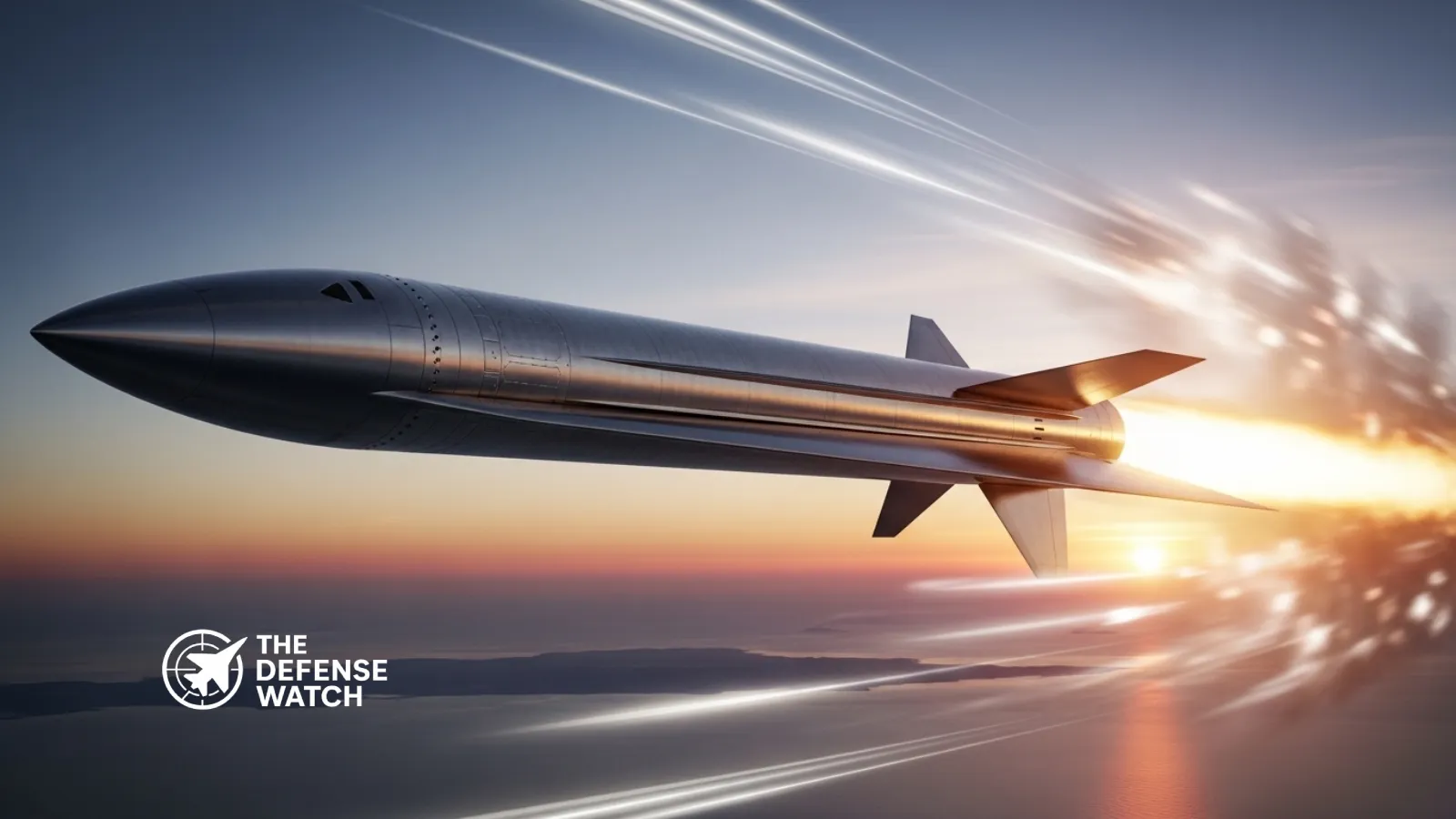
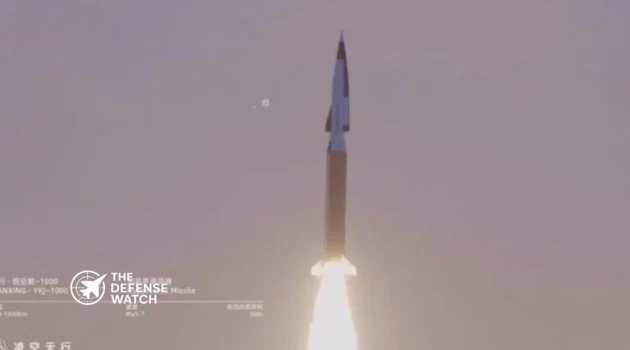
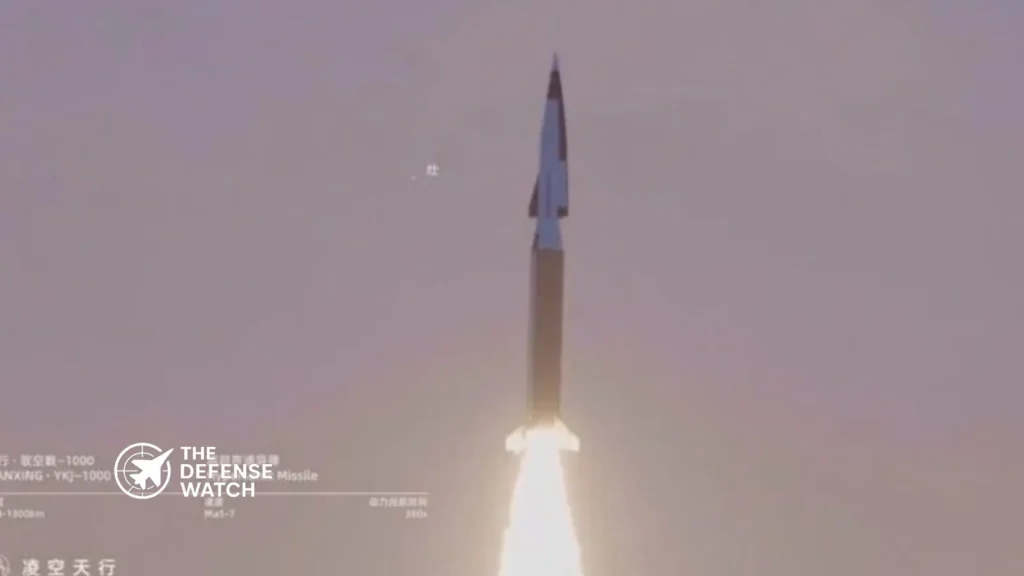
- ► China’s Sichuan Lingkong Tianxing Technology unveiled the YKJ-1000 hypersonic glide missile in late November 2025, advertising a unit cost of approximately $99,000.
- ► The YKJ-1000 is claimed to achieve speeds up to Mach 7 (~8,575 km/h) with a range of 500 to 1,300 kilometers depending on configuration.
- ► A single U.S. Navy SM-6 interceptor costs approximately $4.1 million; THAAD interceptors range from $12 million to $15 million per round.
- ► The missile uses civilian-grade components including consumer drone optics, automotive processors, BeiDou navigation chips, and foamed concrete thermal coatings in place of traditional aerospace-grade materials.
- ► The system is road-mobile and container-launched, enabling rapid concealment and deployment from non-military platforms.
- ► An AI-enabled swarm variant is under development, designed to coordinate multiple YKJ-1000 missiles against single targets simultaneously.
- ► No independent third-party verification of the missile’s performance claims or actual production cost has been published as of February 2026.
China’s YKJ-1000 Doesn’t Have to Be Perfect to Be a Problem
The YKJ-1000 hypersonic missile may be the most strategically consequential weapon system announced in 2025 — not necessarily because it works as advertised, but because of what it signals about the direction of Chinese military development and the economic logic it introduces into modern deterrence.
Developed by Chengdu-based private aerospace firm Sichuan Lingkong Tianxing Technology, the YKJ-1000 is a boost-glide hypersonic missile reportedly capable of Mach 7 flight across a range of 500 to 1,300 kilometers. Its claimed price tag of roughly $99,000 per unit — compared to a $4.1 million SM-6 or a $12–15 million THAAD interceptor — immediately dominated defense discussions when the system was disclosed in late November 2025. Whether or not those numbers hold up under scrutiny, they frame a strategic challenge the U.S. missile defense enterprise cannot afford to ignore.
The Real Story Is the Cost-Exchange Ratio
Western missile defense doctrine has long rested on an uncomfortable but manageable asymmetry: interceptors are expensive, but adversary missiles capable of penetrating them are even more expensive. That equation made layered defense architectures — Patriot, THAAD, SM-6, and eventually NGAD-era directed energy — fiscally painful but strategically viable.
The YKJ-1000 directly attacks that assumption.
If a salvo of even 20 such missiles can be fielded for under $2 million and forces the expenditure of $80 to $300 million in SM-6 or THAAD rounds to defeat it, the attacker wins economically even in a failed strike. The Pentagon’s own Missile Defense Agency has acknowledged in successive budget justifications — including the FY2025 and FY2026 submissions — that the cost-exchange ratio in missile defense is a primary driver of procurement strategy. The YKJ-1000 scenario, however credible, places that entire calculus under pressure.
This is not a new concept. Ukraine’s conflict demonstrated it repeatedly: Iranian-origin Shahed-136 drones costing an estimated $20,000–$50,000 each routinely forced Ukrainian forces to expend Patriot or NASAMS rounds worth orders of magnitude more. The YKJ-1000 follows the same logic, but adds hypersonic speed and claimed maneuverability — factors that complicate intercept geometry in ways that slow drones simply do not.
What China’s Military-Civil Fusion Model Actually Produces
Lingkong Tianxing was founded in 2018 and initially focused on reusable launch vehicles and suborbital systems. Its pivot to hypersonic weapons reflects Beijing’s military-civil fusion policy in unusually concrete form: a private company with commercial space DNA, leveraging China’s dominant position in global consumer electronics manufacturing to undercut the cost structure of traditional weapons development.

The YKJ-1000’s use of BeiDou navigation chips — commercially available for a few dollars in smartphone and automotive applications — in place of bespoke military-grade inertial or GPS/INS systems is an instructive example. U.S. and allied defense contractors face regulatory, labor, and supply-chain constraints that prevent equivalent substitution. China does not face those barriers at the same scale, and its dominance in printed circuit board production, optical sensor fabrication, and chip packaging gives Lingkong Tianxing access to economies of scale that no Western hypersonics program can replicate through comparable means.
This structural advantage is more durable than any single weapon system. Even if the YKJ-1000 fails to meet its stated performance parameters, the next iteration — built on the same industrial base — may well close the gap.
Verifying the Claims: Significant Skepticism Is Warranted
Serious technical questions surround the YKJ-1000. No independent test data has been publicly released. Available disclosure material consists of promotional imagery, computer-rendered animations, and static display photographs. The company’s publicity officer has confirmed that the widely cited $99,000 figure is not precisely accurate, while affirming that the design does rely on mass-market industrial components.
The most significant technical concern involves thermal management. Sustained Mach 7 flight generates surface temperatures exceeding 1,600°C. Traditional hypersonic programs — including the U.S. AGM-183A ARRW and the Russian Kinzhal — rely on purpose-engineered carbon-ceramic or ablative composites specifically rated for those conditions. The YKJ-1000’s reported use of foamed concrete and industrial cement-based coatings raises legitimate questions about whether those materials can survive full-envelope hypersonic flight without structural degradation, loss of maneuverability, or guidance system failure from thermal ingress.
Similarly, integrating consumer-grade optical and processor components into a hypersonic terminal guidance system presents non-trivial engineering challenges. Commercial drone cameras and automotive processors are not radiation-hardened, vibration-qualified, or validated for the electromagnetic environment associated with hypersonic plasma sheaths.
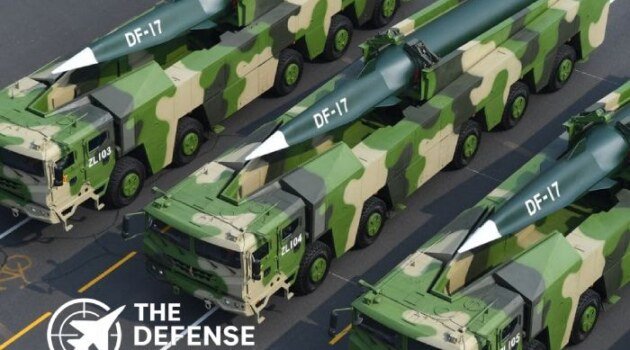
None of this means the program is fraudulent or without merit. China has conducted verified hypersonic tests — the DF-ZF glide vehicle and the DF-17 missile system are real, fielded, and assessed by the Defense Intelligence Agency as operational. Lingkong Tianxing’s principals have credible aerospace backgrounds, and the September 2025 visit by Vice Premier Zhang Guoqing to the company’s facility signals genuine high-level political backing. The question is not whether China can build a functional low-cost hypersonic weapon. The question is whether the YKJ-1000 specifically achieves its stated specifications at its stated price — and that remains unverified.
The Proliferation Risk Is the Most Urgent Concern
Independent of its actual performance, the YKJ-1000’s disclosure introduces a proliferation dynamic that demands immediate policy attention.
If China moves to export this system — even in a degraded or range-limited variant — to aligned states, the strategic landscape in the Middle East, South Asia, and sub-Saharan Africa changes materially. Iran, which already fields Shahed drones and the Abu Mahdi anti-ship missile, would gain a potential first-strike hypersonic capability against Gulf Cooperation Council infrastructure and U.S. naval assets in the Arabian Sea. North Korea, with its established ballistic and hypersonic test programs, could receive design or materials assistance accelerating its own low-cost glide vehicle development. Non-state actors with state backing — Hezbollah, the Houthis — could in theory deploy systems of this class if export controls fail.
China’s own export control regime is more restrictive than its public arms promotion narrative suggests. Beijing has not exported its most capable ballistic missile systems freely, and the YKJ-1000 involves technologies sensitive enough that selective proliferation — calibrated for maximum geopolitical leverage — is a more likely outcome than open market sales. Still, the entry of hypersonic weapons into the export price range of advanced conventional systems is a threshold that, once crossed, is difficult to reverse.
How the U.S. Should Respond: Three Immediate Priorities
The YKJ-1000 disclosure clarifies what U.S. missile defense planners have known but underfunded for years. Three responses are warranted.
First, directed energy. The only sustainable answer to mass-produced low-cost hypersonic saturation attacks is interceptors that are cheaper per shot than the incoming weapon. High Energy Laser with Integrated Optical-dazzler and Surveillance (HELIOS) and the Layered Laser Defense (LLD) programs need accelerated fielding timelines. Congress allocated funding for shipboard laser systems in FY2024 and FY2025, but operational deployment lags development. A $99,000 incoming hypersonic missile defeated by a $1-per-shot laser kill changes the cost-exchange ratio permanently.
Second, distributed defense architecture. Concentrating high-value assets — carriers, large-deck amphibious ships, fixed air bases — in predictable locations within the YKJ-1000’s 1,300-kilometer engagement envelope is a posture problem, not just a missile defense problem. The Navy’s Distributed Maritime Operations concept and the Air Force’s Agile Combat Employment doctrine both address this structurally. They need resourcing that matches the rhetoric.
Third, independent assessment. Congress should direct the Defense Intelligence Agency, in coordination with the Missile Defense Agency, to produce an unclassified assessment of the YKJ-1000’s probable performance parameters, production scalability, and export potential within the next budget cycle. Policy cannot outpace intelligence when the weapons concerned are novel.
Strategic Assessment
The YKJ-1000 represents a convergence of three trends that have been building separately for years: the democratization of precision manufacturing through consumer electronics supply chains, China’s deliberate use of military-civil fusion to compress defense development timelines, and the broader shift toward cost-imposing strategies in peer competition.
Whether or not this specific missile functions as advertised, it reflects a Chinese defense industrial approach that the United States has not yet fully countered at the structural level. American missile defense systems are optimized for quality and reliability at price points that assume adversary systems are equally expensive. That assumption is now actively under challenge.
The deterrence implication is significant. A credible low-cost hypersonic arsenal — even one of uncertain reliability — forces defensive planners to treat every potential engagement as a saturation scenario. That demands more interceptors, more sensors, and more magazine depth than current procurement plans provide. The FY2026 defense budget request, at $849.8 billion, is the largest in nominal terms in U.S. history, but it was structured before the YKJ-1000’s public disclosure and before full assessment of what low-cost hypersonic proliferation means for interceptor inventory requirements.
Regional allies face an even more acute challenge. Japan, Australia, and the Philippines have invested heavily in Aegis-based missile defense. South Korea fields THAAD under political duress. None of these architectures was designed for an environment where a near-peer adversary can field hundreds or thousands of maneuvering hypersonic threats at a unit cost below that of a commercial automobile. The alliance management dimension — specifically, whether partners will sustain missile defense investments if the cost-exchange ratio visibly shifts against them — deserves as much attention as the technical specifications of the missile itself.
-
Finally, the export signal matters more than the current weapon. The narrative that hypersonic weapons can be manufactured and exported at consumer-goods price points — regardless of current technical reality — will shape procurement decisions, threat perceptions, and arms race dynamics across multiple regions for the next decade. That is itself a strategic effect, independent of whether a single YKJ-1000 ever strikes a target.
Get real time update about this post category directly on your device, subscribe now.
-



This website uses cookies to improve your experience. We'll assume you're ok with this, but you can opt-out if you wish. Accept Read More