
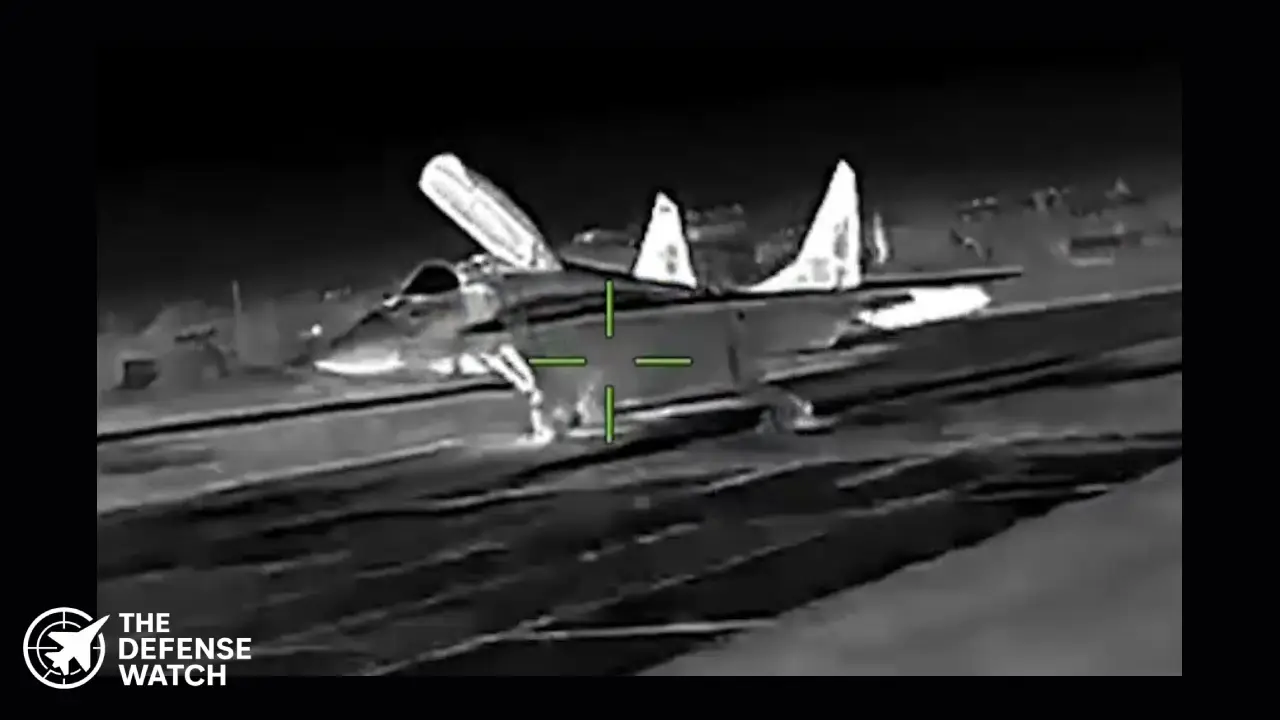
On the night of December 4, 2025, a fighter jet of the Mikoyan MiG-29 belonging to Russian forces was reportedly destroyed at the Kacha military airfield in occupied Crimea. The operation was carried out by the “Prymary” special forces unit of the Main Directorate of Intelligence of Ukraine (HUR), which also struck the nearby Irtysh radar complex close to Simferopol.
The attack was announced via HUR’s Telegram channel, marking what Kyiv described as a deliberate effort to further degrade Russia’s air-defense and aviation capabilities on the Crimean peninsula.
Background: MiG-29 deployments and Crimea’s role
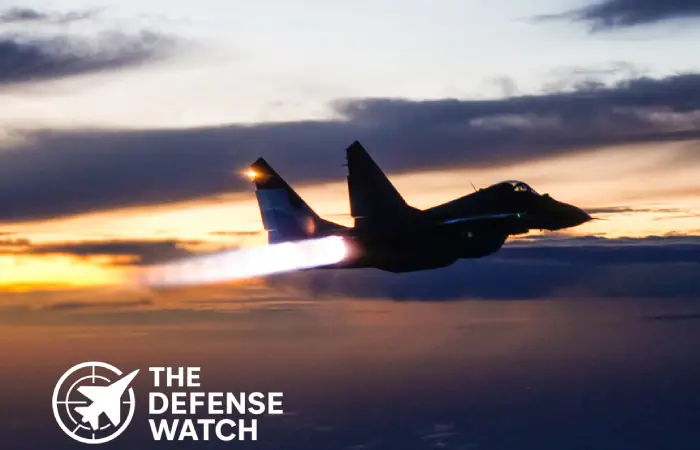
The MiG-29 — first developed in the Soviet era — remains a core element of both Ukrainian and Russian tactical air forces. Among the variants reportedly stationed in Crimea, particular attention falls on the MiG-29KR and its two-seat counterpart MiG-29KUBR, designed originally for carrier-based operations.
These naval-capable MiG variants feature an updated airframe with digital fly-by-wire controls, improved avionics and engines, larger wings with double-slotted flaps, LEVCONs (leading-edge vortex controllers), and an arrester hook — adaptations that allow deck-based carrier launches and recoveries.
Russia ordered 20 MiG-29KR and four MiG-29KUBR fighters in 2012, with the first entering service in 2013. Though originally intended for carrier operations from the sole Russian carrier, Admiral Kuznetsov, increasing technical and operational constraints have reportedly left many of these jets idle or deployed in land-based roles.
Given the enduring conflict and Russia’s intensive militarization of Crimea since 2014, MiG-29s — including naval variants — have been regularly based on the peninsula, often near Sevastopol or at Kacha airfield, supporting Black Sea and southern Ukraine operations.
Details of the strike & ambiguity over aircraft type
According to the HUR press release, the strike “destroyed a Russian MiG-29 multirole fighter” at Kacha airfield, while the radar complex near Simferopol was also hit that same night.
Video and drone footage released alongside the report reportedly show the MiG-29 in the crosshairs before impact, and the destruction of the aircraft on the tarmac.
However, analysts caution that the footage and imagery do not conclusively identify whether the destroyed jet was a standard MiG-29, a naval-adapted MiG-29KR, or even a static mock-up. The naval variants (MiG-29KR/KUBR) share the same distinctive cockpit canopy — making visual differentiation difficult — while their rear fuselage layout differs: a single-seater KR features an additional fuel tank where the two-seat KUBR has a second cockpit.
Historically, satellite imagery from the airfield at Kacha has shown a dark-grey “Fulcrum” parked or absent at different times — which analysts say might indicate the presence of a MiG-29KR or KUBR (or potentially a mockup).
Such uncertainty raises questions about how significant the loss really is — especially if the aircraft was non-operational or not part of front-line units.
Significance: tactical impact and symbolic weight
If confirmed, the destruction of a MiG-29 at an airbase like Kacha represents a tactical blow to Russian air power on Crimea. Prior Ukrainian strikes have targeted radars, anti-aircraft systems, drone infrastructure, and transport/logistics — but striking a combat aircraft signals a potential expansion in operational reach, precision, and willingness to target high-value aviation assets.
Moreover, pairing the MiG strike with a simultaneous hit on the Irtysh radar complex further degrades Russia’s ability to monitor and respond to air or drone incursions from or via Crimea — weakening early-warning and air-defense coordination.
However, the ambiguity over whether the destroyed jet was an active frontline MiG-29, a naval variant, or a static mock-up tempers what can be definitively claimed. If the jet was non-operational — or never intended for sortie — the operational impact could be limited.
Expert Perspectives & Strategic Implications
In previous analyses of the Russian MiG-29KR/KUBR fleet, aviation experts noted that — despite their carrier-capable design — many of these jets have remained land-based throughout the Ukraine war, due to the prolonged idleness of the Admiral Kuznetsov.
This raises a possibility: what Kyiv’s intelligence hit may have been a stored or reserve jet, rather than an active threat in an upcoming mission. But in a war where attrition, morale, and symbolic victories matter, even a stored aircraft represents an adversary resource — and striking it serves as a message about reach, surveillance, and operational risk.
Additionally, targeting both aviation and air-defense infrastructure in one night — MiG and radar together — reflects a growing Ukrainian strategy: systematically dismantling the layered Russian air superiority and denial architecture in Crimea, rather than just sporadic raids.
What’s Next: Verification and Wider Implications
At present, independent verification of the destroyed jet’s exact model remains elusive. Analysts and open-source spotters are likely to monitor satellite imagery of the Kacha airfield in coming days, searching for changes to taxiways, hangars, or replacement jets — which could help confirm whether the loss was operationally significant.
Should further imagery or physical evidence confirm the strike, it may embolden further similar operations, potentially encouraging HUR and other Ukrainian units to continue targeting Russian aircraft and radar infrastructure across Crimea.
But even in the short term, the strike — confirmed by Ukrainian intelligence — underscores one trend: the war’s evolving air dimension, where drones, covert strikes, and degradation of fixed air-defense and aviation assets form a critical part of Kyiv’s strategy to challenge long-held Russian control over Crimea’s skies.
Get real time update about this post category directly on your device, subscribe now.


