
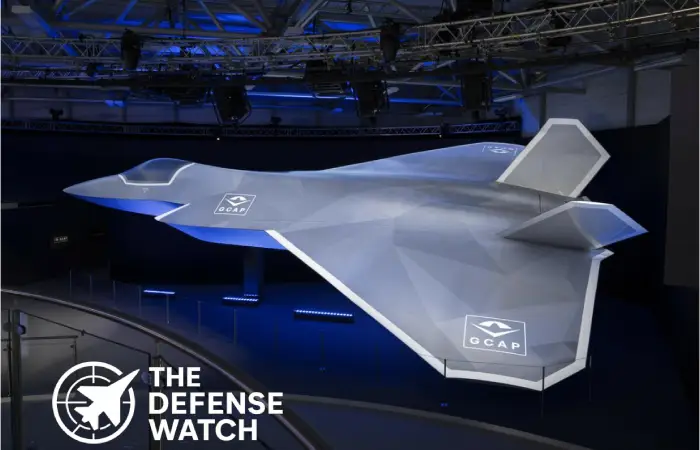
The trilateral partnership of the United Kingdom, Italy and Japan has ramped up its ambitions for the Global Combat Air Programme (GCAP) — a next-generation, sixth-generation stealth fighter program designed to deliver a cutting-edge combat aircraft by around 2035. This article examines the latest developments in GCAP, explores what it means for U.S. defense interests and the broader global combat-air market, and assesses the strategic technology implications.
What is GCAP and how does it differ from prior programs?
The GCAP programme merges three national efforts — the UK’s “Tempest”, Italy’s participation, and Japan’s F-X project — into a unified development programme for a sixth-generation stealth fighter. The objective: develop a multirole, stealth-optimized, networked combat aircraft capable of manned-unmanned teaming, advanced sensors, internal weapon bays and long-range global reach.
Key milestones include:
- Demonstrator flight targeted for 2027.
- Entry into service expected around 2035.
- Joint venture (design authority) formed by BAE Systems (UK), Leonardo (Italy) and Japan Aircraft Industrial Enhancement Co. Ltd. (JAIEC, Japan), each holding roughly equal shares.
- Governance through the inter-governmental organisation (referred to as GIGO) to manage the multi-national structure.
Compared to earlier programmes like the F‑35 Lightning II, GCAP emphasises greater internal payload, global range without refuelling, advanced AI and drone control capabilities. For example, observers note that GCAP partners aim to carry “roughly double an F-35A’s [weapon] payload” and cross the Atlantic on internal fuel.

Latest Developments
In June 2025, the joint-venture “Edgewing” was officially named as the design authority for the GCAP airframe, signalling a transition from concept into structural implementation.
In December 2024, industry partners reached a landmark agreement outlining the structure of the joint venture, expected to be established by mid-2025, with the lifetime of product extending beyond 2070.
Meanwhile, media reports highlight timeline pressures: the U.S. is already pursuing a sixth-generation project (the F-47), meaning GCAP must accelerate to stay relevant.
Analysis: Implications for U.S. Defense & Global Security
1. Competitive landscape
For U.S. defence planners, GCAP represents both a peer-level challenge and a potential partner. The U.S. has long held near-monopoly on fifth-generation fighters globally, but the UK-Italy-Japan axis is seeking to forge a coalition with export potential and sovereign capability outside U.S. export and upgrade constraints.
This may press U.S. industry to sustain lead in sixth-generation fighter development, improve interoperability, and accelerate schedule.
2. Interoperability & coalition operations
There is explicit intent within GCAP to ensure interoperability with allied systems, including U.S. platforms. For example, an Italian official noted the GCAP jet and the prospective U.S. F-47 are “two elements in an integrated system of fighters, not competitors.” This suggests U.S. forces may need to plan for joint operations with GCAP participants, adopt compatible standards and consider data-link/sensor fusion frameworks.
3. Technology leap and risk
The ambition of GCAP reflects a generational leap — advanced manned-unmanned teaming, sensor fusion, directed-energy weapons, digital twin modelling, modular open architecture and AI-enabled decision-support. U.S. aerospace and defence firms will need to match such capabilities. At the same time, as with past multinational programmes (e.g., F-35), schedule risk and cost overruns are real concerns — GCAP’s success or failure will influence U.S. decisions on future fighter programmes.
4. Strategic balance & export control
GCAP represents a path for Japan (and potentially other partners) to reduce reliance on U.S.-supplied fighters and associated restrictions (e.g., on upgrades). For the U.S., preserving its qualitative edge in fighter aviation means tracking such initiatives and possibly accelerating sixth-generation efforts under U.S. leadership or co-operation frameworks.

Outlook & Conclusion
The GCAP partnership among the UK, Italy and Japan is shaping up as a major entry into the sixth-generation combat air domain. With a service target around 2035 and world-class ambitions, it will influence not just partner-nation air forces but also U.S. defence planning, global export dynamics and aerospace innovation.
For the U.S., the emergence of GCAP reinforces the necessity to accelerate its own next-gen programmes, ensure interoperability with allied systems and maintain technological superiority.
With prototypes slated by 2027 and production airframes by the mid-2030s, both strategic risk and opportunity looms large — not just for the partner nations, but across the global combat-air ecosystem.
Get real time update about this post category directly on your device, subscribe now.

5 comments
[…] development also underscores the revitalization of the F-16 production line, which continues to generate export orders despite the global shift toward stealth platforms. For the U.S. defense industry, it highlights the balancing act between meeting […]
[…] intentionally drained from the Tejas’ Environmental Control System (ECS) and On-Board Oxygen Generating System (OBOGS) — normal procedures in high-humidity environments like […]
[…] reliably for decades, generating and harnessing steam to slingshot aircraft forward. However, this system requires extensive infrastructure to generate and store steam throughout the […]
[…] strong air defense capabilities. The Typhoon met these conditions. The aircraft is built by Airbus, BAE Systems, and Leonardo. It features a powerful radar, high performance engines, and a range of air to air […]
[…] tension over technology sharing, Italian and Japanese leaders have publicly expressed satisfaction with GCAP’s overall progress. The partners aim to keep the programme on track for the 2035 […]