
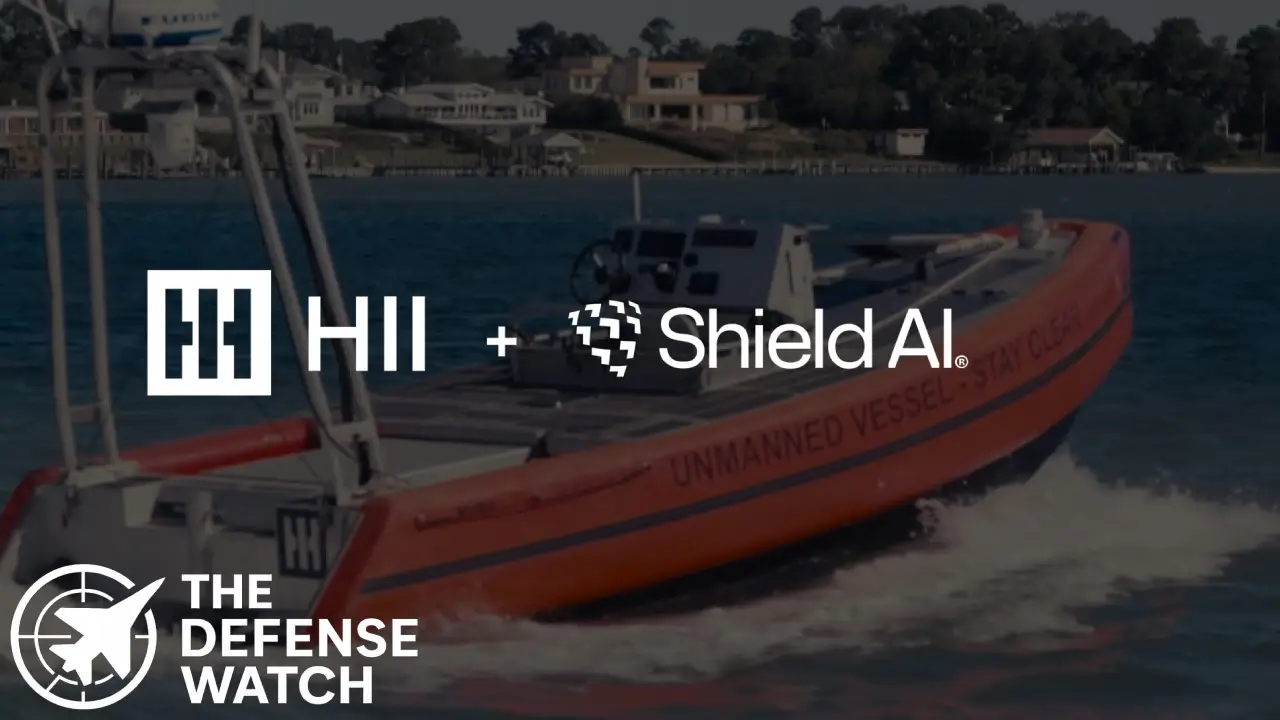
Shield AI and HII Demonstrate Seamless AI Integration in Unmanned Surface Vessels
Shield AI and Huntington Ingalls Industries (HII) have announced a significant milestone in autonomous naval technology: the successful integration of Shield AI’s artificial intelligence software into HII’s unmanned surface vessel (USV) platform. The demonstration showcased how AI-driven autonomy can enhance mission execution, navigation, and operational safety across the U.S. Navy’s growing fleet of unmanned systems.
The collaboration builds on the U.S. Navy’s push toward greater autonomy at sea—part of its Unmanned Campaign Framework designed to integrate artificial intelligence, data fusion, and machine learning into distributed maritime operations.
Advancing Autonomous Maritime Operations
According to Shield AI, the test proved that its AI pilot software, known for powering autonomous flight in unmanned aircraft like the MQ-35A V-BAT, can now enable similar autonomous behaviors in maritime environments. The system allows a vessel to perceive surroundings, make navigational decisions, and execute missions with minimal human oversight.
HII, one of America’s largest shipbuilders and defense contractors, provided the USV platform for integration. The successful trial underscores HII’s strategic investment in autonomous and robotic technologies as the Navy accelerates its shift toward manned-unmanned teaming.
“The integration demonstrates the scalability of AI autonomy across domains—air, land, and sea,” said a Shield AI representative. “It’s a step toward a fully networked fleet capable of operating intelligently and collaboratively.”
Strategic Importance for the U.S. Navy
The U.S. Navy has increasingly prioritized unmanned surface vessels as part of its modernization strategy. Programs such as the Medium Unmanned Surface Vessel (MUSV) and Large Unmanned Surface Vessel (LUSV) are aimed at extending naval reach, improving situational awareness, and reducing risks to human crews.
By incorporating Shield AI’s autonomy suite, future naval operations could see a reduction in crewed missions in high-threat environments and expanded operational endurance for unmanned assets. The technology also supports the Navy’s “Distributed Maritime Operations” concept—leveraging autonomous systems to create flexible, resilient battle networks.
HII’s involvement reinforces the company’s commitment to emerging naval technologies. Through its Mission Technologies division, HII has been developing advanced C5ISR (Command, Control, Communications, Computers, Combat Systems, Intelligence, Surveillance, and Reconnaissance) solutions and has partnered with the Navy on several unmanned and AI-enabled projects.
Analysis: What This Means for U.S. Defense and Global Security
The integration of Shield AI’s autonomy into HII’s surface platforms marks a pivotal step toward AI-enabled naval warfare. It reflects the Pentagon’s broader objective of maintaining technological superiority over peer competitors such as China and Russia, both of which are advancing their own autonomous maritime systems.
For the U.S., the ability to deploy unmanned vessels that can operate independently for extended periods could transform naval strategy—shifting from manpower-heavy operations to data-driven, adaptive fleets. Such systems could conduct surveillance, electronic warfare, or logistics missions autonomously, freeing manned warships for higher-priority combat roles.
Globally, this development underscores the growing role of artificial intelligence in defense innovation. It may also signal increased collaboration between U.S. defense contractors and AI startups, aligning commercial technology advancements with military needs.
Conclusion: Charting the Future of Naval Autonomy
The successful integration between Shield AI and HII highlights the convergence of shipbuilding expertise and cutting-edge artificial intelligence. As the U.S. Navy continues to invest in autonomous maritime operations, partnerships like this one could accelerate the deployment of intelligent, unmanned systems across its global fleet.
Looking forward, autonomous surface vessels—empowered by AI pilots—could become key components of future naval task forces, capable of executing missions beyond human endurance or communication limits. The development marks a decisive move toward a more connected, autonomous, and resilient U.S. Navy.
Get real time update about this post category directly on your device, subscribe now.

26 comments
[…] the United States and its allies, the emergence of the YJ-1000 underscores China’s rapid technological advancement in guided munitions and aerospace integration. The weapon represents more than an incremental upgrade—it demonstrates a growing maturity in […]
[…] proposed aircraft reportedly employs a blended wing body (BWB) configuration — a design integrating wing and fuselage into a unified lifting surface, offering potential aerodynamic and volume efficiencies. Western aerospace research (notably by […]
[…] with evolving technology cycles. The traditional system, anchored by processes such as the Joint Capabilities Integration and Development System (JCIDS), often required years of analysis, coordination, and approvals […]
[…] Bureaucracy Cut, JCIDS EndedA central part of the overhaul is the elimination of the Joint Capabilities Integration and Development System (JCIDS), which Hegseth described as “slow, bloated and disconnected from […]
[…] 2026 reflect a mix of established superpowers and rising maritime players, underscoring shifts in global navy rankings […]
[…] ground threats. From the F-35 and F-22 to the Rafale, J-20, and Gripen, they reflect a nation’s technological capability and defense […]
[…] or the displacement of air. They operate using engines, flight-control systems, and aerodynamic surfaces allowing pilots—or autonomous systems—to maneuver safely through the […]
[…] Technology integration: With advanced sensor and perimeter upgrades underway, the effectiveness of the unit will increasingly depend on how well these systems mesh with human operatives. […]
[…] comprehensive maritime surveillance, hydrographic mapping, and coastal security missions, the craft integrates advanced autonomous navigation systems, radar, and sonar sensors, enabling real-time monitoring of coastal zones […]
[…] in Japanese territorial waters. The deployment is expected to expand gradually as the technology is integrated into additional vessels and fleet operations are adjusted to leverage the new […]
[…] The objectives centered on validating the system’s suitability as a safer and more efficient approach to minehunting. The activity did not aim to introduce a new sensor, but rather to show that an existing, mature system could operate effectively from an unmanned vessel. […]
[…] than double the capability of the older system it may replace.Lockheed noted the design leverages advanced technology including AI and machine learning elements to meet performance […]
[…] messages. During the patrol, the ship was shadowed by seven People’s Liberation Army Navy vessels, which maintained professional […]
[…] next-generation technologies such as advanced sensors, communications systems, and optionally unmanned capabilities. Industry leaders from each country, including BAE Systems, Leonardo, and Mitsubishi Heavy […]
[…] years. Advanced maritime patrol aircraft play a critical role in tracking submarines, monitoring surface vessels, and providing early warning of potential […]
[…] P1118 programme is meant to establish a standardised class of vessels for the Royal Norwegian Navy capable of fulfilling various roles, potentially reducing logistical and maintenance complexity while […]
[…] computing development will integrate advanced sensing technologies with real-time data fusion capabilities. These systems process information at or near the data source rather than relying on centralized […]
[…] munition can reportedly be launched from surface vessels, aircraft, and potentially ground based launchers, supporting the Marine Corps requirement for […]
[…] artillery system developed by BAE Systems Bofors. It builds on the proven 40 mm gun family while integrating advanced sensors, digital fire control, and programmable […]
[…] modularity of the ACV platform allows for future capability integration as technology evolves. The platform was designed with growth potential to address additional mission roles […]
[…] Maritime Big Play program continues to serve as the primary mechanism for integrating autonomous capabilities into operational fleets. Royal Navy officials noted that trilateral collaboration allows partners […]
[…] can perform precision strikes against ground installations, counter enemy aircraft, and engage surface vessels effectively. Lipovoy’s assessment underscores a shift in doctrine, positioning the Su-57 not just […]
[…] platform or class associated with this effort, propulsor research is closely tied to submarine and advanced surface vessel […]
[…] Adm. Kelly Ward, director of strategic effects for CTF 66, emphasized the strategic importance of integrating unmanned tactics directly into operations. The task force leverages artificial intelligence and advanced […]
[…] validation before serial production expansion. Blue Water Autonomy expects to demonstrate the autonomous surface vessel’s capabilities across multiple mission profiles during initial […]
[…] part of Project VANQUISH to inform future requirements and potential demonstrations. The RFI seeks unmanned STOL platforms capable of autonomous operations from carrier decks without the need for traditional launch and recovery […]