
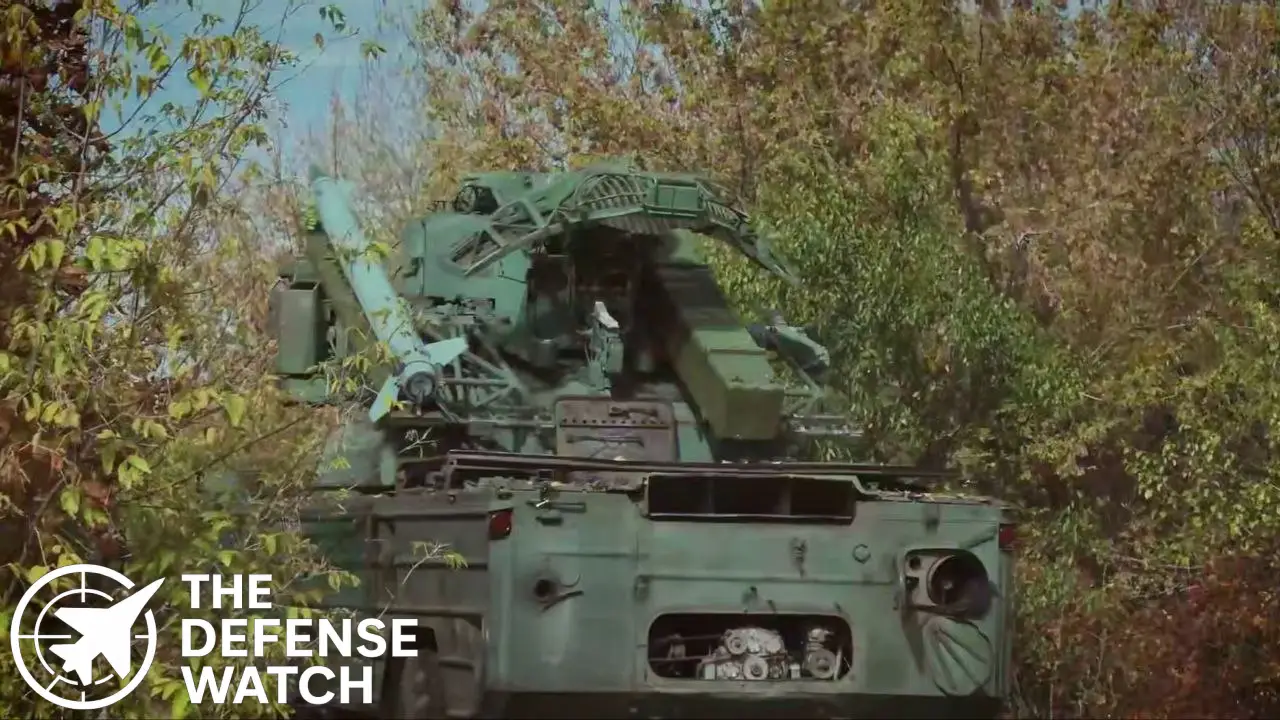
Recent footage from Russian military channels reveals a troubling development for Moscow’s air defense capabilities: Cold War-era surface-to-air missiles from the 1970s are being jury-rigged onto more modern launcher systems, suggesting Russia may be running critically low on interceptor missiles as Ukraine’s relentless drone campaign continues to intensify.
The imagery shows a combat-ready 9K33M3 Osa-AKM system loaded with aging 9M33 missiles—hardware designed five decades ago—instead of the standard 9M33M3 missiles the launcher was built to carry. Defense analysts view this improvised configuration as a potential indicator that Russia’s air defense missile production cannot keep pace with consumption rates driven by Ukrainian unmanned aerial vehicle operations.
Cold War System Adapted for Modern Shortages
The Osa air defense system entered Soviet service in 1970 as the 9K33, carrying four 9M33 missiles without protective transport-launch containers. The system underwent significant upgrades throughout the following decade. In 1975, the 9K33M2 Osa-AK variant increased missile capacity to six rounds and introduced the improved 9M33M2 missile, which required different mounting hardware and was stored in sealed containers.
The final major upgrade came in 1980 with the 9K33M3 Osa-AKM, featuring enhanced 9M33M3 missiles with modernized proximity fuzes and updated electronics designed specifically for engaging helicopters and low-flying aircraft. This represented a two-generation leap in capability over the original system.
What Russian forces have now done is reverse this technological progression. Mechanics appear to have salvaged original 9M33 mounting brackets from decommissioned 9K33 systems and bolted them directly onto Osa-AKM launchers—a configuration never intended by Soviet designers. Photographs show one obsolete 9M33 missile mounted alongside a newer containerized round, creating a mismatched hybrid system.
Implications for Russian Air Defense Capacity
This improvisation carries significant strategic implications. While the modification required minimal technical effort—possibly no software changes whatsoever—its necessity suggests Russian stockpiles of modern 9M33M3 interceptors are running dangerously low. There is no publicly available evidence that production of these missiles continues, and if it does, output appears insufficient to meet operational demands.
Ukraine’s drone warfare strategy has proven remarkably effective at forcing exactly this kind of resource exhaustion. By deploying large numbers of relatively inexpensive unmanned systems—many costing a fraction of the missiles used to intercept them—Ukrainian forces are imposing unsustainable attrition on Russian air defense stocks.
The decision to reintroduce 50-year-old missiles into frontline service, even on systems no longer considered primary air defense assets, indicates the shortage extends beyond elite units to reserve and secondary formations. Russia should theoretically possess substantial reserves of 9M33 missiles in storage, as the naval Osa-M variant deployed on Russian warships also uses this ammunition type.
U.S. Defense and Strategic Context
For U.S. defense planners, this development offers several key insights. First, it validates Western assessments that sustained attrition warfare—even with asymmetric weapons like drones—can strain Russian logistics and industrial capacity despite Moscow’s vast Cold War inheritance.
Second, it demonstrates the vulnerability of air defense networks to high-volume, low-cost aerial threats. The U.S. military has invested heavily in counter-drone technologies, but the Ukrainian model shows how quantity can overwhelm quality when interceptor production cannot match consumption rates.
Third, the situation highlights Russia’s limited defense industrial reconstitution capacity. Despite transitioning to a wartime economy, Moscow appears unable to scale production of critical munitions fast enough to replace combat losses. This suggests Western sanctions on electronics and precision components are having measurable effects on Russian military manufacturing.
Interestingly, Ukraine faced similar air defense missile shortages earlier in the conflict and responded with an even more ambitious improvisation: integrating R-73 air-to-air missiles onto Osa launchers. That modification required far more complex engineering than Russia’s current bracket-swapping approach, but it demonstrated how necessity drives innovation under combat pressure.
Future Outlook and Strategic Assessment
The reappearance of obsolete missiles on modernized launchers represents more than a technical curiosity—it signals a critical inflection point in Russia’s ability to sustain air defense operations. As Ukrainian drone production accelerates with Western support, and as attacks on Russian oil infrastructure and military installations intensify, Moscow faces a stark choice: accept degraded air defense coverage or divert resources from other military priorities to interceptor production.
For NATO and U.S. planners, the lesson is clear: long-term attrition strategies backed by industrial capacity can achieve strategic effects even against numerically superior adversaries. The Ukrainian drone campaign has demonstrated that relatively modest investments in unmanned systems can impose disproportionate costs on conventional air defenses.
As the conflict continues, watch for further indicators of Russian air defense stress—including increased reliance on electronic warfare systems, concentration of remaining modern SAMs around critical sites at the expense of forward positions, and potentially even requests for air defense assistance from allies like China or Iran.
The improvised Osa configuration may seem like a minor battlefield adaptation, but it reveals a deeper vulnerability in Russia’s military-industrial complex—one that Ukraine and its Western partners can continue to exploit through sustained pressure on Russian logistics and production capacity.
Get real time update about this post category directly on your device, subscribe now.

7 comments
[…] have fundamentally altered air defense calculations. Defense analysts emphasize that traditional surface-to-air missile systems face unsustainable cost disadvantages when engaging low-cost unmanned threats. A single Patriot […]
[…] depended on imported technologies for long-range strike. The introduction of indigenous systems like Narwhal and Nightray signals Czech ambitions to strengthen sovereign precision-strike […]
[…] is a modular, medium-range surface-to-air missile system developed jointly by Raytheon (now RTX) and Norway’s Kongsberg Defense & […]
[…] proposal comes amid mounting criticism in Kyiv and among Western allies, who say it disproportionately favors Moscow and undermines […]
[…] systems. Previous strikes at Belbek included hits on MiG-31 interceptors and various radar and surface-to-air missile systems earlier in December. The SBU has increasingly used long-range drones as part of a broader […]
[…] strikes on Islamic State positions across Syrian territory, destroying a communications site, a critical logistics node and weapons storage […]
[…] pilots to engage simulated threats that mirror near-peer adversary capabilities, including advanced surface-to-air missile systems and electronic attack […]