
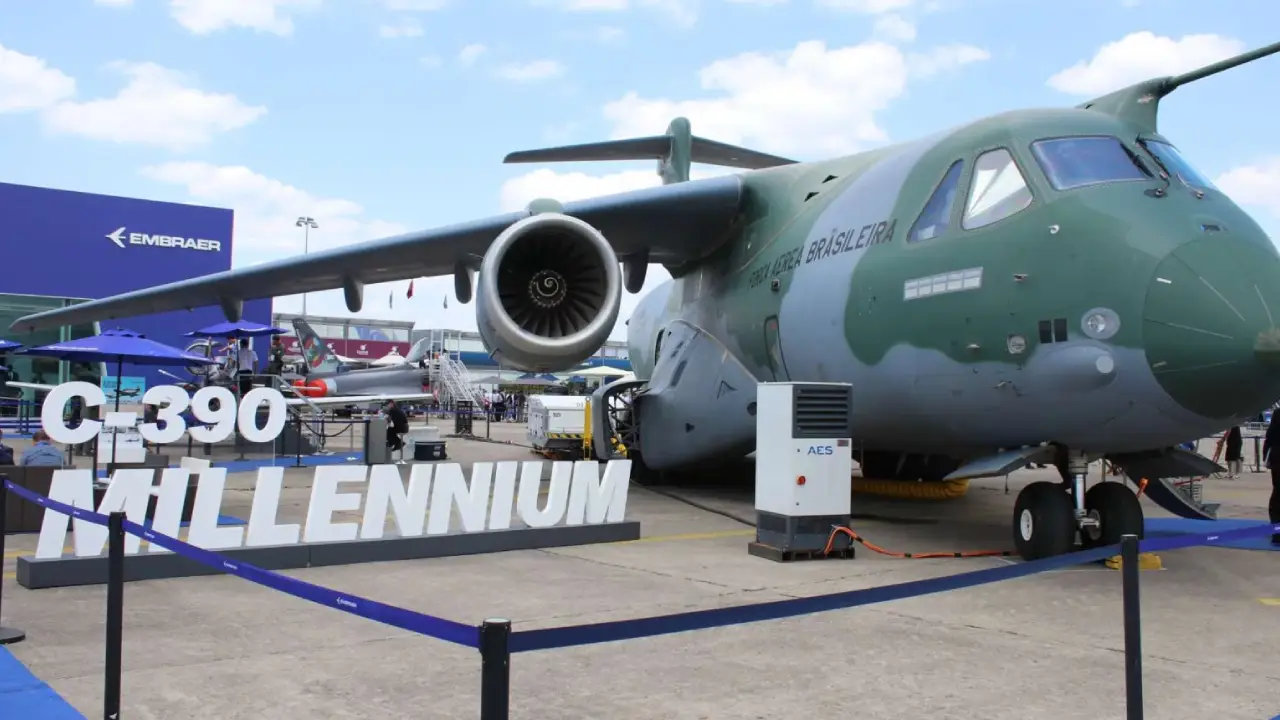
On 12 November 2025, the Dutch Ministry of Defense and Brazilian manufacturer Embraer confirmed the start of structural assembly of the first Dutch-configured C‑390 Millennium military transport aircraft at Embraer’s Gavião Peixoto facility in Brazil. This milestone forms a central part of a trilateral procurement program involving the Netherlands, Austrian Armed Forces and Swedish Air Force aimed at renewing medium-airlift capability across three European nations and reinforcing NATO air mobility.
Background
The C-390 Millennium is a twin-jet, multi-role military transport aircraft from Embraer, designed for tactical transport, medical evacuation, airdrop, tanker roles and rapid logistic operations. The Netherlands, Austria and Sweden signed a joint agreement in July 2024 for a package of 13 aircraft, plus options, under the so-called “Replacement of Tactical Airlift Capacity” program. The Netherlands acts as lead nation in this effort, overseeing the framework and sharing logistics, maintenance and training structures among the participating partners.
In European and NATO terms, the effort reflects a larger trend toward shared fleet architectures, burden-sharing, common mission-kit standards and enhanced interoperability. The C-390 is positioned between smaller turboprop transports and larger heavy airlifters, delivering speed and medium-lift capacity in one package.
Details of the Assembly Milestone
According to the Dutch MoD and Embraer, structural assembly of the first Dutch aircraft has begun in Brazil. The partner nations intend the C-390 series to replace aging fleets in the medium-airlift segment for the Netherlands and Austria, while Sweden’s initial order covers four aircraft plus options. For the Netherlands specifically, the firm order is for five aircraft with initial deliveries expected from 2027 following earlier schedule adjustments.
Embraer notes that construction of a C-390 airframe takes around two years from start to finish: about eight months for the airframe build, followed by integration of flight-management, self-protection and mission-specific systems. The Dutch-led model will share a common configuration, enabling all three partner air forces—Netherlands, Austria and Sweden—to operate the same air-frame, mission kits (such as aeromedical modules) and logistic support regimes.
On performance, the C-390 carries up to around 26 tonnes at cruise speeds near Mach 0.80, giving it a payload-and-speed advantage over many turboprop contemporaries. Comparatively, larger transports such as the A400M offer higher payloads (up to roughly 37 tonnes) but at heavier scale and cost. The C-390 therefore fits a medium-lift niche.
Strategic and Policy Implications
From a NATO mobility perspective, the start of Dutch C-390 assembly strengthens the alliance’s tactical transport network at a time of heightened emphasis on rapid response and surge logistics. Shared procurement and fleet-standardisation across nations not only reduce unit-costs but enhance multinational deployments, joint training and maintainability.
For the Netherlands and Austria, replacing ageing platforms with a modern jet transport will enhance speed, flexibility and strategic reach. For Sweden, participation in the framework builds synergy with partner air forces and aligns with broader defense-industrial and mobility goals.
From an industrial viewpoint, the choice of Embraer and production in Brazil underscores globalized supply chains and cross-continent manufacturing partnerships. For European defense planners, the cooperative model of acquisition reflects evolving approaches to multinational fleet management, training, sustainment and logistics in the medium-lift sector.
What’s Next
With structural assembly underway, deliveries to the Netherlands are currently scheduled from 2027 onward. Its partners, Austria and Sweden, will follow the coordinated window under the trilateral agreement. As the aircraft move from assembly into mission-kit integration, training, certification and shared support systems will become key tasks.
Operational deployment will mark the C-390’s integration into mixed allied fleets, supporting roles such as tactical airlift, humanitarian relief, aeromedical evacuation and rapid logistics across NATO theatres. The program thus not only addresses national capability upgrades, but also advances broader alliance mobility and readiness goals.
Get real time update about this post category directly on your device, subscribe now.

4 comments
[…] in 2022, Washington has acted as Kyiv’s leading defense supporter and security guarantor within NATO structures. While military assistance, training programs, and equipment transfers have dominated policy […]
[…] and implementation of the new air defence structure. Yelizarov is known for leading effective mobile defence units in recent […]
[…] said that even with increased European defence spending, the continent would not be able to stand alone against major security threats without U.S […]
[…] to Europe by late 2026 or early 2027. This strategy is designed to align EOS more closely with European defence procurement cycles and national security […]