

Indonesia’s KMOT-Era Leap: KSOT Fires Its First Torpedo
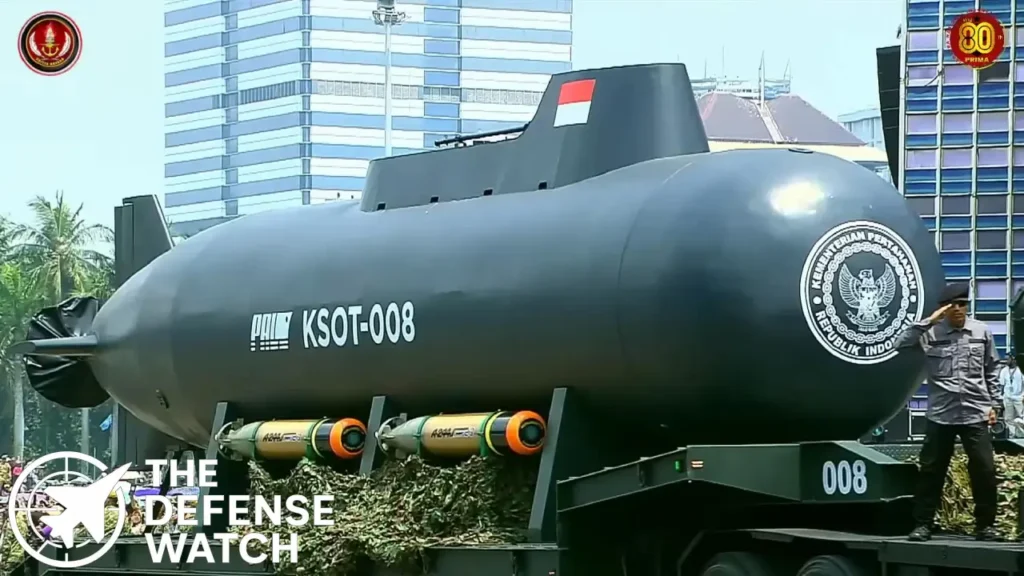
On October 30, 2025, KSOT (Kapal Selam Otonom Tanpa Awak), Indonesia’s state-designed unmanned submarine, successfully fired a lightweight 324 mm torpedo in waters off Surabaya, East Java. The development was announced by the Ministry of Defense of the Republic of Indonesia and shipbuilder PT PAL Indonesia and was observed by senior officials including Defense Minister Sjafrie Sjamsoeddin, Chief of Naval Staff Admiral Muhammad Ali and Armed Forces Commander General Agus Subiyanto.
According to published specifications, the KSOT prototype is approximately 15 metres in length with a beam of 2.2 m and draught of 1.85 m; it can operate up to depths of 350 metres and reach up to 20 knots. PT PAL noted the submarine’s domestic content exceeds 50 % and the torpedo load-out was crane-loaded and launched semi-submerged.
The Indonesian defense ministry projects production of up to 30 KSOT units by 2026 under the Navy’s Submarine Operations Command, targeting deployment in strategic chokepoints.
Why This Matters: Unmanned Undersea Strike Enters Southeast Asia
The KSOT’s successful torpedo launch signals more than a symbolic milestone for Jakarta’s defense industry—it reflects a shift in undersea warfare toward unmanned or optionally-manned platforms. Indonesia joins the United States, Russia and China in conducting autonomous submarine torpedo launches, according to some regional press.
This capability has strategic implications for the Indo-Pacific. First, it offers Indonesia the potential to field a distributed fleet of unmanned systems capable of persistent presence, undersea ISR (intelligence-surveillance-reconnaissance) and strike missions at lower cost and risk compared to conventional manned submarines. Second, it contributes to the normalization of unmanned submarines in maritime deterrence, reducing the entry threshold for “advanced” navies. Third, as Indonesia sets up this capacity around key maritime chokepoints (such as the Lombok and Sunda Straits), regional maritime security and freedom-of-navigation dynamics could shift accordingly.
From a defense-industrial perspective, PT PAL’s achievement underscores a domestic maturation—from earlier licensed construction of conventional submarines (e.g., the Nagapasa class) to indigenous design and production of unmanned subsurface platforms.
Analysis: What This Means for U.S. Defense and Global Security
For U.S. defense planners and policymakers, the KSOT development warrants close attention in several respects:
Undersea Autonomy Becoming Mainstream
The U.S. Navy has pursued unmanned underwater vehicles (UUVs) such as the ORCA XLUUV programme, but has yet to field a mass-deployed unmanned submarine capable of independent combat loads. Indonesia’s KSOT flight-test of torpedo launch capability shows that smaller navies are closing the gap, leveraging off commercial-off-the-shelf (COTS) systems and domestic industrialisation. For U.S. forces, this intensifies the imperative to accelerate unmanned undersea warfare (UUSW) integration and counter-UUV measures.
Regional Balance and Deterrence Effects
In the Indo-Pacific, Indonesia’s move may prompt neighbouring navies to invest in similar unmanned undersea systems, generating cluster effects in a region already witnessing submarine fleet growth. For the U.S. and allies, this trend highlights the need to reassess undersea deterrence architectures—not only against major-power submarines but also proliferated unmanned platforms in littoral and archipelagic zones.
Defense-Industrial and Export Implications
Indonesia’s 30-unit KSOT target by 2026 suggests a production scale and potential export orientation. The U.S. defense-industrial base and policymakers may need to monitor emerging competition in unmanned naval systems. Cooperation or competition with Indonesia’s industry could influence future U.S. allied supply chains or collaborative programmes in unmanned maritime systems.
Strategic Chokepoints and Maritime Domain Awareness
The deployment orientation of KSOT—guarding archipelagic chokepoints—aligns with an asymmetric defense posture. From the U.S. perspective, this could lead to increased unmanned undersea traffic around sea-lanes of communication (SLOCs) and extract new requirements for undersea domain awareness, unmanned sensor networks, and autonomous threat detection.
Conclusion: A New Chapter in Underwater Autonomy
Indonesia’s KSOT torpedo launch marks a tangible step into autonomous undersea combat for a Southeast-Asian navy. As Jakarta moves toward fleet production of unmanned submarines, the broader implications for maritime strategy, regional security, and U.S. defense planning are significant. In the coming years, we can expect Indonesia to refine its unmanned submarine variants (ISR, strike, mine-laying), pursue exports, and operationalize distributed undersea presence. For U.S. and allied navies, this development reinforces the urgency of integrating unmanned under-water systems, strengthening under-sea domain awareness, and adapting deterrence frameworks to a future where autonomous platforms will be as consequential as manned submarines.
Get real time update about this post category directly on your device, subscribe now.

9 comments
[…] test launches like this one serve to validate accuracy, reliability, guidance and re-entry performance of the […]
[…] faces challenges on engines, sensors and networked warfare.Strategic reach: While B-2 gave America global strike reach, B-21 will sustain that with more flexibility. H-20, if realised, would afford China a true […]
[…] DSCA notes the sale will expand Italy’s air-to-surface strike reach, enabling stand-off attacks from safer distances. The missiles are compatible with Italian fighter […]
[…] chokepoints have highlighted the need for novel approaches to maritime security and deterrence. Autonomous underwater systems offer a way to extend presence and sensing without exposing crewed vessels to […]
[…] platforms previously highlighted in related UK coverage include long-endurance autonomous underwater vehicles designed for extended missions, and distributed seabed nodes intended to support […]
[…] a fast attack craft. This diversification mirrors broader global trends in naval warfare, where unmanned underwater vehicles are increasingly used for strike, reconnaissance, and seabed warfare […]
Thank you for your sharing. I am worried that I lack creative ideas. It is your article that makes me full of hope. Thank you. But, I have a question, can you help me?
[…] maintenance and training support can strengthen Indonesia’s defense industrial base and human capital, officials […]
[…] have active development programs for unmanned maritime systems. China has demonstrated various unmanned underwater vehicles in recent years, though specific capabilities remain difficult to assess through open […]