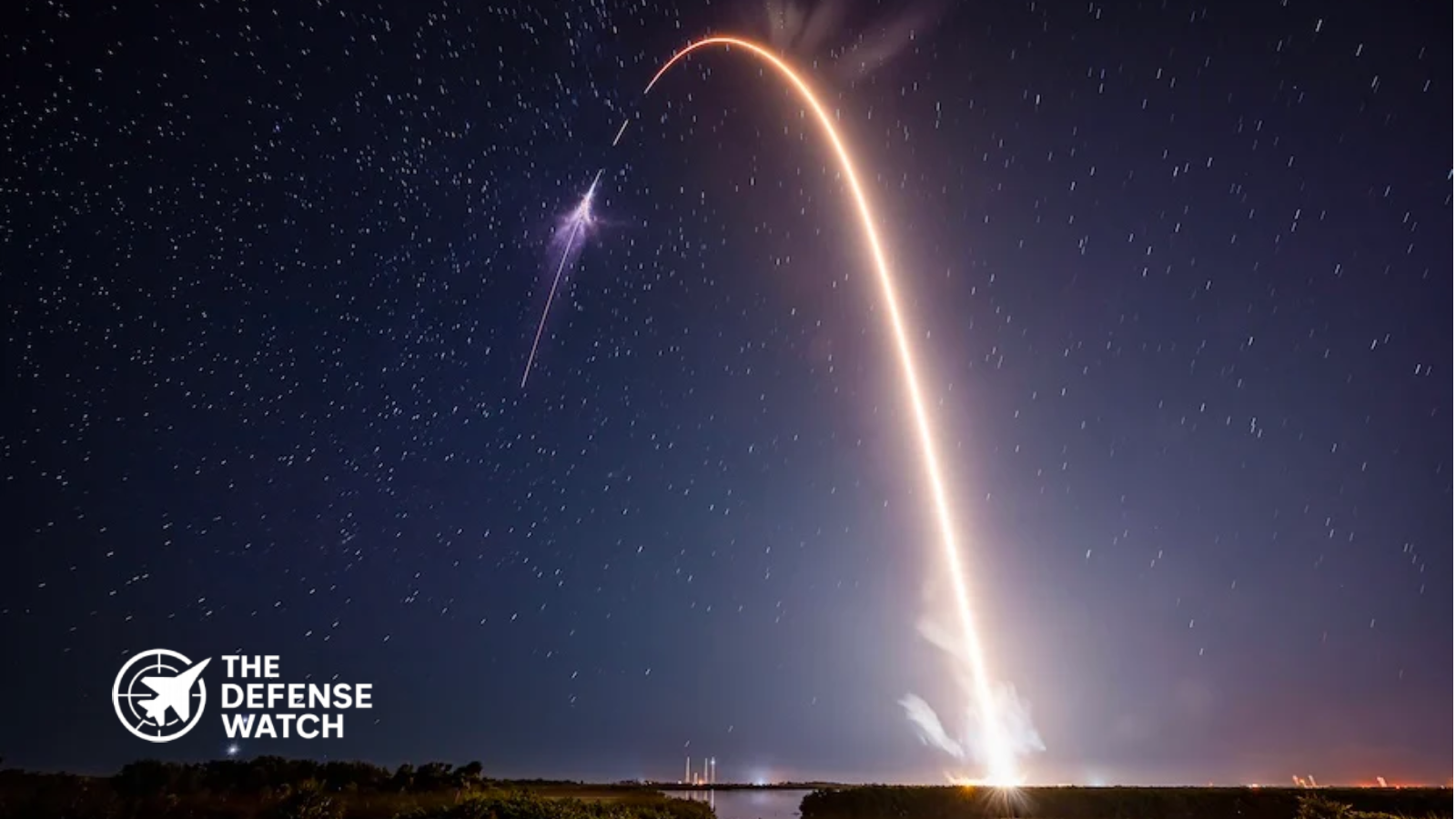
The first satellite developed through the partnership between Rheinmetall Italia and Italian space company Argotec entered orbit on October 1, beginning in orbit validation of a space based surveillance capability intended to support military air defense.
The spacecraft was launched from Vandenberg Space Force Base in California aboard a SpaceX Falcon 9 as part of the Transporter 18 rideshare mission. SpaceX identified Transporter 18 as a dedicated small satellite rideshare mission carrying 130 payloads into low Earth orbit.
Rheinmetall announced the launch on October 2, saying the satellite is the first element of a program intended to provide airspace surveillance and military situational awareness. The company said a second satellite launch is already planned for 2028, with the longer term objective of expanding the capability into a broader constellation.
From space observation to air defense data
The program is notable less for the individual spacecraft than for the role Rheinmetall intends it to play inside an integrated air defense architecture.
According to Rheinmetall, the satellite is intended to identify ground based indicators associated with emerging airborne threats. The resulting situational data and imagery are expected to undergo AI assisted processing before being passed into national defense and air defense systems. The planned architecture combines space based observation with ground nodes, tactical networks and command and control functions.
The company has not publicly disclosed key technical parameters of the satellite, including its mass, orbital altitude, sensor resolution, revisit rate, field of view or specific sensor types. Those omissions are important because they prevent a detailed assessment of the spacecraft’s independent detection performance from public information.
The stated objective also appears different from a conventional Earth observation mission focused primarily on mapping or imaging terrain. Rheinmetall describes the spacecraft as part of an intelligence architecture intended to generate information relevant to air defense warning and situational awareness.
That distinction matters operationally. A satellite does not by itself create an air defense engagement capability. Its value depends on how quickly information can be collected, processed, correlated with other sensors and delivered to command systems that can support decisions.
A European air defense problem increasingly connected to space
The Rheinmetall and Argotec program arrives as NATO places greater emphasis on integrating surveillance across domains.
NATO’s current Integrated Air and Missile Defence framework calls for networked sensors capable of detecting and tracking air and missile threats from the surface to space. Its published policy specifically identifies space based data as a source of early detection and tracking information and also highlights data fusion, including the potential use of artificial intelligence.
NATO has also expanded its space and surveillance initiatives. At the July 2026 NATO Summit Defence Industry Forum in Ankara, eight Allies launched the Hybrid Alliance Layered Operations in Space initiative, or HALO. NATO describes HALO as an effort to connect sovereign military satellites into a resilient network, initially focused on situational awareness and later intended to support targeting, early warning and integrated air and missile defense.
The Rheinmetall program is not identified by NATO as part of HALO, and there is no public evidence that the new satellite will be integrated into that initiative. The two developments nevertheless illustrate the same technical direction: air defense is increasingly dependent on information gathered outside the traditional radar and interceptor chain.
Italy already has a growing satellite industrial base
Argotec is also operating within a rapidly expanding Italian space ecosystem.
The company is involved in Italy’s IRIDE Earth observation program, where it is responsible for developing and building the Hawk for Earth Observation satellite constellation. ESA reported on October 2 that eight additional IRIDE Eaglet II satellites reached orbit on the same Transporter 18 mission, bringing the total number of IRIDE satellites in orbit to 39.
IRIDE is a separate Italian government program coordinated by the European Space Agency with support from the Italian Space Agency. Its satellites support environmental, emergency and security applications, demonstrating the growing role of Italian commercial and government space infrastructure.
That experience provides Argotec with an established industrial and operational base for satellite production and mission operations. It does not, however, establish the performance of the new Rheinmetall satellite itself, which remains subject to the results of the current in orbit validation phase.
The constellation question is more important than the first spacecraft
Rheinmetall describes the current program as modular and says the initial launch is intended to validate operational functionality in orbit before subsequent funding and development phases. The company has committed to a further launch in 2028, but it has not publicly specified the eventual number of satellites in the planned constellation or provided a full deployment schedule.
That leaves several important questions unanswered.
A larger constellation could provide more frequent coverage than a single satellite, but the operational value would depend on orbital configuration, sensor performance, communications architecture, data processing and the ability to fuse satellite observations with terrestrial and airborne sensors.
The command and control layer will be equally important. NATO’s air defense architecture is built around interconnected sensors, command and control systems and weapons. A new space based sensor becomes operationally useful only when its information can move through that wider network with sufficient speed, reliability and confidence.
Rheinmetall has been expanding in this direction beyond the Argotec partnership. Its portfolio already includes the Rheinmetall ICEYE Space Solutions joint venture, which focuses on satellite based intelligence using synthetic aperture radar. Rheinmetall has also announced a separate partnership with Vantor aimed at combining satellite imagery and other spatial intelligence with a European controlled command and intelligence architecture.
The Argotec satellite therefore forms part of a broader expansion of Rheinmetall’s space activities, rather than representing an isolated satellite procurement.
For now, the clearest milestone is the launch itself and the start of in orbit validation. The next significant measure will be whether the system can translate space based observations into timely, usable information for air defense networks. The planned 2028 follow on launch should provide a clearer indication of whether the program is progressing from a technology demonstration toward a persistent constellation.