
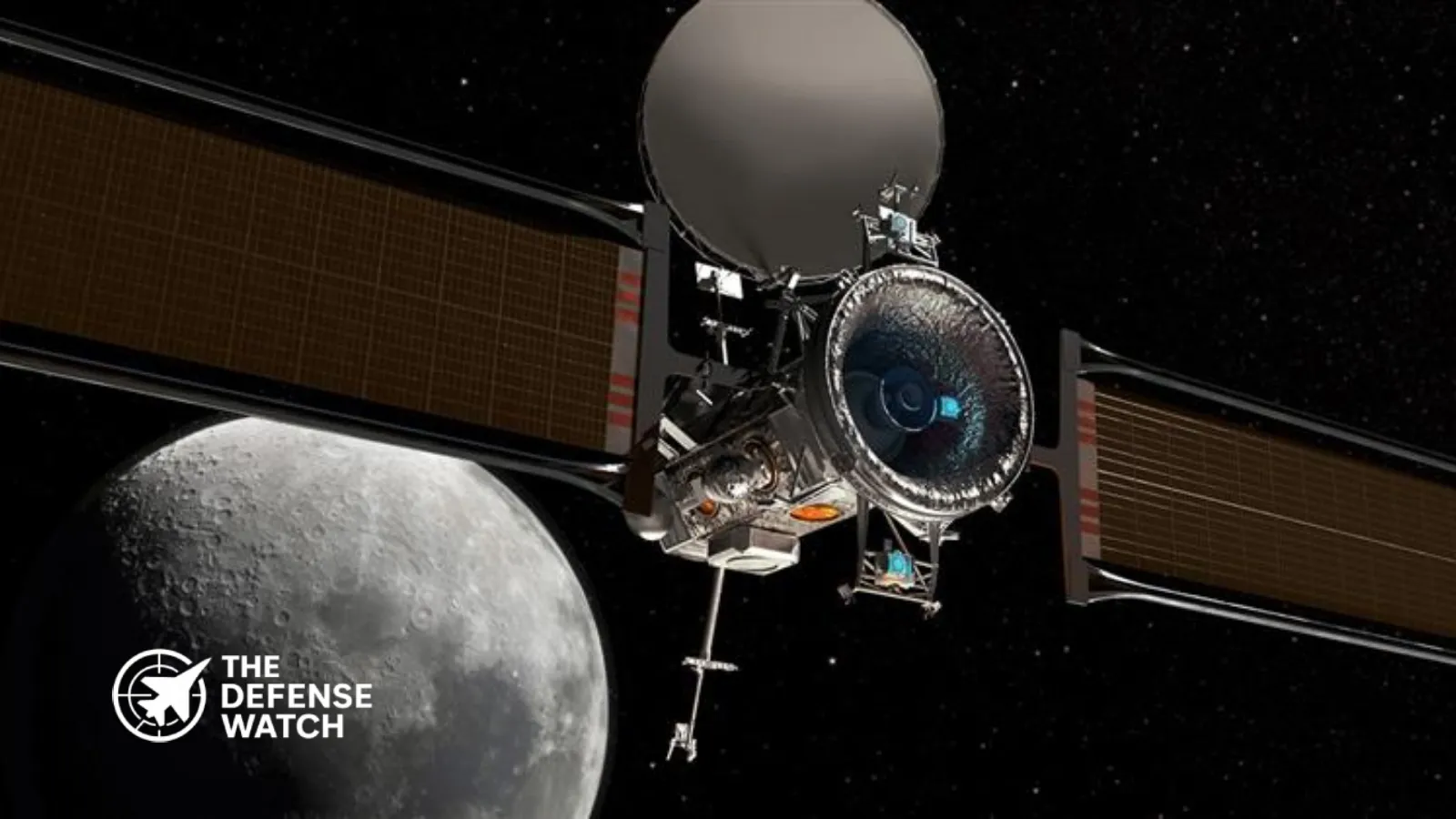
- ► Blue Ring cislunar mission vehicle delivers up to 3,500 kg of hosted and deployable payloads beyond Earth orbit.
- ► Capable of operations across the cislunar domain, including Earth Moon Lagrange points and low lunar orbit.
- ► Deploys multiple constellation satellites from a single vehicle without requiring onboard transfer propulsion per spacecraft.
- ► Reduces propellant mass per satellite, increasing usable payload capacity for sensors and mission equipment.
- ► Provides direct orbit insertion to cislunar destinations without dedicated transfer stages on each spacecraft.
- ► Functions as a command, control, and communications relay node for deployed payloads in deep space.
- ► Supports cost efficient, scalable cislunar missions aligned with growing U.S. civil and defense space objectives.
Blue Ring Cislunar Mission Vehicle Expands Access To Deep Space
The Blue Ring cislunar mission vehicle is designed to deliver up to 3,500 kilograms of hosted and deployable payloads across the cislunar domain, including missions to Earth Moon Lagrange points and low lunar orbit.
The platform is positioned as a multi role space mobility system, capable of transporting satellites beyond traditional geostationary and low Earth orbits without requiring each spacecraft to carry its own dedicated transfer propulsion system.
As interest in the cislunar domain accelerates among U.S. defense agencies, NASA, and commercial operators, Blue Ring represents a shift toward shared transport architecture in deep space.
A Transport Layer For The Cislunar Domain
The cislunar region, which spans the space between Earth and the Moon, is increasingly viewed by the U.S. Space Force and NASA as strategically and scientifically important. Earth Moon Lagrange points, particularly L1 and L2, provide stable gravitational regions that are valuable for communications relay, surveillance, and staging.
The Blue Ring cislunar mission vehicle is engineered to circumnavigate Lagrange points and deliver payloads directly into low lunar orbit. By centralizing propulsion and navigation on a single vehicle, the system reduces mass requirements for individual satellites.
This architecture allows multiple constellation satellites to be deployed on one mission. Instead of each spacecraft carrying large propellant reserves, Blue Ring handles transfer and orbital insertion. That increases usable payload mass and enables more complex sensor or communications packages.
In practical terms, it shifts deep space access from bespoke spacecraft designs to a more scalable transport model.
Hosted And Deployable Payload Operations
The vehicle supports both hosted payloads and deployable spacecraft. Hosted payloads can remain attached and use the platform for power, communications, and command and control functions. Deployable satellites can separate once the target orbit is reached.
Once operating in the cislunar domain, Blue Ring can serve as a command, control, and communications relay node. That reduces or eliminates the need for each deployed satellite to maintain direct to Earth communications capability.
This is a significant technical advantage. Deep space communications systems add cost, mass, and complexity to small satellites. Offloading that function to a central node improves efficiency and simplifies mission design.
For defense applications, this model also enables distributed architectures. Multiple spacecraft can be positioned across key orbital regimes while maintaining coordinated control through a single relay and operations hub.
Cost And Maneuverability Advantages
One of the primary selling points of the Blue Ring cislunar mission vehicle is cost efficiency. By aggregating payloads and removing redundant propulsion systems, the overall mass launched from Earth can be optimized.
Reducing onboard propellant requirements per spacecraft translates into either lower launch costs or greater mission capability. Operators can allocate mass to sensors, processing hardware, or radiation shielding instead of fuel tanks.
Maneuverability is another factor. A centralized propulsion system designed specifically for cislunar operations can execute complex transfers between Lagrange points and lunar orbits more efficiently than smaller, individually constrained spacecraft.
This is particularly relevant as U.S. planners increasingly focus on space domain awareness and resilience beyond geostationary orbit. According to U.S. Space Force doctrine documents, the cislunar domain is expected to host future communications, surveillance, and navigation assets.
Blue Ring aligns with that strategic direction by enabling sustained presence rather than one off demonstration missions.
Strategic Context: Why Cislunar Matters
The Blue Ring cislunar mission vehicle enters service at a time when competition and cooperation in lunar space are both intensifying.
NASA Artemis missions aim to establish a sustained human presence near the Moon, including operations around lunar orbit and the planned Gateway station. Meanwhile, the U.S. Department of Defense has signaled growing interest in monitoring and operating in deep space.
Authoritative analyses from the Center for Strategic and International Studies and the Aerospace Corporation have highlighted the need for infrastructure in cislunar space, including mobility, communications, and tracking networks.
A platform that can deliver 3,500 kilograms to Lagrange points and low lunar orbit addresses a key infrastructure gap. Rather than treating each mission as a standalone effort, Blue Ring supports a layered architecture.
That architecture mirrors how low Earth orbit evolved, from individual satellites to constellations supported by shared services.
Operational Flexibility And Constellation Deployment
The ability to deploy multiple satellites from a single vehicle has both commercial and defense implications.
Commercial operators could use the Blue Ring cislunar mission vehicle to place science payloads or communications relays at L1 or L2 without designing complex transfer stages. Defense users could deploy distributed sensor nodes for tracking objects in deep space.
Because direct orbit access is achieved without dedicated transfer propulsion on each spacecraft, total system complexity decreases. That can shorten development timelines and reduce integration risks.
The vehicle’s role as a communications and control node further strengthens constellation operations. Deployed spacecraft can communicate through Blue Ring instead of carrying high power antennas and deep space transmitters.
This hub and spoke model supports scalability. As more missions target the cislunar domain, shared infrastructure becomes essential to avoid congestion and redundancy.
Analysis: A Shift Toward Infrastructure In Deep Space
At least 30 percent of the significance of Blue Ring lies not in its raw payload capacity, but in its architectural implications.
Historically, deep space missions were bespoke, high cost, and infrequent. Each spacecraft was designed to operate independently, with its own propulsion, power margins, and communications.
Blue Ring reflects a move toward infrastructure first thinking. By providing mobility and relay services as a shared platform, it lowers the barrier to entry for cislunar missions.
This mirrors developments in low Earth orbit, where rideshare launches and shared satellite buses transformed access. In cislunar space, where distances and communication delays increase complexity, shared command and control nodes are even more valuable.
If widely adopted, this approach could shape how both civil and military actors structure their lunar and deep space strategies over the next decade.
Get real time update about this post category directly on your device, subscribe now.
