
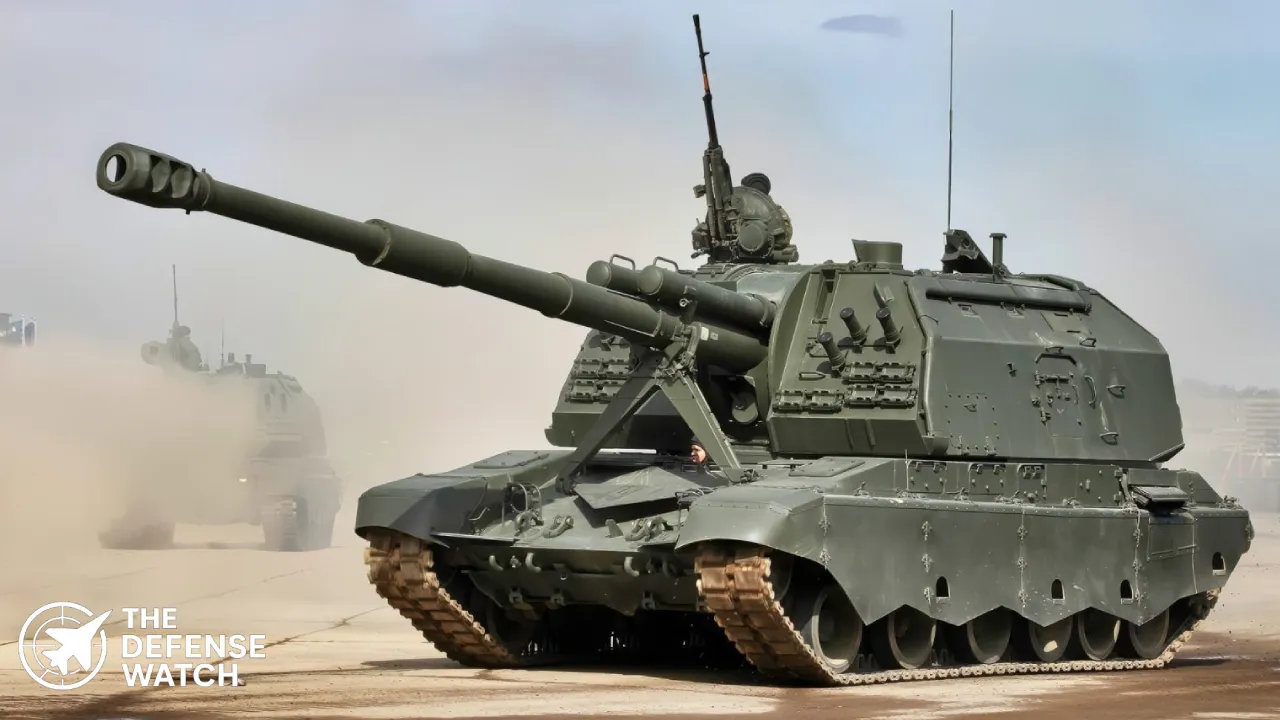
Recent leaks of Russian military export documents indicate that Beijing has, since early 2022, embarked on a clandestine procurement program of Russian military hardware — including air-deployable armored vehicles, parachute systems, and airborne training — reportedly meant to expand and modernize the airborne capabilities of the People’s Liberation Army (PLA).
According to analysis of the leaks by Western think-tanks and investigative media outlets, the deal aligns with a broader Chinese plan to achieve invasion readiness for Taiwan by around 2027 — a milestone that coincides with the centenary of the PLA’s founding.
Context: Why This Matters
For years, analysts of Asian security have flagged the PLA’s limited airborne and rapid-insertion capabilities as a barrier to any credible large-scale cross-strait assault. Traditional amphibious landings across the Taiwan Strait are fraught with risk: Taiwan’s air defenses, coastal fortifications, and geography render seaborne invasions costly and uncertain.
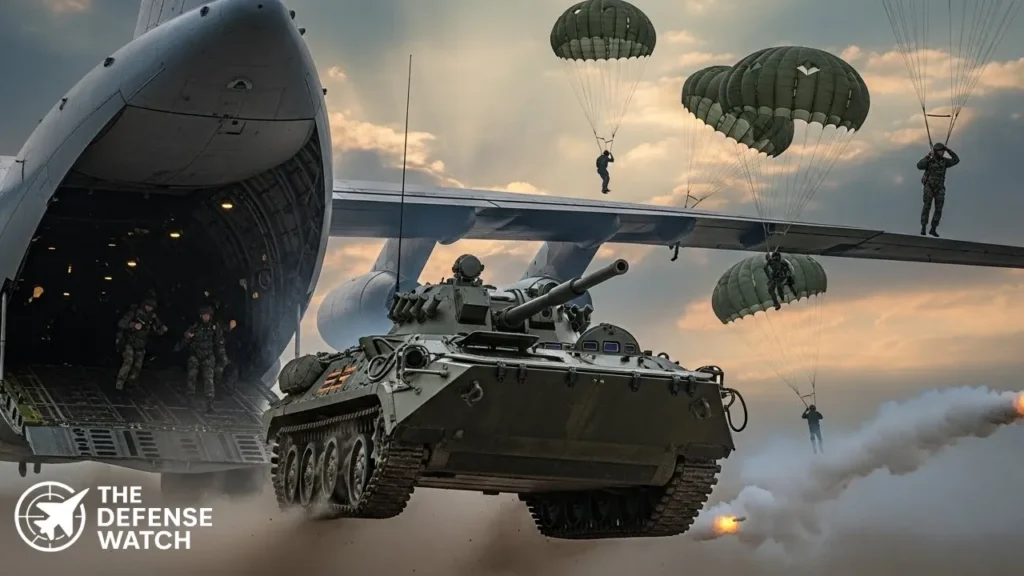
By acquiring air-deployable equipment and high-altitude parachute systems, China could mitigate some of these risks. Armored vehicles parachuted near Taiwan’s ports or airfields — or inserted via high-altitude, long-range parachute drops — would give airborne troops direct access to strategic terrain, bypassing coastal defenses and potentially negating the advantage held by conventional amphibious invasion plans.
What the Leaked Documents and Reports Reveal
- According to the analysis, Russia agreed to supply China with 37 BMD-4M light amphibious assault vehicles, 11 Sprut-SDM1 anti-tank guns, and 11 BTR-MDM “Rakushka” airborne armored personnel carriers, along with command, observation vehicles, and air-deployable support systems.
- Additionally, Moscow committed to delivering high-altitude parachute systems known as “Dalnolyot”, capable of delivering payloads up to 190 kg from altitudes as high as 8,000 m (roughly 26,000 ft). Under favorable conditions, such systems could allow loads — including vehicles or equipment — to glide 30–80 km after drop.
- The agreement reportedly includes a comprehensive training package: Russian instructors will train a battalion of Chinese paratroopers for operation of the vehicles and air-drop procedures, with collective exercises scheduled on Chinese territory.
- The official estimated value of the contract — before finalization — was approximately US$584 million, with a later breakdown listing the main hardware at over US$210 million.
- According to a report by the Royal United Services Institute (RUSI), these deliveries and capabilities could compress China’s airborne modernization timeline by a decade or more — effectively accelerating PLA’s capability to conduct large-scale airborne or airdrop operations.
Taken together, these provisions could significantly shift the balance of options available to the PLA in any potential Taiwan contingency.
Strategic Implications and Expert Observations
According to the RUSI analysis — based on roughly 800 pages of leaked contracts and supporting documents from a hacktivist group known as Black Moon — the procurement is part of a broader campaign of military modernization.
RUSI analysts suggest that the greatest advantage lies not necessarily in the hardware per se, but in the procedures and training being transferred: Russia brings decades of combat-proven airborne doctrine and operational experience, something the PLA’s airborne branch has historically lacked.
However, some analysts caution that capability gaps remain. Previous Russian airborne operations — such as early attempts to seize Ukrainian airfields during the 2022 invasion — ran into stiff resistance and heavy losses when helicopters and air-drops were disrupted before force consolidation.
In that respect, even with enhanced gear and training, the success of an airborne invasion against a defended island like Taiwan would still depend heavily on air superiority, suppression of air defenses, and secure follow-on supply and reinforcement — factors that remain uncertain.
What This Means Going Forward
The procurement and training effort significantly enhances the PLA’s airborne capabilities and broadens China’s options for projecting force in a potential Taiwan contingency. If deliveries and training continue as scheduled, and if China completes integration of Russian hardware with its own communications, ammunition, and command systems, the PLA could field a more robust, airdrop-capable force potentially capable of seizing key terrain on Taiwan quickly.
That said, technical, operational, and geopolitical obstacles remain. Effectively using airborne operations against Taiwan would require not only the hardware, but also suppression of Taiwan’s air defenses, control of air and sea lanes, and secure logistics — all under the watchful eyes of regional powers and likely U.S. intervention.
Get real time update about this post category directly on your device, subscribe now.

6 comments
[…] and cybersecurity officials worry that state-backed hackers from countries such as China, Russia or Iran could use prompt injection to automate espionage, data theft or large-scale […]
[…] the past several years, U.S. lawmakers have increased funding and authorities aimed at improving Taiwan’s ability to withstand a potential military campaign by the People’s Liberation Army. Congress has used both security assistance packages and […]
[…] geopolitical partners, including Russia and China, have also weighed in, calling for respect for sovereignty and cautioning against actions that […]
[…] The newest, the Fujian, shifts to electromagnetic launchers like those on U.S. carriers. That lets China operate heavier aircraft and yields greater payload capacity. But China’s carriers use conventional […]
[…] border conflict. The presence of advanced Chinese‑made launcher systems underscores China’s influence in regional arms supplies and the shifting balance of military hardware among […]
[…] move also comes against a backdrop of heightened tensions with Russia over military activities in the […]