

Turkey’s Kizilelma Drone Fires Radar-Guided Missile in Milestone Test
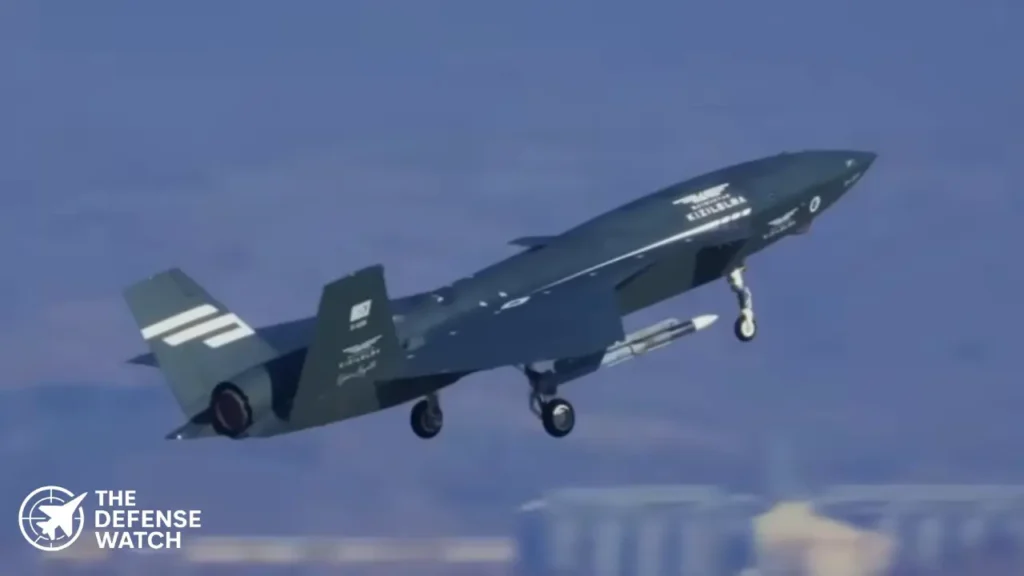
Turkey achieved a notable milestone in unmanned combat aviation when its Kizilelma UCAV successfully fired a radar-guided air-to-air missile at a target drone. The test, conducted alongside Turkish Air Force F-16s, marked the first known instance of a UCAV launching a radar-guided missile in a live-fire scenario, highlighting Turkey’s advancing aerial combat technology.
Background on Kizilelma and Turkish UAV Development
Developed by Baykar, the Kizilelma is a fighter-like unmanned combat air vehicle designed for air superiority missions. With stealth features, supersonic capability, and compatibility with advanced missiles, the Kizilelma represents Turkey’s push to enhance its autonomous and semi-autonomous aerial warfare capabilities. Previous attempts at arming drones with air-to-air weapons have largely focused on infrared-guided missiles, such as the U.S. MQ-1 Predator and MQ-9 Reaper programs, but the Kizilelma’s radar-guided engagement signals a new step forward.
Details of the Live-Fire Test
During the test, the PT-5 variant of Kizilelma took off with four F-16s, one of which acted as a safety chase plane. An Akinci high-altitude UCAV also participated in chase duties. Equipped with two Gökdoğan air-to-air missiles, one inert and one live, the Kizilelma successfully engaged and destroyed a target drone. Baykar released video footage showing the missile launch and subsequent target impact.
While details remain limited, questions linger regarding the level of assistance provided by crewed fighter aircraft in targeting and engagement. Analysts note that external missile carriage slightly compromises the UCAV’s radar signature reduction but does not diminish the operational significance of the demonstration.
Expert Perspectives
Defense analysts highlight that integrating radar-guided air-to-air missiles on UCAVs could redefine future aerial combat. “This test demonstrates Turkey’s capacity to expand drone roles beyond surveillance and strike missions to potential air-to-air engagements,” noted Thomas Newdick, a military aviation analyst.

The Kizilelma test may also influence regional UAV development trends, prompting other nations to explore similar capabilities for force multiplication in contested airspace.
Implications and Next Steps
Turkey’s successful demonstration reinforces its growing domestic defense industry and unmanned combat expertise. The Kizilelma could eventually operate alongside manned aircraft in mixed formations, providing enhanced strike and air defense flexibility. Further tests and operational deployment are expected to refine targeting autonomy and multi-missile engagement capability.
As UAV technology continues to evolve, the Kizilelma program underscores Turkey’s commitment to advancing unmanned combat operations and shaping future air warfare doctrines.
Get real time update about this post category directly on your device, subscribe now.


9 comments
[…] adoption of an air-to-air missile appears to represent the next phase of this evolution, broadening the drone’s mission set beyond […]
[…] air intake, and twin canted V-tails. It carries weapons in internal bays — including air-to-air missiles such as the AIM-120 […]
[…] JF-17C Block III is configured to employ advanced Chinese air-to-air missiles, including the PL-10 short range missile and the PL-15 very long range air-to-air missile. These […]
[…] deployment in 2026. Among systems he cited were the Tayfun Blok-4 ballistic missile, the Gokbora air-to-air missile and the 300 ER missile, work on which “continues at full […]
[…] SFDR technology has been under DRDO development for several years with earlier flight trials in 2018, 2019 and 2021 showing incremental progress. Successful validation in 2026 places India among a small group of countries capable of mastering this propulsion approach for long range air-to-air missiles. […]
[…] Previous imagery and battlefield reporting indicated Russian forces had begun experimenting with air-to-air missiles mounted forward on Shahed platforms, likely intended to threaten Ukrainian helicopters and […]
[…] part of that shortfall.How These Missiles Fit Ukrainian NeedsThe AIM-7 Sparrow is a medium-range radar-guided air-to-air missile first introduced in the 1950s and widely exported. Though older by modern standards, stocks of its […]
[…] Weapons Systems: R-77M long-range and R-37M extended-range air-to-air missiles […]
[…] practical terms, autonomous aircraft could carry additional air-to-air missiles, electronic warfare payloads, or intelligence, surveillance, and reconnaissance systems. This […]