
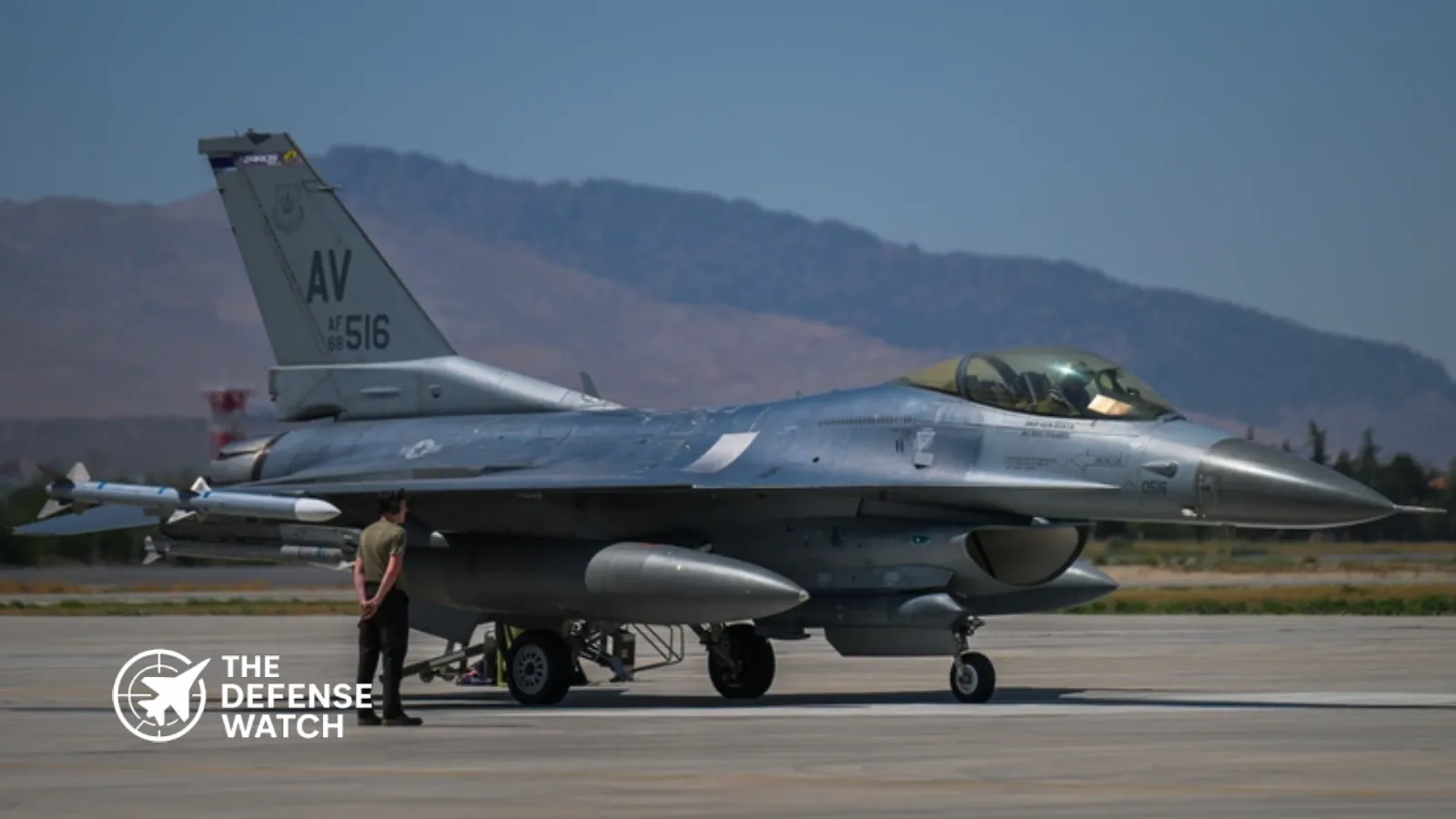
- Turkey has deployed six F-16 fighter jets to the Turkish Republic of Northern Cyprus to strengthen regional security.
- The deployment includes additional air defense systems to enhance protection of the island’s northern sector.
- The move follows a drone attack on Cyprus linked to escalating Middle East tensions.
- Greek forces previously deployed F-16 aircraft to the southern part of the island, raising military activity in the region.
- The deployment highlights growing strategic competition in the Eastern Mediterranean airspace.
Turkey F-16 Northern Cyprus Deployment Signals New Security Posture
The Turkey F-16 Northern Cyprus deployment marks a significant escalation in military activity around the divided Mediterranean island, as Ankara moves to strengthen the security of the Turkish Cypriot territory amid growing regional tensions.
According to officials cited by Reuters, Turkey has sent six F-16 fighter jets and supporting air defense systems to the Turkish Republic of Northern Cyprus (TRNC), a self-declared state recognized only by Ankara.
The deployment follows a series of regional security developments, including a drone strike on Cyprus linked to broader hostilities in the Middle East.
The Big Picture
Eastern Mediterranean security dynamics have shifted rapidly over the past decade as regional rivalries, energy competition, and military modernization reshape the balance of power.
Cyprus sits at the center of this evolving strategic landscape. The island hosts key military installations, including British sovereign bases used by NATO forces, and lies close to critical maritime routes connecting Europe, the Middle East, and North Africa.
The island has been divided since 1974 following a Turkish military intervention after a coup backed by Greece. Today, the internationally recognized Republic of Cyprus controls the south, while the Turkish-backed TRNC governs the north.
Military activity around the island has intensified as regional conflicts spill into the Eastern Mediterranean. Several countries, including Greece and European partners, have recently increased defense cooperation with the Republic of Cyprus.
Turkey’s decision to deploy fighter aircraft to Northern Cyprus reflects its intent to maintain a strong security presence in the region and protect the Turkish Cypriot community.
What’s Happening
Turkish authorities confirmed that six F-16 fighter jets have been deployed to Northern Cyprus as part of what officials described as a phased security response to recent developments in the region.
The aircraft are expected to operate from facilities near Ercan Airport, the main airfield in the northern part of the island.
Officials said the deployment will not disrupt civilian aviation operations and commercial flights will continue normally.
The move comes shortly after a drone attack struck a British military base in Cyprus, an incident linked to the broader escalation following military operations involving the United States, Israel, and Iran.
Greece had already deployed several of its own F-16 fighter jets to the southern part of Cyprus, further increasing military activity in the area.
Ankara has stated that the deployment forms part of a broader strategy to ensure the security of the TRNC and that additional measures could follow depending on how the regional situation evolves.
Why It Matters
The deployment of Turkish F-16 fighter jets to Northern Cyprus significantly improves Ankara’s ability to respond quickly to potential threats in the Eastern Mediterranean.
Operating fighter aircraft directly from the island dramatically reduces response times compared with aircraft flying from mainland Turkey. This allows faster interception of drones, missiles, or hostile aircraft approaching the area.
The move also reinforces Turkey’s air defense coverage around strategic maritime zones that are central to ongoing disputes over energy exploration and maritime boundaries.
Cyprus lies near several major offshore gas fields discovered in the Eastern Mediterranean, making control of surrounding airspace an increasingly important element of regional power projection.
By placing fighter jets on the island, Turkey strengthens both deterrence and surveillance capabilities in a region where military incidents have become more frequent.
Strategic Implications
Turkey’s deployment of F-16 aircraft introduces a new layer of military capability into an already complex security environment.
The Eastern Mediterranean has become a strategic crossroads where NATO allies, European Union members, and regional powers maintain overlapping military interests.
Ankara’s decision to forward deploy fighter aircraft may serve several operational objectives:
First, it creates a rapid reaction air defense capability near potential threat vectors originating from the Middle East.
Second, it increases Turkish air presence near maritime zones contested between Turkey, Greece, and Cyprus.
Third, it reinforces Turkey’s commitment to defending the Turkish Cypriot administration, which Ankara views as essential to its regional strategy.
From a military perspective, the deployment also enhances air patrol coverage over sea lanes connecting the Levant, Suez Canal routes, and Southern Europe.
Competitor View
Regional actors are likely to interpret the Turkish F-16 deployment through the lens of broader geopolitical competition in the Eastern Mediterranean.
Greece and Cyprus have strengthened defense cooperation with European partners and Israel in recent years, conducting joint exercises and expanding security agreements.
The presence of Turkish fighter aircraft in Northern Cyprus could therefore be viewed in Athens and Nicosia as an attempt by Ankara to consolidate military control over northern airspace.
Iran and other Middle Eastern actors may interpret the move differently, seeing it as a defensive step by Turkey to shield strategic territory from spillover effects of regional conflict.
For NATO planners, the situation highlights the complex dynamic of alliance members maintaining competing security positions in the same region.
What To Watch Next
Several developments will determine how this situation evolves in the coming months.
First, analysts will monitor whether Turkey rotates additional aircraft or expands air defense deployments on the island.
Second, regional partners may increase their own military presence in Cyprus, particularly through joint exercises or temporary deployments.
Third, NATO and European Union diplomacy could intensify to prevent further escalation between regional actors.
Another key indicator will be whether Ankara upgrades infrastructure at Northern Cyprus airbases to support longer-term fighter deployments.
Capability Gap
The deployment addresses a key operational gap in Turkey’s regional air defense posture.
Before the move, fighter aircraft responding to threats near Cyprus would typically launch from bases in southern Turkey, requiring longer flight times and reducing on-station endurance.
Forward basing F-16 aircraft on the island shortens response times significantly, especially against low-flying drones or cruise missiles.
However, the deployment also has limitations.
Six aircraft provide a modest defensive capability and would primarily support air policing and interception missions rather than sustained high-intensity air operations.
Maintaining a continuous air defense posture would require additional aircraft rotations, ground support infrastructure, and integrated radar coverage.
The Bottom Line
Turkey’s deployment of F-16 fighter jets to Northern Cyprus strengthens its regional deterrence posture and signals a more permanent Turkish airpower presence in the Eastern Mediterranean.
Get real time update about this post category directly on your device, subscribe now.


