
Operation Epic Fury Ends: U.S. Forces Strike Over 13,000 Targets, Crushing Iran’s Military Capabilities in 38 Days
The White House confirmed this week that Operation Epic Fury, a 38-day U.S. military campaign targeting Iran, concluded with the systematic dismantling of Iran’s core military capabilities. American forces executed more than 10,200 air sorties and struck over 13,000 individual targets — a scale of precision warfare rarely seen in the post-Cold War era. The operation ended with Tehran agreeing to a ceasefire and the reopening of the strategically vital Strait of Hormuz.
- Operation Epic Fury lasted 38 days and involved more than 10,200 air sorties conducted by U.S. joint forces against Iran.
- Over 13,000 targets were struck across Iran’s military infrastructure, including command centers, air defense networks, and naval assets.
- More than 85% of Iran’s defense industrial base was reported destroyed, and daily Iranian air flight activity was reduced to zero.
- 150 Iranian naval vessels were destroyed across multiple classes, and Iran’s submarine force was fully eliminated.
- The campaign concluded with Iran agreeing to a ceasefire and reopening the Strait of Hormuz to international shipping.
What Was Operation Epic Fury?
Operation Epic Fury was a concentrated, joint-force military campaign ordered by President Trump on February 28, 2026. According to Gen. Dan Caine, Chairman of the Joint Chiefs of Staff, the operation was built around three primary military objectives: neutralizing Iran’s ballistic missile and drone arsenals, dismantling the Iranian Navy, and destroying Iran’s defense industrial base to permanently eliminate its capacity to project military power beyond its own borders.
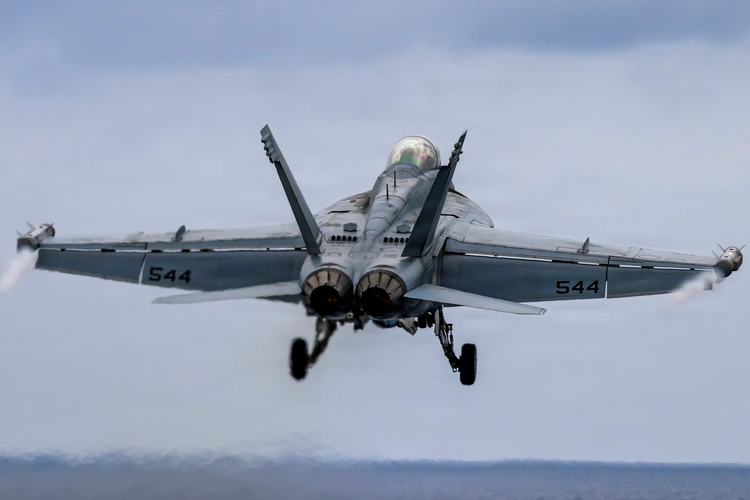
The White House reported that U.S. forces struck more than 13,000 targets during the 38-day campaign, which involved over 10,200 air sorties. What made this operation particularly notable was not just its breadth, but the systematic, layered approach used to simultaneously collapse multiple pillars of Iranian military power within a compressed operational timeline.
Target Categories: A Sweeping Dismantlement
The scope of targets engaged during Operation Epic Fury reveals a deliberate strategy to degrade Iran’s military at every functional layer:
Command & Control: More than 2,000 command and control sites were struck, disrupting the coordination networks Iran relies upon to synchronize military operations across its conventional forces and proxy networks throughout the region.
Air Defense & Missile Infrastructure: Over 1,500 air defense systems and more than 450 ballistic missile-related sites were targeted, gutting Iran’s ability to defend its own airspace and deploy the long-range strike capabilities that have long posed a threat to U.S. partners in the Gulf.
Drone Capabilities: Approximately 800 attack drone targets were struck — a pointed response to Iran’s established role as a leading supplier of low-cost attack drones to armed groups across the Middle East and to Russia during the Ukraine conflict.
Naval Forces: More than 600 naval targets were engaged, with 150 vessels destroyed across multiple classes and Iran’s submarine capability fully eliminated.
Mine Warfare: Over 700 mine systems were destroyed, directly addressing one of Iran’s most asymmetric tools for threatening Gulf shipping lanes.
Defense Industrial Base: More than 1,450 defense and industrial base targets were struck, with officials reporting that over 85% of Iran’s defense industrial capacity had been destroyed.
Defensive Intercepts: The Battle Above Iranian Airspace
The campaign was not entirely one-directional. U.S. forces intercepted more than 1,000 incoming drone threats and over 700 ballistic missiles during the course of operations — a figure that underscores both the intensity of Iranian resistance and the effectiveness of American missile defense systems in a live, high-threat environment. This volume of successful intercepts represents one of the most significant real-world tests of layered U.S. air and missile defense architecture in history, providing invaluable operational data that defense planners will analyze for years.
Senior Officials Declare Objectives Met
Gen. Caine was direct in his assessment of the outcome. Over the course of 38 days of major combat operation, the joint force achieved the military objectives as defined by the President,” he stated, adding that the campaign methodically degraded Iran’s capacity to conduct offensive military operations.
White House Press Secretary Karoline Leavitt framed the result in broader terms, stating that the operation had achieved and exceeded its stated objectives within the planned four-to-six-week window. Secretary of Defense Pete Hegseth also highlighted the campaign’s conclusion, noting that “Iran begged for this ceasefire,” and crediting President Trump’s decision-making as central to the outcome.
Space and Advanced Weapons Programs Hit Hard
Beyond conventional military targets, the operation also degraded Iran’s space-related infrastructure, with approximately 70% of those facilities reported destroyed or rendered inoperable. This aspect of the campaign signals a deliberate effort to close off future Iranian pathways to satellite-enabled intelligence, reconnaissance, and ballistic missile guidance — capabilities that would have allowed Tehran to reconstitute a credible long-range strike posture even after suffering conventional military losses.
The Strait of Hormuz: A Strategic Endgame
Perhaps the most consequential strategic outcome of Operation Epic Fury is the reopening of the Strait of Hormuz. Approximately 20% of the world’s traded oil transits this narrow waterway daily, and Iranian threats to close it have for decades served as a powerful leverage point in regional geopolitics. With the strait now open and Iran’s naval forces largely neutralized, global energy markets have seen immediate pressure ease — a tangible economic dividend from the military campaign.
Analysis: What Operation Epic Fury Signals for Future Warfare
Operation Epic Fury represents a watershed moment in how the United States conducts large-scale, high-tempo conventional military operations. The combination of over 10,200 sorties, precision strike packages against 13,000+ discrete targets, and simultaneous large-scale ballistic missile defense in a live combat environment places this campaign in a category alongside Operation Desert Storm in terms of its doctrinal significance.
Several lessons stand out for defense analysts. First, the campaign demonstrated that the U.S. joint force can sustain an extraordinarily high operational tempo against a peer-regional military adversary with meaningful air defense capabilities — and do so with sufficient precision to isolate military targets from broader civilian infrastructure. Second, the successful intercept of more than 700 ballistic missiles in a single campaign validates years of investment in layered missile defense architecture, particularly THAAD, Patriot, and naval Aegis-based systems. Third, the deliberate targeting of Iran’s defense industrial base — rather than simply its deployed forces — reflects an evolving U.S. doctrine aimed at preventing reconstitution, not just winning the immediate engagement.
The campaign also raises critical questions for adversaries watching closely. China, Russia, and North Korea will be intensively studying the degradation sequence used against Iran’s integrated air defense, missile, naval, and industrial capabilities. The speed with which a modern, reasonably well-armed regional power was effectively disarmed in under six weeks will recalibrate threat assessments in capitals from Beijing to Pyongyang. Whether the long-term political settlement matches the military outcome, however, remains the defining open question of this chapter in Middle Eastern history.
Ceasefire and the Road Ahead
The campaign’s conclusion with a ceasefire agreement and Hormuz reopening marks the immediate end of hostilities, but the diplomatic architecture required to translate this military outcome into durable regional stability remains entirely unbuilt. Iran retains its territory, its government, and a population that — regardless of political orientation — will likely view this period as a national trauma. Reconstruction of Iran’s military will be constrained for years by the destruction of its industrial base, but the underlying geopolitical drivers of regional tension have not been eliminated. American policymakers now face the harder task: converting an overwhelming military victory into a lasting strategic outcome.
FAQs
Operation Epic Fury was a 38-day U.S. military campaign launched on February 28, 2026, targeting Iran’s ballistic missile capabilities, naval forces, drone arsenals, and defense industrial infrastructure. It concluded with a ceasefire and the reopening of the Strait of Hormuz.
U.S. forces struck more than 13,000 targets across Iran, supported by over 10,200 air sorties conducted by the joint force.
White House officials stated that more than 85% of Iran’s defense industrial base was destroyed or severely damaged during the campaign.
American forces intercepted more than 1,000 incoming Iranian drones and over 700 ballistic missiles during the 38-day campaign, representing one of the largest real-world tests of U.S. layered missile defense systems in history.
The Strait of Hormuz is one of the world’s most critical energy chokepoints, through which approximately 20% of globally traded oil passes daily. Iran’s agreement to reopen the strait following the ceasefire is considered a major strategic and economic outcome of the operation.
U.S. forces destroyed 150 Iranian naval vessels across multiple classes and fully eliminated Iran’s submarine force during the operation.
Get real time update about this post category directly on your device, subscribe now.
