Executive Summary: A Congressional Research Service report dated May 13, 2026, formally documents the loss or significant damage of 42 U.S. military aircraft during Operation Epic Fury — the 40-day American-Israeli air campaign against Iran that began February 28, 2026. The $2.6 billion tally covers 24 MQ-9 Reapers, seven KC-135 tankers, an E-3 AWACS, and multiple fighter types. The Pentagon has yet to provide Congress with a comprehensive, verified accounting of those losses.
US Operation Epic Fury Aircraft Losses Now Formally Documented — And the Bill Is $2.6 Billion
The full scope of U.S. military aircraft attrition during Operation Epic Fury is coming into focus — and the numbers are forcing a hard reckoning on Capitol Hill. The U.S. military lost or suffered significant damage to 42 aircraft during the aerial bombing campaign against Iran, which is currently in a tenuous ceasefire.
A Congressional Research Service report dated May 13, 2026, has formally documented what aviation and defense analysts had been tracking piecemeal since late February — that the United States military lost or sustained damage to more than 40 aircraft during Operation Epic Fury, the 40-day US-Israeli air campaign against Iran that began on February 28, 2026. The Defense Department estimated the total cost of the losses at $2.6 billion.
The report represents the first government-level document to systematically quantify those losses — and it arrives amid mounting frustration in Congress over the Pentagon’s reluctance to confirm the full extent of combat damage.
What the CRS Report Found: A Platform-by-Platform Breakdown
The Congressional Research Service report lists the aircraft combat losses from Epic Fury through early April 2026, including: four F-15E Strike Eagle fighter aircraft; one F-35A Lightning II; one A-10 Thunderbolt II; seven KC-135 Stratotanker aerial refueling aircraft; one E-3 Sentry AWACS; two MC-130J Commando II special operations aircraft; one HH-60W Jolly Green II combat search-and-rescue helicopter; 24 MQ-9 Reaper medium-altitude long-endurance drones; and one MQ-4C Triton high-altitude unmanned aircraft.
While many incidents were previously reported, the full scope of the impact was laid out in the CRS report released on May 13. Though the document in some cases cites media reports rather than Pentagon statements, it represents the first government source to quantify losses on platforms like the General Atomics MQ-9A Reaper UAS, Boeing KC-135 Stratotanker refueling jets, Sikorsky HH-60W combat rescue helicopter, and Northrop Grumman MQ-4C maritime patrol UAS.
The report itself acknowledges that the numbers may not be final. “The number of aircraft damaged or destroyed may remain subject to revision due to multiple factors, which may include classification, ongoing combat activity and attribution,” the CRS report notes.
The Drone Attrition Problem
The single largest category of loss involves unmanned systems. Data cited during congressional questioning suggests approximately 24 MQ-9 Reaper drones were destroyed during the campaign — a figure representing more than 60 percent of reported attrition — demonstrating the vulnerability of persistent surveillance and strike platforms inside highly contested air-defense environments.
In early 2025, Houthi forces in Yemen shot down seven MQ-9s in just six weeks, demonstrating both the vulnerability of the platform and the willingness of operators to accept such losses in pursuit of operational objectives. Iran’s air-defense network proved considerably more lethal.
The scale of Reaper losses raises a broader strategic question: whether a platform optimized for counterterrorism and low-threat environments can sustain acceptable loss rates against near-peer integrated air defenses. The answer, based on Operation Epic Fury, appears to be a qualified no — and will likely accelerate procurement decisions around next-generation attritable and survivable unmanned platforms.
Tanker Fleet Under Strain: Seven KC-135s Gone
The tanker losses represent a serious, compounding readiness problem. Seven Boeing KC-135 Stratotankers have been lost as a result of the Iran war, according to the CRS report, citing official statements and unofficial media reports. US Central Command confirmed the destruction of one Stratotanker and significant damage to another during a mid-air collision over Iraq while providing air refueling support to the bombing campaign. That incident resulted in six US Air Force fatalities.
Another five KC-135 jets were destroyed on the ground by the same strike that hit the E-3, with the CRS citing news reports.
The U.S. Air Force operates approximately 376 KC-135s across active duty, Air Force Reserve, and Air National Guard units. The Air Force has been gradually replacing the Stratotanker with the Boeing KC-46A Pegasus, which entered service in 2019 and has reached a fleet of 100 aircraft.
The loss of seven Stratotankers — roughly two percent of the total fleet — may not be strategically crippling in isolation. But combined with the operational demands of a potential future conflict in the Pacific, where aerial refueling coverage is even more critical over vast oceanic distances, the depletion of aging tanker capacity carries long-term risk that Pentagon planners cannot ignore.
One indicator that combat losses are taking a toll on the tanker fleet is a move by the U.S. Air Force to begin restoring mothballed KC-135s to active service in the weeks since the Iran war began. A retired Stratotanker was moved from the Davis-Monthan AFB “boneyard” in the first week of April to a depot maintenance facility at Tinker AFB that specializes in restoring aircraft to flight status.
AWACS Loss Flags Capability Gap — and Forces a Procurement Rethink
Among the most strategically significant single-platform losses is the destruction of a Boeing E-3 Sentry. One E-3 AWACS was destroyed on the ground by an Iranian strike, with no immediate replacement available. Though the Pentagon now says it will pursue fielding Boeing’s E-7A Wedgetail successor, covering two prototypes and five operational jets, those aircraft are years from delivery.
The loss of an E-3 is specifically flagged by the CRS as a numerically limited asset that could “create capability gaps or increase risk in other theaters.”
The E-3 Sentry is no longer in production, and the fleet is shrinking. The US Pentagon is reportedly rethinking its decision to cancel the E-7 replacement program and is considering adding the E-7 back into its budget, as the Iran conflict has highlighted the strategic value of the E-3 Sentry.
The AWACS loss is perhaps the most strategically irreversible single incident of the campaign. Unlike fighter jets or tankers, the airborne early warning mission requires specialized aircraft with no near-term off-the-shelf substitute. The gap in theater air command-and-control coverage, even temporary, creates exactly the kind of seam adversaries like China and Russia are studying for future exploitation.
F-35 Damaged in Combat — A Historic First
Among the most notable losses was the damage sustained by an F-35A Lightning II stealth fighter — the first time in the aircraft’s operational history that it had been hit in combat. The F-35 was damaged in a combat mission on March 19, most likely by Iranian forces.
Iranian officials claimed it as a victory for their air-defense forces. The Islamic Revolutionary Guard Corps said it had “seriously damaged” the F-35 over central Iran. A Ukrainian news agency said the IRGC’s Raad air defense system could have hit the aircraft, while Chinese analysts told the South China Morning Post that the damage was likely caused by an adapted air-to-air missile.
The incident will fuel years of technical and doctrinal debate. The F-35’s low-observable characteristics were designed to reduce risk, not eliminate it — and any confirmed kill or near-kill against the platform in a peer-contested environment has implications for how the aircraft is employed in future high-end conflicts.
The MC-130J Incident: Aircraft Abandoned on Iranian Soil
Two US military special operations transport aircraft were abandoned and destroyed on the ground inside Iran as part of the effort to recover a downed American airman. Photos and videos circulated by Iranian state media showed the charred remains of two fixed-wing transports on a flat desert pan in Isfahan province. The aircraft appear to be the specialized MC-130J Commando II variant used to infiltrate and exfiltrate special operations troops into enemy-controlled areas. Also visible in the wreckage were the remnants of what appeared to be Boeing MH-6 Little Birds.
Some 155 aircraft were involved in the recovery mission, including bombers, fighters, tankers, rescue helicopters, and special operations transports, with one fighter shot down and two rescue transports abandoned on the ground. The sheer scale of the rescue effort underscored both the commitment of U.S. forces to personnel recovery and the operational cost of sustaining combat search-and-rescue in a deeply hostile air environment.
Congressional Pressure Mounts as Pentagon Stays Quiet
US Democratic Congressman Ed Case said during a special Senate committee hearing that the United States had lost 39 aircraft since the start of the war with Iran on February 28, citing a report from a US defense publication. Case asked whether the Pentagon had calculated “a retention cost on all those aircraft.”
The Pentagon’s response was less than definitive. Pentagon CFO Jay Hurst declined to provide verified loss data, stating “We want to do a full diagnosis of the aircraft before we estimate that cost,” leaving replacement costs uncalculated.
During a May 12, 2026, hearing, Acting Pentagon Comptroller Jules W. Hurst III testified that the department’s cost estimate for military operations in Iran has increased to $29 billion. “A lot of that increase comes from having a refined estimate on repair or replacement costs for equipment,” he said.
The Pentagon’s refusal to confirm total loss figures in an open congressional session, combined with the CRS report’s documentation of 42 aircraft at a total cost of $2.6 billion, leaves a significant gap between what the public record shows and what the Defense Department has formally acknowledged.
The CRS report raises pointed questions for congressional oversight: it remains unclear whether the Department of Defense has provided Congress a full accounting of aircraft lost in Operation Epic Fury. Congress may need to assess whether it has sufficient information to evaluate the potential effects of aircraft losses and potential plans for developing or procuring replacements.
What This Means for US Airpower Going Forward
The high-intensity phase of Operation Epic Fury lasted approximately 39 days and generated nearly 13,000 United States Air Force sorties across a battlespace stretching from Persian Gulf operational corridors into Iranian territory. The Pentagon currently estimates operational expenditure at approximately $29 billion.
The replacement costs for the 42 aircraft lost could exceed $7 billion, according to a recent defense and intelligence report prepared for Congress. That estimate covers out-of-production platforms — including the KC-135, E-3, and A-10 — where no direct replacement is immediately available.
The lessons of Epic Fury extend well beyond the Middle East. As a preview of what China could do to American bases and equipment, the IRGC destroyed dozens of American aircraft — some of which are no longer in production. After unrelenting bombardment using some of America’s biggest and heaviest bombs, the intelligence community reportedly assesses that 90% of Iran’s underground missile storage and launch facilities are still active.
The combination of drone mass, integrated air defense, and ground-based missile strikes demonstrated that even a second-tier military power can impose significant material costs on U.S. forces in a contested theater. For Pentagon planners focused on a potential future Pacific conflict, where operational distances are greater and logistics chains more fragile, Operation Epic Fury is a data point that cannot be dismissed.
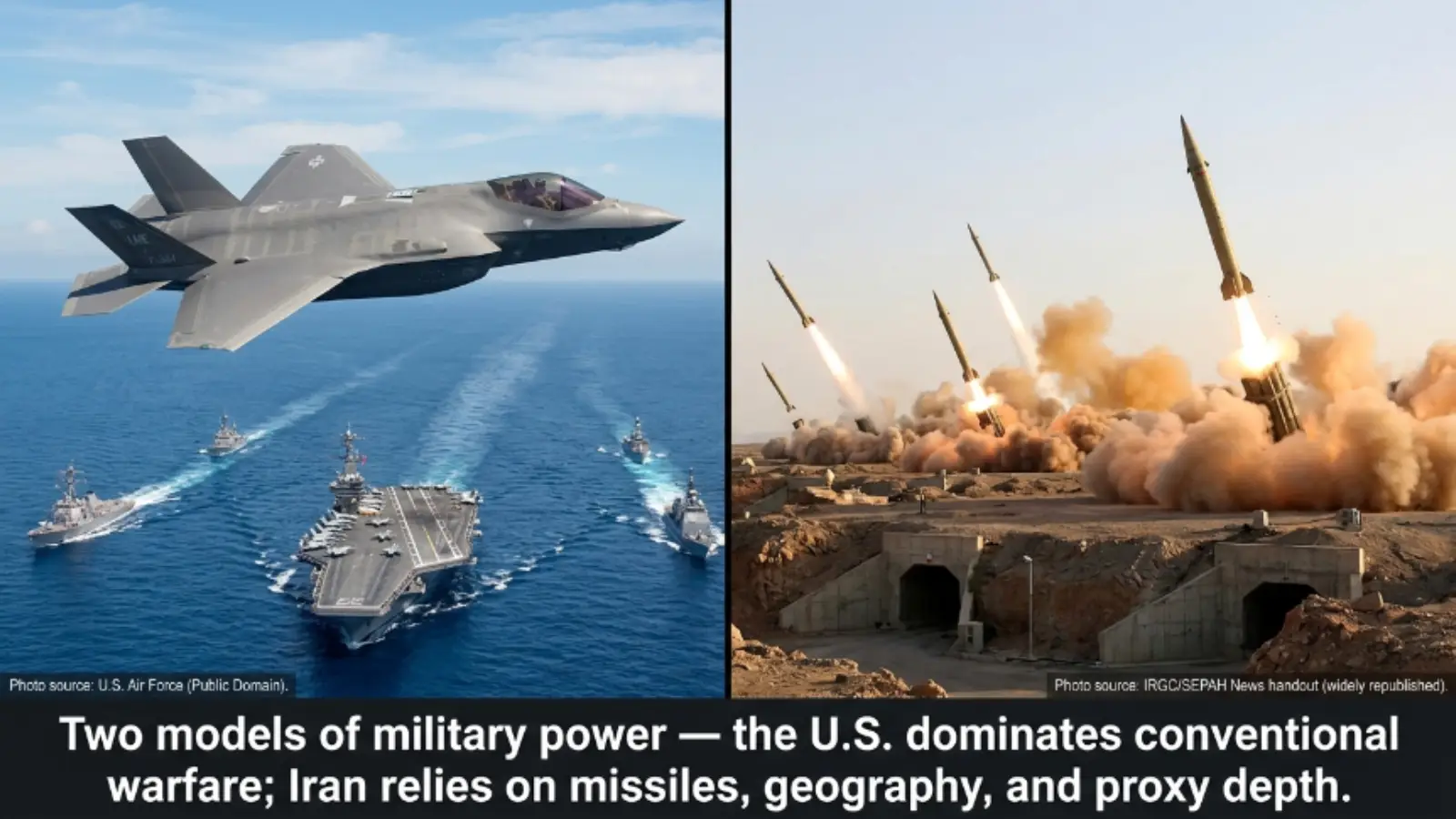
The United States fields the most powerful military force in human history. Iran fields the most capable asymmetric force in the Middle East. As active hostilities and ceasefire negotiations run in parallel through May 2026, this breakdown of US vs Iran military power examines what each side actually brings to the fight — and why the outcome of this conflict is not simply a function of who has the larger defense budget.
¦ KEY FACTS AT A GLANCE- The United States ranks #1 in global military power.
- Operation Epic Fury launched on February 28, 2026 — U.S. and Israeli forces struck nuclear infrastructure, missile production sites, and the compound of Supreme Leader Ali Khamenei, who was killed in the strikes.
- Iran possesses the largest ballistic missile arsenal in the Middle East — over 3,000 missiles — representing its primary strategic equalizer against U.S. air dominance.
- A fragile ceasefire has been in place since April 8, 2026, brokered by Pakistan — but both sides have violated it, and Strait of Hormuz clashes continued as recently as May 8, 2026.
- Trump called Iran’s latest counterproposal, submitted May 10, 2026, “TOTALLY UNACCEPTABLE” — leaving the conflict’s diplomatic resolution deeply uncertain.
US vs Iran War: Who Would Win? A 2026 Military Power Breakdown
The question of who would win a US vs Iran war is no longer entirely theoretical. Since late February 2026, American and Iranian forces have been engaged in a real — if constrained — military confrontation, with Operation Epic Fury reshaping the strategic landscape of the Middle East. As Pakistan-mediated ceasefire talks stall and the Strait of Hormuz remains a live flashpoint, this comparison of US and Iran military power in 2026 carries immediate operational relevance. Raw numbers tell part of the story. Context, doctrine, and geography tell the rest.
Where the Two Forces Stand in 2026
According to GlobalFirepower’s annually updated 2026 rankings, the United States holds a Power Index score of 0.0741 — ranking first among 145 nations — while Iran scores 0.3199, placing it 16th globally. That gap, however, compresses significantly when the analysis shifts from global force projection to regional conflict dynamics.
The U.S. military operates on a global scale with a worldwide network of bases, while Iran focuses its considerable resources on regional influence in the Middle East. This is not merely a structural difference — it is the defining strategic divergence between the two militaries, shaping every domain from air power to naval posture to cyber operations.
Air Power: The United States Holds Decisive Superiority
The air power gap is arguably the most decisive asymmetry in any US vs Iran military comparison. The United States operates approximately 13,300 aircraft — including 5th-generation F-22 and F-35 stealth fighters — while Iran’s air force fields roughly 500 aircraft, many of which date to Shah-era purchases from the 1970s.
The 2025 conflict with Israel provided a live demonstration of just how severe that gap is. A senior Iran analyst at the International Crisis Group noted following the June 2025 war that “Iran’s air defenses are no match for the US and Israeli air power.” Earlier, Israeli strikes in October 2024 reportedly destroyed most of Iran’s air defense network, including nearly all of its advanced S-300 systems, long-range surface-to-air batteries, and detection radars.
Iran has attempted to compensate through Russian and Chinese partnerships. China has transferred offensive drones, loitering munitions, and air-defense systems — including variants of the HQ-16 and HQ-17 surface-to-air missile families — while Beijing has also reportedly supplied rocket fuel chemicals sufficient to power hundreds of mid-range ballistic missiles. These transfers meaningfully extended Iran’s strike capabilities but did not close the fundamental air superiority gap.
Iran’s Real Equalizer: Missiles, Drones, and Underground Arsenals
Where Iran genuinely narrows the power differential is in its missile and drone programs. Iran holds the largest ballistic missile arsenal in the Middle East — over 3,000 missiles — and the geographic proximity of U.S. regional bases means those weapons do not require intercontinental range to carry strategic significance.
The Islamic Revolutionary Guard Corps (IRGC) has built extensive “missile cities” deep underground to survive airstrikes, and Iran is surrounded by the Zagros and Alborz mountain ranges, which act as massive natural barriers limiting viable land invasion routes to a narrow few. This combination of hardened infrastructure and challenging terrain makes Iran one of the most difficult military targets in the world — as U.S. planners discovered firsthand during Operation Epic Fury.
Iranian drone doctrine has also evolved considerably. Tehran has developed and deployed large swarms of one-way attack drones — the Shahed family being the most notable — and has supplied these systems to proxy forces across the region, creating a distributed, resilient strike capability that no single air campaign can easily eliminate.
The Proxy Network: Iran’s Strategic Depth
No honest assessment of Iran military power in 2026 can ignore its proxy network, which functions as a force multiplier across at least seven countries. Hezbollah, Iran’s premier proxy, operates as a state-within-a-state in Lebanon with its own military command structure, social services apparatus, and a substantial missile arsenal. Even after Israel’s sustained targeting of Hezbollah leadership — including the killing of Secretary-General Hassan Nasrallah in September 2024 — the organization reconstituted command authority and rebuilt combat capability under successor Naim Qassem.
Iran has increasingly relied on a dual strategy combining foreign-backed military capability with an entrenched proxy network across the Middle East. When Operation Epic Fury struck Iran’s homeland on February 28, the proxy response was near-simultaneous — demonstrating that Tehran’s strategic depth is not simply a deterrent but an active operational instrument.
The Foundation for Defense of Democracies documented in February 2026 that Israeli forces were still killing Hezbollah operatives actively rebuilding military infrastructure south of the Litani River just days before Operation Epic Fury was launched — evidence that the proxy network’s regenerative capacity presents a durable challenge that kinetic strikes alone cannot resolve.
Naval Warfare and the Strait of Hormuz
The Strait of Hormuz remains the single most consequential chokepoint in the conflict. Iran’s three Kilo-class submarines — purchased from Russia in the 1990s — are diesel-electric boats that are exceptionally quiet when operating on battery power in shallow Gulf waters, creating a submarine threat that U.S. anti-submarine warfare assets cannot dismiss. Iran’s fast-attack craft, missile corvettes, and mine-laying capabilities are purpose-built for Hormuz warfare, not blue-water competition with U.S. carrier groups.
The consequences have been severe. By March 10, 2026, only 15 ships made it through the Strait of Hormuz before the United States imposed a naval blockade. Iran subsequently closed the Strait to all foreign shipping and captured several foreign-flagged vessels. The economic disruption has been global — and this is precisely the leverage Iran calculated it could exercise even against a vastly superior conventional adversary.
The 2026 Conflict: What the Fighting Has Revealed
The theoretical has become operational. On February 28, 2026, U.S. and Israeli forces struck targets across Tehran, Isfahan, Qom, Karaj, and Kermanshah — targeting nuclear infrastructure, missile production facilities, and the compound of Supreme Leader Ali Khamenei, who was killed in the strikes. Iran responded with missile and drone strikes against Israel, U.S. bases, and allied countries in the Middle East, while closing the Strait of Hormuz.
In the wider regional escalation, Qatar was targeted by over 200 missiles and drones, Saudi Arabia absorbed at least 38 missiles and 435 drones, and Jordan was struck by a combined 204 missiles and drones. The scale of Iran’s retaliatory salvo underscored that its missile arsenal, while degraded, retained significant operational reach even after sustained strikes on production facilities.
A fragile ceasefire, brokered by Pakistan, took hold on April 8, 2026. But as of May 11, 2026, the diplomatic picture remains deeply uncertain. The U.S. sent Iran a 14-point proposal requiring Tehran to halt all uranium enrichment for at least 12 years and surrender its estimated 440kg stockpile of uranium enriched to 60 percent. Iran’s counterproposal, submitted May 10, focused on ending regional hostilities, maritime security in the Gulf, nuclear negotiations, and sanctions relief. Trump immediately called the response “TOTALLY UNACCEPTABLE.”
Analytical Assessment: Who Would “Win”?
The honest answer to the us vs iran war question is that the framing itself requires qualification. The United States would win any conventional, force-on-force engagement by a large margin — the combination of 5th-generation airpower, carrier strike groups, precision munitions, and global logistics creates an asymmetry that Iran’s military planners have never sought to overcome on those terms.
What Iran has instead built is a military designed to make winning costly, protracted, and strategically ambiguous. Iran’s doctrine is built around imposing costs rather than winning pitched battles, with an asymmetric framework honed across decades of preparation against a technologically superior adversary. The 2026 conflict has validated this approach: U.S. and Israeli forces struck Iran’s nuclear program and killed its supreme leader, yet the proxy network endures, the Strait of Hormuz remains contested, and diplomatic resolution has proven elusive.
Victory in a conventional sense — full territorial control, elimination of Iran’s military capacity, regime replacement — would require a ground campaign that no senior U.S. military planner has publicly advocated. The mountains, the missile cities, the proxy depth, and the global economic consequences of a prolonged Hormuz closure all counsel against that option. What the 2026 conflict has demonstrated, in operational terms, is that the U.S. can decisively degrade Iran’s conventional and nuclear infrastructure — but that degrading and defeating are not the same thing.
FAQs
Who would win a direct US vs Iran conventional war in 2026?The United States holds an overwhelming conventional military advantage across air power, naval capability, and precision strike. In a force-on-force confrontation, the U.S. would dominate. However, Iran’s missile arsenal, geography, and proxy networks ensure that “winning” would come at considerable cost and strategic complexity.
What is Iran’s biggest military strength against the U.S.?Iran’s ballistic missile arsenal — the largest in the Middle East with over 3,000 missiles — combined with its proxy network spanning Lebanon, Yemen, Iraq, and Syria, and its ability to disrupt the Strait of Hormuz, represent its most effective strategic tools against a superior adversary.
Has the US already fought Iran in 2026?Yes. Operation Epic Fury on February 28, 2026 saw U.S. and Israeli forces strike nuclear and missile sites across Iran. A ceasefire brokered by Pakistan took effect on April 8, though both sides have continued to violate it, including naval clashes in the Strait of Hormuz as recently as May 8, 2026.
How does Iran’s air force compare to the United States?There is no realistic comparison. The U.S. operates approximately 13,300 aircraft including F-22 and F-35 stealth fighters. Iran’s fleet of roughly 500 aircraft includes many aging Shah-era platforms. Iran’s air defenses were also heavily degraded in 2024 and 2025 Israeli strikes.
Can Iran close the Strait of Hormuz against the U.S. Navy?Iran cannot permanently seal the Strait against U.S. naval power, but it can significantly disrupt traffic in the short to medium term using mines, fast-attack craft, shore-based anti-ship missiles, and submarines — as demonstrated in March 2026 when shipping through the Strait was reduced to 15 vessels per day.
U.S. Iran Blockade Pressure Continues During Ceasefire
The Iran blockade remains a central pillar of U.S. strategy as Washington pressures Tehran during an uneasy ceasefire. U.S. Defense Secretary Pete Hegseth said American forces are prepared to restart combat operations if negotiations fail, while also maintaining maritime restrictions aimed at Iranian trade and military-linked shipping.
Speaking at the Pentagon, Hegseth said Iran should choose wisely as diplomatic talks continue. He added that U.S. forces are rearming and positioned to strike strategic infrastructure if directed by President Donald Trump.
¦ KEY FACTS AT A GLANCE- Defense Secretary Pete Hegseth said U.S. forces remain ready to resume combat if talks with Iran fail.
- Washington described the naval blockade as ongoing economic and military pressure during the ceasefire.
- U.S. officials warned Iranian power and energy infrastructure could be targeted if ordered.
- The Strait of Hormuz remains central to negotiations due to its global energy importance.
- Regional stability now depends on whether temporary ceasefire talks become a broader settlement.
Why The Iran Blockade Matters Now
The current blockade goes beyond symbolic pressure. Reuters reported that thousands of U.S. personnel and multiple warships are involved in enforcement measures tied to Iranian maritime activity. Several vessels have reportedly turned away rather than risk interception.
That matters because Iran relies heavily on sea lanes for energy exports and imports. Sustained pressure at sea can create economic strain without immediately escalating to a broader air campaign.
From a defense planning perspective, this reflects a familiar U.S. approach, using naval dominance to shape negotiations before committing to larger kinetic action.
Strait Of Hormuz Still A Global Flashpoint
The Strait of Hormuz remains one of the most sensitive waterways in the world. A major share of global oil shipments moves through the narrow passage, making any disruption a global economic issue.
Washington has tied parts of its demands to reopening secure commercial navigation routes. Even limited uncertainty in Hormuz can move energy prices and affect allied economies.
This gives the Iran blockade strategic value beyond the immediate conflict. It is not only about Iran, it is also about preserving freedom of navigation and deterring future coercion.
Military Readiness After Operation Epic Fury
The Pentagon has also framed current force posture as a continuation of pressure following Operation Epic Fury, the recent U.S. campaign against Iranian targets. Officials say forces in theater remain ready if diplomacy collapses.
That suggests no rapid drawdown is imminent. Carrier groups, missile defense assets, and regional airpower likely remain on standby to respond to missile launches, attacks on shipping, or renewed proxy activity.
For military planners, this is a deterrence phase backed by combat-ready forces.
What Comes Next
The next few days are likely to determine whether the Iran blockade becomes leverage for a negotiated settlement or the opening stage of renewed conflict.
If talks progress, maritime restrictions could eventually ease in exchange for security guarantees. If talks fail, Washington has openly signaled that military options remain available.
Either way, the Iran blockade has become the key pressure tool shaping the next phase of the crisis.
U.S. Naval Blockade of Iran Enters Full Effect After Islamabad Talks Collapse
The U.S. naval blockade of Iran entered full force on April 13, 2026, following the breakdown of peace negotiations in Islamabad and a direct order from President Donald Trump to the U.S. Navy to interdict all maritime traffic linked to Iranian ports. U.S. Central Command confirmed the operation effective at 10:00 a.m. ET, deploying more than 15 warships to enforce what constitutes the most expansive American maritime interdiction operation since the Gulf War era.
¦ KEY FACTS AT A GLANCE- U.S. Central Command activated a full naval blockade of Iran on April 13, 2026, covering all Iranian ports along the Arabian Gulf and Gulf of Oman, effective at 10:00 a.m. ET.
- More than 15 U.S. warships are currently enforcing the blockade; vessels entering or departing Iranian ports without authorization are subject to interception, diversion, and capture.
- NATO allies, the United Kingdom, and most Western partners have declined to participate, limiting the blockade to a largely unilateral U.S. military operation backed by Israel.
- Over 60 percent of Iran’s IRGC fast-attack craft fleet remains intact, posing an ongoing operational challenge to full enforcement of the blockade at the strait level.
- Operation Epic Fury, which began February 28, has cost an estimated $25–$35 billion; mediators from Pakistan, Egypt, and Turkey continue efforts to broker a ceasefire deal.
The Big Picture
The naval blockade of Iran does not exist in a vacuum. It is the latest escalation in a military conflict — Operation Epic Fury — that began February 28, 2026, following coordinated U.S.-Israeli strikes against Iranian targets. The strait has been effectively closed to most commercial traffic since Iran deployed mines and leveraged its Revolutionary Guard Corps (IRGC) fleet to control access, choking off roughly 20 percent of the world’s seaborne oil supply. This blockade represents Washington’s attempt to turn Iran’s own chokepoint strategy against Tehran — using naval power to deny Iran the economic leverage it has wielded through control of the Strait of Hormuz.
For the United States, the Strait of Hormuz has long been identified as the most critical maritime vulnerability in the Persian Gulf theater. The decision to enforce a full blockade rather than simply contest Iran’s access represents a significant doctrinal escalation: the U.S. is no longer seeking to reopen the strait for all traffic — it is actively closing it to Iranian commerce.
What’s Happening
CENTCOM announced it would enforce the blockade starting April 13, 2026, at 10:00 a.m. ET, targeting all maritime traffic connected to Iranian ports along both the Arabian Gulf and Gulf of Oman.
Any vessel entering or departing the blockaded area without authorization is subject to interception, diversion, and capture, according to a notice sent to mariners. CENTCOM clarified that neutral transit passage through the Strait of Hormuz to non-Iranian destinations remains permitted, though vessels may encounter U.S. military forces, directed communications, or boarding procedures.
The Wall Street Journal reported that more than 15 U.S. warships are currently participating in the enforcement operation. The aircraft carrier USS George H.W. Bush is transiting through the Strait of Gibraltar and is expected to reach the eastern Mediterranean before the end of the week, reinforcing the third carrier strike group now moving toward the CENTCOM area of responsibility.
Lloyd’s List Intelligence confirmed that shipping through the Strait of Hormuz came to a standstill following Trump’s announcement of the blockade.
Why It Matters
The imposition of a formal naval blockade carries enormous legal, operational, and geopolitical weight. Under international law, a blockade is an act of war — a fact that Iran’s armed forces were quick to invoke. An Iranian Armed Forces spokesperson stated that restricting vessels in international waters is illegal and described the action as amounting to piracy.
From a military standpoint, the blockade targets Iran’s two remaining economic lifelines: oil export revenues and the toll income Tehran has been collecting from commercial vessels seeking safe passage through the strait. Iran’s parliamentary speaker Mohammad Bagher Ghalibaf publicly warned that the blockade would drive U.S. gasoline prices significantly higher, suggesting Iran views energy price inflation as a retaliatory lever against domestic American opinion.
The blockade also places the U.S. in direct confrontation with Chinese energy interests. Chinese Defense Minister Adm. Dong Jun stated that China has trade and energy agreements with Iran, that Chinese ships are actively transiting the strait, and that Beijing expects those agreements to be honored. This is not a peripheral concern. Iran supplies a significant share of China’s oil imports, and Beijing’s economy faces mounting stress as the strait closure drags on.
Strategic Implications
The naval blockade of Iran is simultaneously a military operation and a coercive bargaining tool. Analysts tracking the Islamabad negotiations believe Washington is using the blockade to force Tehran into an agreement on American terms — particularly regarding uranium enrichment. According to Axios, the U.S. demanded a 20-year moratorium on uranium enrichment during the Islamabad talks, while Iran countered with a proposal measured in single digits.
Netanyahu confirmed that the core U.S. demand is the removal of all enriched material from Iran and a prohibition on further enrichment lasting potentially decades.
The strategic calculus for the Trump administration rests on a dual-pressure model: economic isolation through the blockade combined with the threat of resumed strikes. The Wall Street Journal reported that Trump and his advisers are considering resuming limited military strikes, while characterizing a full-scale bombing campaign as less likely given concerns about regional destabilization and the administration’s stated aversion to prolonged conflict.
Whether the blockade constitutes genuine strategic coercion or primarily serves as a domestic political signal depends on enforcement depth. A blockade that stops a trickle of vessels while leaving IRGC fast-attack craft free to operate will not decisively alter Iran’s economic calculus. The hard military question is whether 15-plus warships can enforce meaningful interdiction across the entirety of Iran’s Gulf and Gulf of Oman coastline — a substantial operational footprint that dwarfs the narrow Strait of Hormuz chokepoint.
Competitor View
Beijing’s response to the blockade carries the most significant long-term implications. China has not simply issued a diplomatic protest — its defense minister explicitly stated that Chinese vessels are transiting the strait and that Beijing will honor its commitments to Iran. CENTCOM declined to clarify its rules of engagement regarding Chinese vessels that might attempt to pass through the blockaded area.
This ambiguity is strategically dangerous. If a Chinese-flagged vessel or PLAN escort attempts to break the blockade, CENTCOM will face a real-time decision that could rapidly escalate beyond the Iran conflict. Beijing, for its part, faces its own pressure: every day the strait remains disrupted deepens Chinese energy insecurity and tests the credibility of the Sino-Iranian relationship.
Russia signaled a potential off-ramp by indicating readiness to accept Iran’s highly enriched uranium as part of a peace settlement, a move that — if genuine — could reduce the hardest U.S. demand: the removal of Iran’s nuclear material. Moscow’s offer may reflect less altruism toward Tehran than a calculated attempt to insert itself into the final settlement architecture and gain leverage over any post-conflict regional order.
Iran’s IRGC continues to threaten reciprocal action. The IRGC warned that approaching U.S. military vessels near the Strait of Hormuz constitutes a ceasefire violation, and Iranian state media threatened that no port in the region would be safe if the blockade continues.
What To Watch Next
The most immediate operational flashpoint is the status of IRGC fast-attack craft. According to Farzin Nadimi of the Washington Institute for Near East Policy, more than 60 percent of the IRGC’s fast-attack and speedboat fleet remains operational — the asymmetric force Iran uses to contest the strait through harassment, mining, and missile threats. Trump has threatened to destroy any IRGC vessel approaching the blockade perimeter.
The USS George H.W. Bush Carrier Strike Group’s arrival in the eastern Mediterranean this week will provide additional naval depth, though its primary role will likely be airpower projection rather than maritime interdiction.
Pakistani, Egyptian, and Turkish mediators plan to continue talks between Washington and Tehran in the coming days in an effort to bridge remaining gaps. Iran reportedly made contact with U.S. officials on April 13, signaling possible willingness to negotiate further. Whether these overtures translate into substantive movement on the uranium enrichment issue remains the decisive variable.
Mine clearance operations are the other critical near-term requirement. Trump indicated that NATO countries and the United Kingdom would provide minesweepers to clear the strait, though the U.K. government has since distanced itself from blockade participation. The operational timeline for clearing Iranian mines — which currently define the navigable routes through the strait — remains unknown.
Capability Gap
The blockade exposes a structural gap in U.S. maritime strategy: the difficulty of enforcing comprehensive interdiction against an adversary that relies on asymmetric, shallow-water naval tactics. The U.S. Navy excels at blue-water operations and carrier-strike power projection. Contesting IRGC fast-attack swarms in confined littoral waters — particularly in an environment seeded with mines — requires a different force mix: minesweepers, small surface combatants, maritime patrol aircraft, and persistent ISR coverage.
Trump claimed U.S. forces destroyed approximately 158 Iranian naval vessels since the conflict began, but the IRGC’s asymmetric fleet — specifically designed to survive attrition through dispersion and low signature — remains the primary threat to blockade enforcement. The administration’s acknowledgment that IRGC fast-attack craft were not considered a major threat may reflect confidence in U.S. surveillance and strike capabilities, but it also understates the operational complexity of policing hundreds of miles of Iranian coastline against a motivated irregular naval force.
The Bottom Line
The U.S. naval blockade of Iran represents the most consequential American maritime operation in decades — a high-stakes coercive gamble that will either force Tehran back to the negotiating table on Washington’s terms or trigger the next escalatory rung in a conflict that has already cost over $30 billion and drawn in the interests of China, Russia, and a fractured Western alliance.
U.S. Navy Begins Strait of Hormuz Blockade After Iran Nuclear Talks Collapse In Islamabad
The U.S. Navy has been ordered to blockade the Strait of Hormuz effective immediately, President Donald Trump announced on April 12, 2026, following the failure of direct U.S.–Iran peace talks in Islamabad, Pakistan. The decision marks a significant escalation of Operation Epic Fury and directly threatens a fragile two-week ceasefire that had allowed the first tanker transits from the Gulf in weeks.
¦ KEY FACTS AT A GLANCE- President Trump ordered the U.S. Navy to begin blockading the Strait of Hormuz “effective immediately” on April 12, 2026, following the collapse of direct U.S.–Iran talks in Islamabad, Pakistan.
- The Navy has been directed to interdict all vessels in international waters that have paid a toll to Iran, and to begin clearing Iranian mines from the strait.
- The Strait of Hormuz is a choke point for approximately 20 percent of global energy supplies; hundreds of tankers remain stranded in the Persian Gulf awaiting passage.
- Operation Epic Fury has been ongoing since February 28, 2026; Pentagon data as of April 8 reported 13 U.S. troops killed and 346 wounded.
- Iran’s core demands — control of the strait, war reparations, release of frozen assets, and recognition of its nuclear program — were rejected by the U.S. delegation led by Vice President JD Vance.
The Big Picture
The conflict between the United States and Iran entered a new and potentially decisive phase in April 2026. What began on February 28, 2026, with coordinated U.S. and Israeli air strikes on Iranian military and nuclear infrastructure has since evolved into a sustained campaign with meaningful human and economic costs on both sides.
The Strait of Hormuz sits at the center of this confrontation. Roughly 20 percent of global oil and liquefied natural gas supplies transit the strait, making it one of the most strategically sensitive maritime chokepoints on Earth. Iran moved to block the waterway early in the conflict, deploying mines and leveraging its geographic position along the northern shore to interdict commercial shipping. The ripple effects have sent global oil prices soaring and disrupted supply chains across Europe, Asia, and beyond.
The Islamabad talks represented the first direct high-level U.S.–Iran contact in over a decade. Their failure, and the subsequent blockade order, signals that Washington has concluded diplomacy cannot achieve its core objectives — free passage through the strait and the elimination of Iran’s nuclear weapons capability — within an acceptable timeframe.
What’s Happening
President Trump announced on April 12, 2026, via Truth Social that the U.S. Navy would begin blockading the Strait of Hormuz, ordering the interdiction of every vessel in international waters that had paid a toll to Iran and the destruction of Iranian mines in the strait.
Vice President JD Vance led the U.S. delegation at the weekend talks in Islamabad — the first direct U.S.–Iranian meeting in more than a decade and the highest-level discussions since the 1979 Islamic Revolution. The talks ended without agreement.
Iran’s Parliamentary Speaker Mohammad Baqer Qalibaf and Foreign Minister Abbas Araqchi led Tehran’s delegation. Qalibaf blamed the U.S. for failing to earn Iran’s trust despite what he described as “forward-looking initiatives” from his side.
Iran’s semi-official Tasnim news agency attributed the breakdown to what it called excessive U.S. demands, while other Iranian media reported that the Strait of Hormuz and Iran’s nuclear program remained the main unresolved points.
Despite the diplomatic collapse, three fully laden supertankers passed through the Strait of Hormuz on Saturday — apparently the first vessels to exit the Gulf since the ceasefire deal — while hundreds of tankers remained stranded in the Gulf awaiting passage.
Why It Matters
The blockade order is operationally and legally unprecedented in the modern era. The U.S. Navy has interdicted vessels before — most notably during the 1990 Gulf War embargo against Iraq — but a declared naval blockade of an active international transit corridor of this scale would carry profound consequences for maritime law, energy markets, and U.S. alliance relationships.
From a military standpoint, blockade enforcement requires sustained surface and subsurface presence in a contested, mine-threatened environment. The Navy’s Arleigh Burke-class destroyers, already operating in the Arabian Sea under Operation Epic Fury, would form the backbone of any interdiction force. Mine countermeasures vessels and maritime patrol aircraft — including P-8 Poseidons — would be essential to the mine-clearing mission Trump referenced.
The mine threat is significant. Iran has a substantial inventory of both moored contact mines and more sophisticated influence mines capable of defeating basic countermeasures. Clearing a waterway as wide and trafficked as the Hormuz strait under potential Iranian fire is a complex, time-consuming operation that cannot be executed overnight regardless of the presidential order’s “effective immediately” language.
Strategic Implications
The blockade announcement fundamentally changes the deterrence calculus in the Persian Gulf. By committing the Navy to active interdiction, the administration has staked American credibility on the outcome. Any Iranian attack on U.S. vessels enforcing the blockade will demand a military response, narrowing the diplomatic off-ramps available to both governments.
Pakistan’s Foreign Minister Ishaq Dar called it “imperative” to preserve the ceasefire agreed the previous Tuesday, and Israeli security cabinet minister Zeev Elkin warned that the Iranians were “playing with fire.”
The ceasefire now appears highly fragile. Iran has consistently tied any agreement to a regional-level cessation of hostilities, including Israeli operations against Hezbollah in Lebanon. Israel has continued bombing Hezbollah rocket launchers in Lebanon, insisting that conflict falls outside the Iran–U.S. ceasefire framework — a position Iran explicitly rejects. With combat operations continuing on a secondary front, Tehran has limited political incentive to accept U.S. terms on the strait or the nuclear file.
The economic dimension also deserves attention. Trump’s stated minimum objectives are free passage for global shipping through the strait and crippling Iran’s nuclear enrichment program. Achieving both simultaneously through military pressure alone — without a negotiated settlement — would require a degree of sustained operational intensity that risks widening the conflict beyond its current geographic scope.
Competitor View
China and Russia are watching the Hormuz crisis with a mix of strategic interest and economic exposure. Beijing imports a substantial share of its oil through the strait; any prolonged disruption to tanker traffic directly damages Chinese industrial output. Beijing has publicly called for diplomatic resolution, but has largely avoided taking sides — a posture that preserves Chinese leverage with both Washington and Tehran.
Moscow, meanwhile, benefits from elevated oil prices driven by the disruption. Russian energy revenues remain a critical prop for its defense budget and war economy. A prolonged Hormuz crisis that keeps global oil prices elevated serves Russian economic interests, even as the Kremlin publicly calls for de-escalation.
Iran’s threat perception will likely harden following the blockade announcement. Tehran has long framed its nuclear program as an existential deterrent. The combination of military strikes, a collapsing ceasefire, and a naval blockade order will reinforce the Iranian leadership’s conviction that only a nuclear deterrent can guarantee the regime’s survival — the precise dynamic the U.S. seeks to prevent.
What To Watch Next
The immediate operational question is how quickly the Navy can establish enforceable interdiction lines across the strait’s roughly 21-mile-wide navigable channel. Mine countermeasures operations will likely begin in parallel, with MCM vessels and explosive ordnance disposal teams working under surface and air cover.
Congressional reaction will also shape the operation’s legal and political durability. A sustained naval blockade of international waters constitutes an act of war under international law, and sustained enforcement may require formal authorization beyond an executive order. Whether the administration seeks AUMF-style authorization or proceeds on existing war powers authority will be a key variable.
Oil markets opened higher following the announcement, and Asian buyers — particularly in Japan, South Korea, and India — are likely to accelerate purchases of non-Gulf crude as insurance against prolonged supply disruption.
Diplomatically, Pakistan’s role as a neutral intermediary has been significant. Islamabad hosted the failed talks, and Pakistani officials have publicly pressed for ceasefire preservation. Whether a third round of negotiations is possible — potentially with broader mediator involvement — remains the central open question.
Capability Gap
The Hormuz blockade exposes a persistent tension in U.S. naval strategy: the gap between the ability to project overwhelming strike power and the slower, manpower-intensive work of sustained maritime interdiction in a contested environment.
The Navy’s surface combatant fleet has been under sustained pressure for years. Readiness challenges, deferred maintenance, and a shipbuilding industrial base that cannot keep pace with the fleet’s operational demands mean that prolonged high-intensity Persian Gulf operations will stretch available assets. Mine warfare remains an acknowledged weak point; the Navy has invested in improved countermeasures, but the force structure for sustained MCM operations in a conflict zone is thin.
Iran, meanwhile, retains asymmetric capabilities — fast attack craft, anti-ship missiles, coastal defense batteries, and submarine forces — that could threaten even Arleigh Burke-class destroyers operating in restricted Gulf waters. The Navy has managed these threats effectively in Operation Epic Fury so far, but a blockade posture that requires sustained presence close to Iranian shores increases exposure.
The Bottom Line
The U.S. Navy’s blockade of the Strait of Hormuz marks a strategic inflection point: Washington has moved from coercive strikes to active maritime control, and the durability of that posture — against Iranian resistance, allied concern, and domestic political constraints — will determine whether the operation achieves its core objective of restoring free navigation and halting Iran’s nuclear program.
Operation Epic Fury Ends: U.S. Forces Strike Over 13,000 Targets, Crushing Iran’s Military Capabilities in 38 Days
The White House confirmed this week that Operation Epic Fury, a 38-day U.S. military campaign targeting Iran, concluded with the systematic dismantling of Iran’s core military capabilities. American forces executed more than 10,200 air sorties and struck over 13,000 individual targets — a scale of precision warfare rarely seen in the post-Cold War era. The operation ended with Tehran agreeing to a ceasefire and the reopening of the strategically vital Strait of Hormuz.
¦ KEY FACTS AT A GLANCE- Operation Epic Fury lasted 38 days and involved more than 10,200 air sorties conducted by U.S. joint forces against Iran.
- Over 13,000 targets were struck across Iran’s military infrastructure, including command centers, air defense networks, and naval assets.
- More than 85% of Iran’s defense industrial base was reported destroyed, and daily Iranian air flight activity was reduced to zero.
- 150 Iranian naval vessels were destroyed across multiple classes, and Iran’s submarine force was fully eliminated.
- The campaign concluded with Iran agreeing to a ceasefire and reopening the Strait of Hormuz to international shipping.
What Was Operation Epic Fury?
Operation Epic Fury was a concentrated, joint-force military campaign ordered by President Trump on February 28, 2026. According to Gen. Dan Caine, Chairman of the Joint Chiefs of Staff, the operation was built around three primary military objectives: neutralizing Iran’s ballistic missile and drone arsenals, dismantling the Iranian Navy, and destroying Iran’s defense industrial base to permanently eliminate its capacity to project military power beyond its own borders.

The White House reported that U.S. forces struck more than 13,000 targets during the 38-day campaign, which involved over 10,200 air sorties. What made this operation particularly notable was not just its breadth, but the systematic, layered approach used to simultaneously collapse multiple pillars of Iranian military power within a compressed operational timeline.
Target Categories: A Sweeping Dismantlement
The scope of targets engaged during Operation Epic Fury reveals a deliberate strategy to degrade Iran’s military at every functional layer:
Command & Control: More than 2,000 command and control sites were struck, disrupting the coordination networks Iran relies upon to synchronize military operations across its conventional forces and proxy networks throughout the region.
Air Defense & Missile Infrastructure: Over 1,500 air defense systems and more than 450 ballistic missile-related sites were targeted, gutting Iran’s ability to defend its own airspace and deploy the long-range strike capabilities that have long posed a threat to U.S. partners in the Gulf.
Drone Capabilities: Approximately 800 attack drone targets were struck — a pointed response to Iran’s established role as a leading supplier of low-cost attack drones to armed groups across the Middle East and to Russia during the Ukraine conflict.
Naval Forces: More than 600 naval targets were engaged, with 150 vessels destroyed across multiple classes and Iran’s submarine capability fully eliminated.
Mine Warfare: Over 700 mine systems were destroyed, directly addressing one of Iran’s most asymmetric tools for threatening Gulf shipping lanes.
Defense Industrial Base: More than 1,450 defense and industrial base targets were struck, with officials reporting that over 85% of Iran’s defense industrial capacity had been destroyed.
Defensive Intercepts: The Battle Above Iranian Airspace
The campaign was not entirely one-directional. U.S. forces intercepted more than 1,000 incoming drone threats and over 700 ballistic missiles during the course of operations — a figure that underscores both the intensity of Iranian resistance and the effectiveness of American missile defense systems in a live, high-threat environment. This volume of successful intercepts represents one of the most significant real-world tests of layered U.S. air and missile defense architecture in history, providing invaluable operational data that defense planners will analyze for years.

Senior Officials Declare Objectives Met
Gen. Caine was direct in his assessment of the outcome. Over the course of 38 days of major combat operation, the joint force achieved the military objectives as defined by the President,” he stated, adding that the campaign methodically degraded Iran’s capacity to conduct offensive military operations.
White House Press Secretary Karoline Leavitt framed the result in broader terms, stating that the operation had achieved and exceeded its stated objectives within the planned four-to-six-week window. Secretary of Defense Pete Hegseth also highlighted the campaign’s conclusion, noting that “Iran begged for this ceasefire,” and crediting President Trump’s decision-making as central to the outcome.
Space and Advanced Weapons Programs Hit Hard
Beyond conventional military targets, the operation also degraded Iran’s space-related infrastructure, with approximately 70% of those facilities reported destroyed or rendered inoperable. This aspect of the campaign signals a deliberate effort to close off future Iranian pathways to satellite-enabled intelligence, reconnaissance, and ballistic missile guidance — capabilities that would have allowed Tehran to reconstitute a credible long-range strike posture even after suffering conventional military losses.
The Strait of Hormuz: A Strategic Endgame
Perhaps the most consequential strategic outcome of Operation Epic Fury is the reopening of the Strait of Hormuz. Approximately 20% of the world’s traded oil transits this narrow waterway daily, and Iranian threats to close it have for decades served as a powerful leverage point in regional geopolitics. With the strait now open and Iran’s naval forces largely neutralized, global energy markets have seen immediate pressure ease — a tangible economic dividend from the military campaign.
Analysis: What Operation Epic Fury Signals for Future Warfare
Operation Epic Fury represents a watershed moment in how the United States conducts large-scale, high-tempo conventional military operations. The combination of over 10,200 sorties, precision strike packages against 13,000+ discrete targets, and simultaneous large-scale ballistic missile defense in a live combat environment places this campaign in a category alongside Operation Desert Storm in terms of its doctrinal significance.
Several lessons stand out for defense analysts. First, the campaign demonstrated that the U.S. joint force can sustain an extraordinarily high operational tempo against a peer-regional military adversary with meaningful air defense capabilities — and do so with sufficient precision to isolate military targets from broader civilian infrastructure. Second, the successful intercept of more than 700 ballistic missiles in a single campaign validates years of investment in layered missile defense architecture, particularly THAAD, Patriot, and naval Aegis-based systems. Third, the deliberate targeting of Iran’s defense industrial base — rather than simply its deployed forces — reflects an evolving U.S. doctrine aimed at preventing reconstitution, not just winning the immediate engagement.

The campaign also raises critical questions for adversaries watching closely. China, Russia, and North Korea will be intensively studying the degradation sequence used against Iran’s integrated air defense, missile, naval, and industrial capabilities. The speed with which a modern, reasonably well-armed regional power was effectively disarmed in under six weeks will recalibrate threat assessments in capitals from Beijing to Pyongyang. Whether the long-term political settlement matches the military outcome, however, remains the defining open question of this chapter in Middle Eastern history.
Ceasefire and the Road Ahead
The campaign’s conclusion with a ceasefire agreement and Hormuz reopening marks the immediate end of hostilities, but the diplomatic architecture required to translate this military outcome into durable regional stability remains entirely unbuilt. Iran retains its territory, its government, and a population that — regardless of political orientation — will likely view this period as a national trauma. Reconstruction of Iran’s military will be constrained for years by the destruction of its industrial base, but the underlying geopolitical drivers of regional tension have not been eliminated. American policymakers now face the harder task: converting an overwhelming military victory into a lasting strategic outcome.
FAQs
What was Operation Epic Fury?Operation Epic Fury was a 38-day U.S. military campaign launched on February 28, 2026, targeting Iran’s ballistic missile capabilities, naval forces, drone arsenals, and defense industrial infrastructure. It concluded with a ceasefire and the reopening of the Strait of Hormuz.
How many targets did U.S. forces strike during Operation Epic Fury?U.S. forces struck more than 13,000 targets across Iran, supported by over 10,200 air sorties conducted by the joint force.
What percentage of Iran’s defense industrial base was destroyed?White House officials stated that more than 85% of Iran’s defense industrial base was destroyed or severely damaged during the campaign.
How did U.S. forces handle Iranian missile and drone attacks during the operation?American forces intercepted more than 1,000 incoming Iranian drones and over 700 ballistic missiles during the 38-day campaign, representing one of the largest real-world tests of U.S. layered missile defense systems in history.
Why is the Strait of Hormuz significant to this conflict?The Strait of Hormuz is one of the world’s most critical energy chokepoints, through which approximately 20% of globally traded oil passes daily. Iran’s agreement to reopen the strait following the ceasefire is considered a major strategic and economic outcome of the operation.
What happened to Iran’s naval capabilities?U.S. forces destroyed 150 Iranian naval vessels across multiple classes and fully eliminated Iran’s submarine force during the operation.
B-2 Spirit Drops GBU-57 Bunker Busters On IRGC Command Compound In Tehran During Operation Epic Fury
U.S. B-2 Spirit stealth bombers struck an underground Islamic Revolutionary Guard Corps command bunker near Tehran on April 7, 2026, using GBU-57 Massive Ordnance Penetrator bombs, The Wall Street Journal reported. The strike was executed as part of Operation Epic Fury — an active U.S. campaign that simultaneously included the combat recovery of a downed American airman inside Iranian territory, one of the most complex concurrent operations in recent American military history.
¦ KEY FACTS AT A GLANCE- U.S. B-2 Spirit stealth bombers struck a hardened underground IRGC command compound in Tehran on April 7, 2026, according to The Wall Street Journal.
- The aircraft reportedly employed the GBU-57 Massive Ordnance Penetrator — a 30,000-pound precision hard-target defeat weapon engineered specifically to destroy deeply buried, reinforced facilities.
- The mission was ordered by CENTCOM commander Admiral Brad Cooper after intelligence reportedly identified a high concentration of senior IRGC leaders inside the bunker — indicating a dynamic, time-sensitive targeting decision rather than a pre-planned strike.
- The B-2 sortie launched from Whiteman Air Force Base, Missouri, requiring intercontinental range, aerial refueling support, and a round-trip penetration of Iranian airspace — demonstrating the full reach of U.S. homeland-based power projection.
- The strike formed part of Operation Epic Fury, which simultaneously included the rescue of a downed U.S. F-15E airman inside Iran and supporting interdiction strikes to suppress Iranian ground forces in the recovery corridor.
The Big Picture
Washington’s willingness to apply strategic long-range bombers against hardened leadership targets deep inside Iran reflects a fundamental shift in how U.S. CENTCOM has approached Iranian military infrastructure. For years, deterrence against Iran rested primarily on regional air presence, carrier strike groups, and the implicit threat of escalation. Operation Epic Fury suggests a posture that has moved beyond deterrence by denial and toward active, kinetic suppression of Iran’s most protected command architecture — including deeply buried sites within the capital.
That shift carries meaning well beyond the immediate tactical outcome. The B-2 Spirit remains the sole operational platform capable of combining low-observable penetration of advanced air defense environments with the carriage and precision delivery of the GBU-57 MOP. When Washington deploys that specific combination against targets near Tehran, it signals a willingness to match the most demanding aimpoints in the Iranian target set with the most capable conventional weapons in the American inventory.
B-2 Spirit and GBU-57 in Operation Midnight Hammer, June 2025
What’s Happening
CENTCOM commander Admiral Brad Cooper ordered B-2 bombers to conduct a round-trip strike mission from Whiteman Air Force Base in Missouri after intelligence reportedly pinpointed a significant gathering of senior IRGC commanders inside a hardened underground compound in Tehran. According to The Wall Street Journal, the decision was driven by time-sensitive targeting data — meaning the window to strike the leadership concentration was narrow and required rapid command authorization, rapid aircraft tasking, and sustained aerial refueling support across intercontinental distance.
Each B-2 released GBU-57 Massive Ordnance Penetrators against the bunker. The GBU-57 is a 30,000-pound GPS-guided weapon with a hardened steel casing and a delayed fuze designed to penetrate multiple meters of earth and reinforced concrete before detonating. It is not a general-purpose munition. Its development was driven explicitly by the requirement to defeat the type of deeply buried, purpose-built command and weapons facilities that Iran, North Korea, and other adversaries have invested in for decades.
The mission unfolded while separate U.S. forces were executing a combat search and rescue operation to recover a downed F-15E Strike Eagle aircrew member inside Iran — a personnel recovery mission that itself required American bombers to drop approximately one hundred 2,000-pound bombs to suppress Iranian forces attempting to intercept the rescue corridor.
Why It Matters
The operational significance of this strike rests on three converging elements: what was targeted, what was used, and when it happened.
Targeting an IRGC command bunker near Tehran during an active personnel recovery operation means U.S. forces were simultaneously managing at least two high-risk, high-complexity mission threads inside Iranian territory at the same moment. That level of concurrent joint-force integration — dynamic leadership targeting layered on top of combat rescue — reflects the maturity and responsiveness of the American kill chain in a contested, rapidly evolving operational environment.
The selection of the GBU-57 confirms that the target was assessed as deeply hardened. Standard 2,000-pound penetrating bombs are capable against moderate protection, but the IRGC has constructed facilities specifically designed to survive conventional bombardment. Only the MOP — carried exclusively by the B-2 — provides the combination of mass, penetration geometry, and fuze delay necessary to defeat such structures with conventional ordnance.
The launch from Whiteman AFB rather than a forward theater base is equally deliberate. It demonstrates that the United States can generate power projection directly from the continental homeland without requiring in-region basing that could be denied, threatened, or politically complicated. For planners in Tehran, that removes one of the key assumptions behind Iranian A2/AD strategy: that U.S. airpower depends on vulnerable regional airfields to generate sustained strike sorties.
Strategic Implications
This mission accelerates the erosion of a core Iranian strategic assumption — that underground military architecture provides meaningful sanctuary for senior leadership and command nodes.
Iran has invested heavily in buried facilities over decades. The logic was straightforward: depth and reinforced construction would preserve regime command continuity under air attack, effectively holding a critical element of Iranian military capacity beyond the reach of conventional American airpower. The June 2025 Operation Midnight Hammer already challenged that assumption by marking the first confirmed combat employment of the GBU-57 against hardened Iranian nuclear facilities. The April 2026 strike against the IRGC command bunker near Tehran extends that logic directly to protected leadership infrastructure.
The implications for Iranian force posture are significant. If the IRGC can no longer rely on fixed underground compounds as secure command centers during a conflict, it must adapt — dispersing leadership more widely, shifting to mobile command platforms, reducing the concentration of senior officers in any single location, and accepting the degraded coordination that comes with that dispersal. None of these adaptations are costless. Greater dispersion reduces coherence. Mobile command platforms are harder to secure and easier to detect. The tradeoff between survivability and command effectiveness becomes a permanent operational tension.
For U.S. deterrence signaling, the strike delivers a message that is precise, concrete, and unmistakable: the combination of B-2 Spirit penetration and GBU-57 hard-target defeat capability can be applied against deeply buried command sites in the Iranian capital on compressed timelines, driven by real-time intelligence, and executed from the American homeland.
Competitor View
For China and Russia, both of which maintain extensive hardened underground military facilities — including leadership bunkers and nuclear command infrastructure — the B-2 and GBU-57 pairing carries a sobering deterrent signal. The demonstrated willingness of the United States to employ its deepest-penetrating conventional ordnance against protected command sites in a real operational context, rather than in exercise scenarios, sharpens the credibility of American hard-target defeat capability in any future high-end contingency.
Beijing’s People’s Liberation Army operates numerous deeply buried strategic facilities, and Chinese defense planners will have noted both the weapon employed and the dynamic, intelligence-driven targeting cycle that preceded the strike. Moscow similarly maintains Cold War-era and more recent deep underground command complexes. Both capitals now have updated empirical evidence that U.S. conventional hard-target defeat capability has moved from validated testing into active combat use against a non-nuclear regional adversary.
For Iran specifically, the strike against an IRGC command node — not merely nuclear or missile infrastructure — indicates that Washington views the IRGC’s protected command architecture as a legitimate conventional target set during active hostilities. That broadens the perceived target menu and further compresses Iranian confidence in the survivability of command-and-control during a sustained U.S. air campaign.
What To Watch Next
The immediate follow-on questions center on battle damage assessment and Iranian operational response. Independent confirmation of the physical damage inflicted on the IRGC bunker will take time, and the U.S. government has not issued a formal official statement as of this publication. Commercial satellite imagery of the affected area near Tehran will likely provide initial indicators.
Strategically, the pace of subsequent U.S. strike activity within Operation Epic Fury — and whether Washington signals any pause linked to diplomatic signaling — will indicate whether the current campaign posture is oriented toward coercive pressure or toward sustained degradation of Iranian military capability. The U.S. has also not publicly defined the operational boundaries or stated objectives of Epic Fury, leaving Iranian and regional interlocutors to assess U.S. intentions based primarily on the actions observed.
Capability Gap
The GBU-57 Massive Ordnance Penetrator was developed because no previous conventional weapon in the American inventory could reliably defeat the class of hardened and deeply buried facilities that Iran, North Korea, and other actors have constructed specifically to survive standard munitions. The B-2 was already the only aircraft large enough and stealthy enough to carry the MOP into contested airspace, but the weapon languished as a contingency asset through most of the previous decade.
Operation Midnight Hammer in June 2025 closed the gap between validated capability and operational credibility. The April 2026 IRGC bunker strike confirms that GBU-57 employment is now an established tool in the active U.S. operational playbook — not a threshold reserved exclusively for existential scenarios.
The realistic limitation is inventory depth. The GBU-57 is a specialized, expensive, and low-volume munition. Sustained employment in a prolonged campaign would draw down available stocks. The degree to which the United States has expanded MOP production or pre-positioned additional units since Midnight Hammer remains classified, but inventory management will be a real planning constraint in any extended hardened-target campaign.
The Bottom Line
The reported B-2 Spirit strike against a hardened IRGC command bunker near Tehran with GBU-57 Massive Ordnance Penetrators confirms that the United States has integrated deep-strike hard-target defeat into active, time-sensitive, concurrent operations — fundamentally undermining the strategic logic that underground military architecture provides durable sanctuary for Iranian leadership.
U.S. Tomahawk Missile Stockpile Faces Pressure After Record Expenditure in Iran Campaign
The United States has fired at least 850 Tomahawk long-range cruise missiles in just over one month of Operation Epic Fury, the joint U.S.-Israeli military campaign against Iran — a figure that marks the highest single-campaign expenditure of the weapon in its four-decade operational history. The burn rate has prompted serious concern among Pentagon planners and defense analysts, not primarily over the current conflict, but over what depletion means for U.S. deterrence commitments elsewhere — most critically in the Indo-Pacific.
¦ KEY FACTS AT A GLANCE- The U.S. has launched at least 850 Tomahawk cruise missiles in just over one month of Operation Epic Fury, the joint U.S.-Israeli campaign against Iran — the highest expenditure rate in any single conflict in the missile’s operational history.
- The Center for Strategic and International Studies (CSIS) estimates the U.S. retains roughly 3,000 Tomahawks, meaning the current campaign has consumed approximately 28% of the total estimated inventory.
- Each Tomahawk Block V costs approximately $3.5 million and carries a 1,000-pound warhead with a range exceeding 1,000 miles — making it one of the most capable and expensive conventional strike weapons in the U.S. arsenal.
- Raytheon secured a contract in February 2026 to build thousands of additional missiles, including Tomahawks, but analysts estimate it will take two to three years to replenish current expenditures at existing production rates.
- The Maritime Strike Tomahawk (MST) variant, capable of engaging surface ships, has reportedly been employed in Operation Epic Fury and represents a critical capability for any future conflict in the Indo-Pacific.
The Big Picture
The Tomahawk Land Attack Missile has served as the backbone of U.S. long-range conventional strike capability since the 1991 Gulf War. Its combination of standoff range, precision, and launch flexibility — from surface ships and submarines — has made it the weapon of choice for opening salvos against defended targets.
The missile has been upgraded continuously over time, with the Block V being the current operational version. That iterative modernization has kept the Tomahawk relevant across decades of conflict, but it has not solved the fundamental problem of industrial production capacity. Building a Tomahawk is not like producing small arms or even artillery rounds. It requires precision manufacturing, sophisticated guidance systems, and a supply chain that cannot be surged overnight.
The Iran campaign has forced that structural constraint into the open at a strategically inconvenient moment.
What’s Happening
The Washington Post reported that the U.S. launched at least 850 Tomahawks in the first month of Operation Epic Fury, a rate far exceeding the missile’s use in any previous conflict, according to a CSIS assessment by analysts Mark Cancian and Chris Park.
While the Department of Defense does not publicly disclose precise Tomahawk inventory figures, CSIS estimates the U.S. retains approximately 3,000 missiles. That estimate, if accurate, means the Iran campaign has already consumed roughly one-quarter to one-third of the total U.S. cruise missile stockpile in approximately 30 days of combat.
Tomahawks were employed heavily during the early stages of Epic Fury, until the United States and Israel had suppressed what remained of Iran’s air defense network. Once air superiority was established, the rate of Tomahawk use declined — not to zero, but significantly — as shorter-range, cheaper munitions became viable.
The cost differential is stark. A Tomahawk costs approximately $3.5 million per unit and carries a range of 1,000 miles. A JDAM — a precision guidance kit fitted to an unguided bomb — costs around $80,000 and delivers comparable accuracy and explosive effect at a range of roughly 20 miles. Once the threat environment permits, the operational calculus shifts decisively toward cheaper alternatives.
Why It Matters
The immediate operational concern is manageable. According to CSIS analyst Mark Cancian, the U.S. has sufficient Tomahawks and other precision munitions to sustain Operation Epic Fury. The more serious issue is the second and third-order effect on global deterrence posture.
The strategic concern centers on the effect of stockpile depletion on other theaters, particularly Ukraine and the Western Pacific, where a potential conflict with China looms as the primary pacing threat. Defense strategists warn that degraded inventories weaken the U.S. ability to deter — or fight — a conflict in the Indo-Pacific, where standoff precision strike is not a supporting capability but a central pillar of warfighting strategy.

Image : U.S. Central Command The Tomahawk’s role in a Taiwan contingency is not hypothetical. U.S. war planners have long relied on the missile’s ability to hold Chinese naval and ground forces at risk from beyond the reach of China’s formidable anti-access/area denial (A2/AD) defenses. Burning through that inventory against Iran — even in a justified and necessary campaign — directly degrades the depth of that deterrent.
Strategic Implications
The Maritime Strike Tomahawk, a relatively new variant capable of engaging moving surface targets, represents a particularly valuable asset in any Indo-Pacific conflict scenario. In the event of a Chinese invasion of Taiwan, the ability to strike naval vessels at standoff range would be operationally significant. Reports suggest this variant has seen employment in Operation Epic Fury, which, while providing real-world validation of the system, simultaneously draws down an inventory that took years to build.
The parallel Patriot missile situation reinforces the broader concern. CSIS estimated the U.S. entered the Iran conflict with approximately 4,000 Patriot interceptors. After roughly one month of combat, approximately 1,000 have been expended — about one quarter of the total inventory — with the U.S. producing around 600 Patriots annually, split equally between domestic and allied requirements.
The combined drawdown of Tomahawks and Patriots across a single theater engagement illustrates a systemic vulnerability: the U.S. defense industrial base, despite years of effort, has not achieved the production surge capacity required to sustain simultaneous high-intensity operations in multiple theaters. This is not a new problem — it has been documented in DoD reports and congressional testimony for years — but Operation Epic Fury is now providing the most consequential real-world stress test that vulnerability has ever faced.
Competitor View
China’s military planners will draw careful conclusions from Operation Epic Fury’s opening phase. The expenditure of 850-plus Tomahawks in approximately 30 days — well above any historical precedent — provides Beijing with invaluable empirical data on U.S. sustained strike capacity, consumption rates, and the industrial constraints limiting rapid replenishment.
Chinese strategists have long studied U.S. precision strike dependencies. The People’s Liberation Army Rocket Force (PLARF) has developed its own extensive land-attack and anti-ship cruise missile arsenal partly to offset U.S. standoff advantages and partly to impose a cost-exchange calculus that favors attrition of American stockpiles. Seeing that calculus play out in real time — even in a different theater — will inform Chinese assessments of how long the U.S. could sustain high-intensity operations in a Taiwan contingency.
Russia and Iran’s other strategic partners will similarly note the constraints revealed by Epic Fury, potentially calculating that a protracted conflict could erode U.S. conventional strike depth faster than the American defense industry can reconstitute it.
What To Watch Next
Raytheon secured a contract in February 2026 to produce thousands of additional missiles, including Tomahawks. Defense Secretary Hegseth has conducted an “Arsenal of Freedom” tour of defense manufacturing facilities, emphasizing the need to accelerate production rates. The effort reflects bipartisan recognition of the stockpile problem, with groundwork laid during the Biden administration and continued under the current Pentagon leadership.
According to Cancian, replacing the 850 to 1,000 Tomahawks already expended in Epic Fury will require two to three years at current production rates. That timeline assumes no further major escalation and no additional high-intensity campaigns drawing on the same stockpile — assumptions that are far from guaranteed given the current geopolitical environment.
Congressional appropriators will face growing pressure to fund accelerated production contracts. The key decision point is whether Congress will authorize multi-year procurement agreements that provide Raytheon with sufficient long-term demand signal to invest in production line expansion. Without such commitments, manufacturers cannot justify the capital expenditure required to meaningfully increase output.
Capability Gap
The Tomahawk stockpile situation exposes a structural gap between U.S. operational demand in sustained high-intensity conflict and the industrial throughput required to match that demand. The missile’s 1,000-mile standoff range is effectively irreplaceable in contested environments where aircraft cannot safely operate — a scenario that applies directly to early-phase operations against advanced adversaries.
No currently fielded U.S. munition replicates the Tomahawk’s combination of range, payload, precision, and in-flight retargeting capability at comparable cost efficiency relative to its operational effect. The Joint Air-to-Surface Standoff Missile (JASSM) family provides some complementary capability but is air-launched and faces its own inventory constraints.
The deeper problem is structural: the U.S. military spent decades optimizing for technological overmatch and relatively low-volume precision strike, without building the industrial surge capacity required for prolonged peer or near-peer conflict. Operation Epic Fury is not that conflict, but it is demonstrating, in real time, what the industrial shortfall looks like under conditions far less demanding than a full-scale Taiwan contingency would impose.
The Bottom Line
The Tomahawk stockpile pressure revealed by Operation Epic Fury is not simply a logistics challenge — it is a strategic warning that the U.S. defense industrial base must be restructured for sustained high-intensity warfare before, not after, a crisis in the Indo-Pacific forces the issue.
¦ KEY FACTS AT A GLANCE- U.S. intelligence assessed Iran held the Middle East’s largest ballistic missile stockpile entering 2025 — estimated at over 3,000 missiles before active hostilities began.
- On March 20, 2026, Iran fired two ballistic missiles toward the joint U.S.-UK base at Diego Garcia — approximately 4,000 km from Iranian territory — shattering assumptions about Tehran’s maximum strike range.
- As of mid-March 2026, U.S. Central Command reported missile launch rates had dropped roughly 90 percent from Day 1 of the conflict; drone attacks were down approximately 86 percent — though analysts warn the decline reflects inventory management, not depletion.
- Israel reportedly disabled up to 290 of Iran’s estimated 410–440 ballistic missile launchers through sustained strikes, according to a senior Israeli official cited by the Institute for the Study of War.
- Iran’s Shahed-series drones — costing between $20,000 and $50,000 per unit — can be produced rapidly in dispersed, simple facilities, giving Tehran a cost-asymmetric edge that is extremely difficult to neutralize from the air.
Iran’s Missile Arsenal in 2026: Stockpiles, Surviving Capability, and the Diego Garcia Shock
When the United States and Israel launched Operation Epic Fury against Iran on February 28, 2026, one of their central strategic objectives was clear: neutralize Tehran’s missile and drone forces before they could be turned against American bases, Gulf partners, and Israeli cities. Four weeks into the conflict, that mission is proving far more complicated than Washington’s initial battle damage assessments suggested.
The power of its air force diminished by Western sanctions over decades, Iran invested heavily in missiles and drones, amassing what U.S. intelligence called in early 2025 the “largest stockpile” of such systems in the Middle East. That arsenal — a combination of ballistic missiles, cruise missiles, and one-way attack drones — has now become both the primary target of American and Israeli air power and Tehran’s only meaningful tool of retaliation.
How Large Was Iran’s Missile Arsenal Before the War?
Accurately sizing Iran’s missile inventory has long been one of the hardest problems in Middle Eastern defense intelligence. U.S. military assessments have suggested Iran possessed more than 3,000 ballistic missiles — a commonly cited estimate — though analysts stress that the exact stockpile size remains unknown. Other defense research groups and regional intelligence estimates place the pre-war figure closer to around 2,500 missiles, noting such figures are approximations rather than confirmed totals.
Iranian ballistic missile capacity is difficult to independently verify, given the limited reliable information on quantities. The U.S. Air Force and some non-governmental organizations have released estimates in the past, but these typically count launchers rather than missiles themselves, since launchers are, in principle, easier to track and observe.
The arsenal itself spans multiple categories. Iran’s medium-range ballistic missiles (MRBMs), with heavy warheads, put the entire Middle East and parts of southeastern Europe, Southeast Asia, and northeast Africa within reach from Iranian territory. Meanwhile, short-range ballistic missiles and cruise missiles pose the greatest threat to U.S. bases, forces, and Gulf partners, given their shorter flight times and exposure to less robust air defenses.
Iran has also invested heavily in survivability. At least five known underground “missile cities” exist in provinces including Kermanshah and Semnan, as well as near the Gulf. These facilities include storage depots, concealed launch systems, and transport tunnels. Iran demonstrated in 2020 the ability to fire a ballistic missile from underground — establishing that degrading its capabilities would require sustained operations rather than a single decisive strike.
What Has the War Cost Iran So Far?
Weeks of intensive U.S. and Israeli strikes have made a measurable dent in Iran’s operational missile infrastructure. According to a senior Israeli military official cited by the Institute for the Study of War, Israel has put up to 290 launchers out of service, out of an estimated 410 to 440 total launchers.
U.S. Central Command reported that Iran had fired more than 500 ballistic missiles and in excess of 2,000 drones since the war began. Western officials noted a sharp drop in attack rates in recent days, with the top U.S. commander General Dan Caine noting an 86 percent decline in ballistic missile strikes from the first day of fighting, while Central Command cited a further 23 percent reduction in drone attacks.
Yet defense analysts are warning against reading those declining numbers as a sign that Iran is running out of weapons. The pattern of Iranian attacks is more consistent with recalibration than capacity constraints. Tehran could be using this period to learn, adapt, and refine its tactics — including stockpiling weapons for larger coordinated salvos designed to saturate air defenses, a tactic Moscow has repeatedly employed against Ukrainian defenses in Ukraine.
The White House declared on March 15 that Iran’s ballistic missile capacity was “functionally destroyed” and its navy “combat ineffective.” Yet just days later, Qatar announced it had intercepted an incoming Iranian missile, and new drone strikes were reported across the UAE, including a fire near Dubai International Airport that temporarily disrupted flights.
The Diego Garcia Revelation: A 4,000-Kilometer Surprise
The single most strategically significant development of the conflict came on March 20, 2026, when Iran launched two ballistic missiles toward the joint U.S.-UK military base at Diego Garcia — an island in the Indian Ocean that had never previously been considered within Tehran’s strike envelope.
UK Housing Secretary Steve Reed confirmed the attack, stating: “Our assessment is that the Iranians certainly targeted Diego Garcia. As we understand it, one missile fell short and failed. The other was intercepted and prevented.”
Israel’s military chief, Lieutenant General Eyal Zamir, stated that Iran employed a two-stage intercontinental ballistic missile with a range of approximately 4,000 kilometers to target the base, warning that such weapons put European capitals — including Berlin, Paris, and Rome — within direct threat range.
Analysts described the attack as potentially changing the strategic calculus of the conflict. “These missiles to Diego Garcia mean Iran has 4,000km-plus ballistic missiles, and that hasn’t been revealed before,” said Muhanad Seloom of the Doha Institute for Graduate Studies. If you reverse the direction of these missiles, they could reach London, so that changes the calculus not only for the U.S. but also for a reluctant London and European Union.”
Defense analysts have linked the weapons system to the Khorramshahr-4 (Kheibar) ballistic missile — one of Iran’s most advanced long-range systems, assessed by many researchers to be derived from the North Korean Musudan intermediate-range ballistic missile, which has an estimated range of 2,500 to 4,000 kilometers depending on payload and trajectory.
Iran has formally denied responsibility for the Diego Garcia strike, with Tehran’s Foreign Ministry calling the claims an “Israeli false flag” operation. However, the denial has done little to reduce international alarm over the demonstrated capability.
The Drone Wildcard: Cheap, Dispersed, and Hard to Kill
While the ballistic missile debate dominates strategic headlines, Iran’s drone fleet may prove the more durable long-term threat. Iran relies heavily on one-way attack drones — slower and cheaper than ballistic missiles — which can be deployed in waves to overwhelm air defenses or apply sustained pressure on airports, ports, and energy infrastructure.
The Shahed-136 drone can be built quickly in large numbers in relatively simple factories. With a speed of just 185 km/h, it can theoretically be shot down by helicopters — yet many have still managed to penetrate U.S. and Gulf air defense systems.
The economics are stark. Shahed drones cost between $20,000 and $50,000 to produce, according to Stacie Pettyjohn of the Center for a New American Security, while the interceptors used to destroy them can cost many times more. That cost asymmetry is one Iran intends to exploit for as long as possible.
Prewar estimates placed Iran’s total drone inventory at several thousand to well above 10,000 units. Even assuming Iran’s manufacturing capacity has been significantly degraded — for which there is no confirmed evidence — Tehran likely retains a substantial operational inventory. The Shahed requires no dedicated launch infrastructure, no transporter-erector launcher, and no fixed facility. It launches from an angled rail on a pickup truck, after which crews can quickly relocate — a design specifically engineered to frustrate the targeting methods effective against ballistic missiles.
Analysis: Iran’s Strategy Is Attrition, Not All-Out Barrage
The trajectory of this conflict points to something more nuanced than a straightforward war of annihilation. Tehran appears to be operating from a deliberate playbook — conserving high-value ballistic missiles for psychologically and strategically significant targets, deploying cheap drones to maintain continuous pressure on Gulf infrastructure and shipping, and managing launch rates to avoid the rapid depletion of key systems.
The Diego Garcia strike fits this pattern perfectly. Even though both missiles failed to reach their target, the political signal was unmistakable: Iran possesses — or is rapidly developing — the ability to threaten assets far beyond the Middle East. The fact that one missile failed mid-flight may indicate Iran is operating these extended-range systems at the edge of their tested capabilities. But the attempt itself has already reshaped the escalation calculus for U.S. allies in Europe, who had until now viewed the conflict as a regional matter.
Meanwhile, the persistent flow of drone strikes, however reduced in frequency, continues to impose real economic costs. Disruptions near Dubai International Airport, maritime paralysis in the Strait of Hormuz, and sporadic strikes on Gulf energy infrastructure are grinding down regional confidence even as U.S. officials claim the air campaign is succeeding.
Ultimately, assessing Iran’s remaining strength is as much a psychological exercise as a bean-counting one. As one analyst put it plainly: “It does not matter how many you launch as long as you maintain a credible threat. It takes one successful drone to shatter a sense of security.” Tehran, for the moment, still has enough to keep that threat alive.
FAQs
How many ballistic missiles does Iran have left in 2026?Exact figures are classified and disputed. Pre-war estimates placed Iran’s inventory at approximately 2,500–3,000 ballistic missiles. After the June 2025 twelve-day war with Israel and weeks of Operation Epic Fury, Israeli intelligence estimates suggest the functional stockpile may be closer to 1,500 missiles — though Tehran has shown signs of active replenishment efforts.
Can Iran really hit targets 4,000 kilometers away?The March 20, 2026, strike attempt on Diego Garcia demonstrated Iran’s intent to reach targets at 4,000 km. However, both missiles failed — one fell short, one was intercepted. Analysts suggest Iran may be operating extended-range systems at or beyond their reliably tested limits, and that these weapons are expensive and likely held in limited numbers.
What is Iran’s most dangerous missile system?Defense analysts point to Iran’s medium-range ballistic missiles — particularly the Khorramshahr-4 (Kheibar) and the hypersonic-class Sejil — as the most dangerous in its inventory due to their combination of range, payload, and speed. Short-range ballistic missiles and cruise missiles pose the greatest practical threat to U.S. bases and Gulf infrastructure.
How does Iran’s drone program compare to its missile forces?Iran’s drone fleet — led by the Shahed-136 loitering munition — complements its missile forces through cost asymmetry. Drones are far cheaper to produce and harder to fully neutralize from the air. While individually less destructive than ballistic missiles, they can be launched in coordinated swarms that overwhelm layered air defense systems.
Has the U.S.-Israel air campaign neutralized Iran’s missile threat?U.S. officials have claimed Iran’s ballistic missile capacity is “functionally destroyed,” but persistent Iranian launches — including attacks into the UAE, Qatar, and the Gulf — indicate significant residual capability. Analysts widely assess that declining launch rates reflect deliberate conservation rather than a collapse in inventory.
¦ KEY FACTS AT A GLANCE- The United States has conducted over 6,000 combat sorties against Iran since Operation Epic Fury began.
- Operations involve a mix of strike, ISR, and support missions across multiple domains.
- The scale signals a sustained high intensity air campaign in the Middle East.
- The campaign reflects ongoing escalation following initial strikes earlier in 2026.
- Airpower remains the primary tool for U.S. force projection against Iranian targets.
US Conducts 6,000 Combat Sorties Against Iran
US combat sorties against Iran have surpassed 6,000 under Operation Epic Fury, marking one of the most sustained American air campaigns in the region in recent years. The figure reflects a high operational tempo and signals a prolonged military effort targeting Iranian-linked assets and infrastructure.
The Big Picture
U.S. airpower remains central to Washington’s approach to managing escalation in the Middle East. Operation Epic Fury demonstrates how the Pentagon continues to rely on precision strike capabilities, ISR networks, and rapid deployment forces to maintain operational pressure without committing large ground formations.
This campaign aligns with broader U.S. military priorities, including maintaining regional deterrence, protecting allied forces, and countering state and proxy threats. It also reflects lessons learned from past conflicts in Iraq and Syria, where sustained air operations enabled strategic effects with reduced troop exposure.
What’s Happening
U.S. forces have conducted more than 6,000 combat sorties since the launch of Operation Epic Fury in 2026. These missions include:
- Precision airstrikes on Iranian military and proxy targets
- Intelligence, surveillance, and reconnaissance flights
- Electronic warfare and suppression of enemy air defenses
- Aerial refueling and support operations
The campaign spans multiple operational areas, with aircraft operating from regional bases and carrier strike groups. The scale of sorties indicates continuous operations rather than limited or symbolic strikes.
Why It Matters
The volume of US combat sorties against Iran highlights a shift from episodic strikes to sustained air warfare. This level of activity requires significant logistical coordination, including tanker support, munitions supply chains, and maintenance cycles.
It also underscores the maturity of U.S. joint operations. Modern campaigns integrate air, cyber, and space assets to achieve persistent battlefield awareness and strike precision. This reduces risk to pilots while increasing the effectiveness of each sortie.
From a policy perspective, the campaign shows that Washington is willing to sustain long duration military pressure without rapid escalation to full scale war.
Strategic Implications
The sustained sortie rate strengthens U.S. deterrence by demonstrating both capability and endurance. It signals that American forces can maintain pressure over extended periods, complicating adversary planning and limiting operational freedom.
At the same time, the campaign raises questions about escalation management. Continuous strikes increase the risk of retaliation, miscalculation, or broader regional conflict involving proxy groups or allied states.
The operation also reinforces U.S. commitments to regional partners, particularly those concerned about Iranian missile and drone capabilities.
Competitor View
Iran is likely to interpret the 6,000 sortie milestone as evidence of a long term U.S. campaign rather than a limited response. This may drive Tehran to rely more heavily on asymmetric tactics, including proxy operations and dispersed assets.
China and Russia will view the campaign through a different lens. Both countries monitor U.S. operational patterns to understand force readiness, logistics resilience, and airpower doctrine. The ability to sustain thousands of sorties provides insight into U.S. capacity for prolonged high intensity conflict.
Regional actors will assess whether the campaign enhances stability or increases the risk of wider confrontation.
What To Watch Next
Future developments will focus on whether sortie rates remain consistent or begin to decline. A sustained pace would indicate ongoing operational objectives, while a reduction could signal mission completion or strategic recalibration.
Analysts will also watch for:
- Deployment of additional air assets or carrier groups
- Shifts in targeting priorities
- Integration of new technologies such as autonomous systems
- Diplomatic efforts aimed at de escalation
Capability Gap
Operation Epic Fury addresses a key challenge in modern warfare, the need for persistent, precision strike capability without large ground deployments. Airpower fills this gap by providing rapid response and scalable force.
However, limitations remain. Air campaigns alone rarely achieve decisive political outcomes. They depend on intelligence accuracy, partner coordination, and clear strategic objectives. Sustained operations also strain logistics and maintenance systems over time.
The Bottom Line
The 6,000 US combat sorties against Iran reflect a sustained, high intensity air campaign that underscores Washington’s reliance on airpower to project force and manage regional conflict.
Newer Posts