
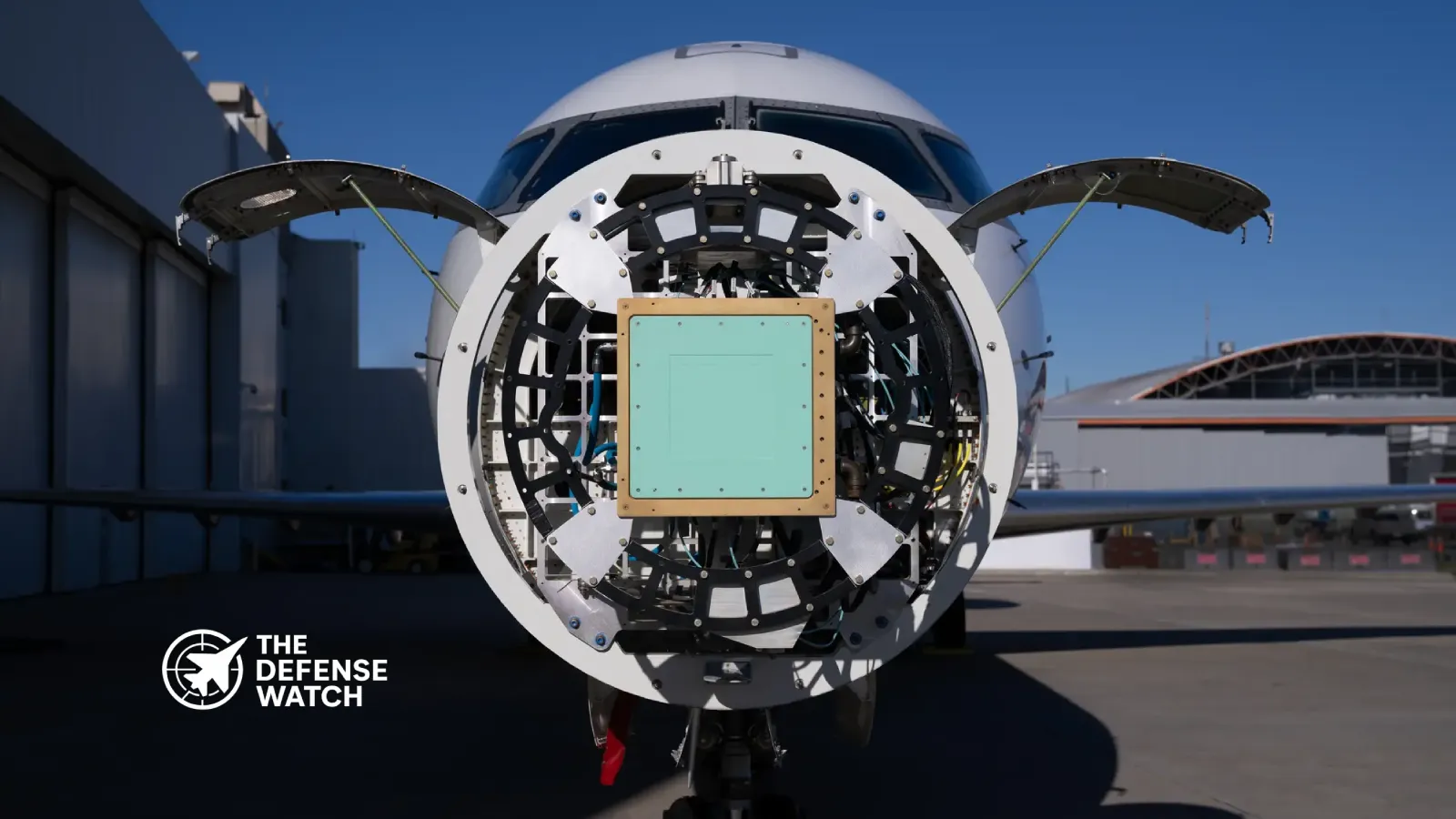
Northrop Grumman VALEN AESA Radar Signals A New Phase In Airborne Sensing
Northrop Grumman VALEN AESA is being positioned as a generational leap in airborne sensing, expanding the capabilities of active electronically scanned array radar for modern and future combat environments.
In an announcement published by Northrop Grumman, the company introduced VALEN as a scalable AESA radar family designed to support next generation aircraft and mission systems. The system builds on decades of experience in electronically scanned arrays and digital radar architectures.
The launch reflects growing demand across the U.S. and allied defense sectors for sensors capable of operating in contested, spectrum dense environments.
What Is VALEN AESA?
VALEN, which stands for a new radar product line under Northrop Grumman’s portfolio, is a modular, open architecture AESA radar system engineered for adaptability across multiple platforms.
AESA radars use electronically controlled beams instead of mechanically steered antennas. This allows rapid beam steering, simultaneous multi-mode operations, and improved resistance to electronic attack.
According to Northrop Grumman, VALEN integrates:
- Advanced digital beamforming
- Scalable hardware configurations
- Software defined capabilities
- Open mission systems compatibility
The company describes VALEN as a future ready sensing backbone rather than a single platform specific radar.
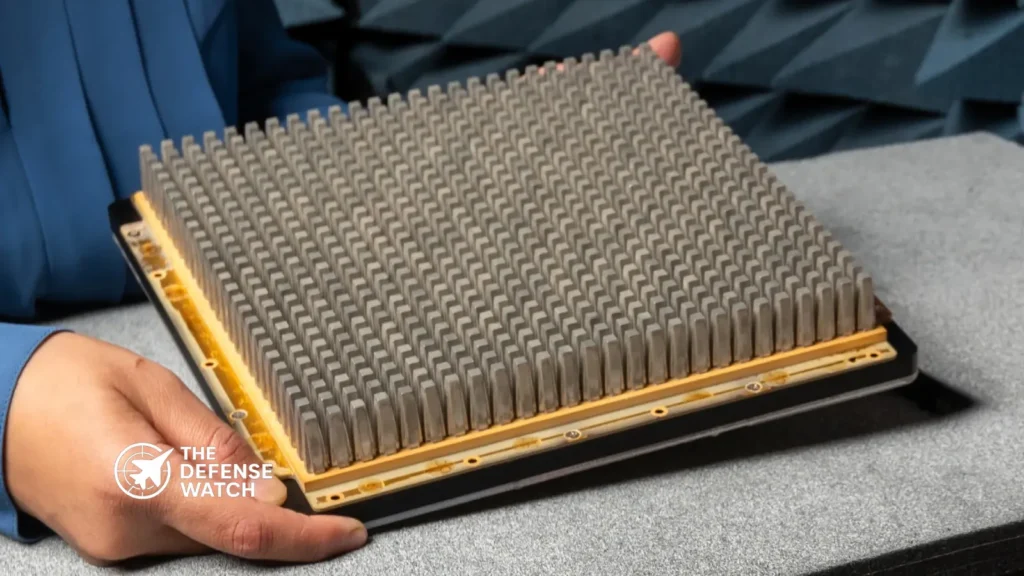
Built For Multi Domain Operations
Modern combat aircraft and unmanned systems operate in increasingly complex environments. Air superiority missions, long range strike, electronic warfare, and intelligence gathering often occur simultaneously.
The Northrop Grumman VALEN AESA radar is designed to support these multi mission demands.
By leveraging digital architecture and scalable transmit receive modules, the system can be tailored to various aircraft sizes and mission sets. This includes:
- Tactical fighters
- Advanced trainers
- Unmanned aerial systems
- Collaborative combat aircraft
Northrop Grumman has long supplied AESA radars to U.S. platforms, including systems for the U.S. Air Force and U.S. Navy. VALEN builds on that legacy, with a focus on modularity and digital transformation.
Digital Backbone And Open Architecture
A key feature of the VALEN AESA radar system is its open systems approach.
The U.S. Department of Defense has increasingly emphasized Modular Open Systems Approach, or MOSA, to reduce vendor lock in and speed up upgrades. By aligning with open architecture standards, VALEN can integrate with evolving mission software, data links, and sensor fusion frameworks.
This design philosophy supports rapid capability insertion, allowing operators to add new waveforms, electronic protection features, and processing upgrades without redesigning the entire radar.
In practical terms, that means improved lifecycle flexibility and reduced long term sustainment costs.
Enhanced Survivability In Contested Environments
Air forces are preparing for high end conflicts where adversaries deploy advanced integrated air defense systems, jamming platforms, and cyber tools.
AESA radars already provide advantages such as low probability of intercept modes and agile beam steering. Northrop Grumman states that VALEN is engineered to further enhance survivability in electronically contested environments.
Digital beamforming enables more precise target tracking and improved discrimination in cluttered battlespaces. The scalable architecture also allows tailored electronic protection measures depending on mission needs.
This is particularly relevant as near peer competitors continue investing in advanced air defense and electronic warfare capabilities.
Supporting Next Generation Aircraft Programs
While Northrop Grumman has not publicly linked VALEN to a specific aircraft program, the timing aligns with several major U.S. modernization efforts.
These include:
- Next generation air dominance initiatives
- Collaborative combat aircraft concepts
- Advanced unmanned systems development
The U.S. Air Force and Navy are both pursuing future air combat ecosystems that rely heavily on sensor fusion and data sharing. In such architectures, radar is not just a detection tool but a central node in a larger combat cloud.
VALEN appears positioned to function as part of that distributed sensing framework.
Northrop Grumman is also a key player in strategic and stealth programs such as the B-21 Raider, underscoring its experience in integrating advanced sensors into low observable platforms.
Scalability Across Platforms
One of the defining features of the Northrop Grumman VALEN AESA radar is scalability.
Rather than designing unique radars for each aircraft, VALEN’s architecture can be adjusted in size, power output, and processing capability.
This approach offers several advantages:
- Reduced development timelines
- Common logistics and training pipelines
- Easier cross platform upgrades
- Interoperability across allied fleets
For allied nations seeking advanced radar performance without bespoke development programs, scalable AESA families can reduce risk and accelerate fielding.
Strategic Implications For U.S. Defense
The introduction of VALEN comes amid intensified global competition in sensor technology.
China and Russia have both invested heavily in AESA radars and electronic warfare systems. Maintaining an edge in sensing and electronic protection remains central to U.S. air dominance strategy.
By focusing on digital architecture, open systems, and modularity, Northrop Grumman is aligning its radar roadmap with Pentagon priorities for adaptability and long term modernization.
For policymakers and defense planners, the emergence of systems like VALEN underscores the shift from platform centric thinking to network centric operations, where sensors, shooters, and command nodes operate as an integrated ecosystem.
Industry Context
Northrop Grumman is one of several major U.S. defense contractors advancing AESA technology. Companies such as Raytheon Technologies and Lockheed Martin also field advanced radar systems across multiple platforms.
However, Northrop Grumman has historically been a pioneer in electronically scanned arrays, including early airborne AESA deployments.
With VALEN, the company signals a continued push toward digitally defined sensing capabilities designed for rapid evolution over decades of service life.
Why VALEN Matters
The Northrop Grumman VALEN AESA radar represents more than a hardware update. It reflects a broader transformation in how airborne sensors are designed, integrated, and upgraded.
As air combat shifts toward data driven, network enabled operations, radar systems must serve as both detection tools and information hubs.
VALEN’s emphasis on scalability, digital backbone, and open architecture aligns with this operational reality.
While specific performance metrics such as range, power class, or waveform details were not disclosed, the strategic positioning of the system suggests it is intended to anchor future airborne sensing solutions across U.S. and allied fleets.
Get real time update about this post category directly on your device, subscribe now.
