
China’s J-36 in New Footage: What We Now See
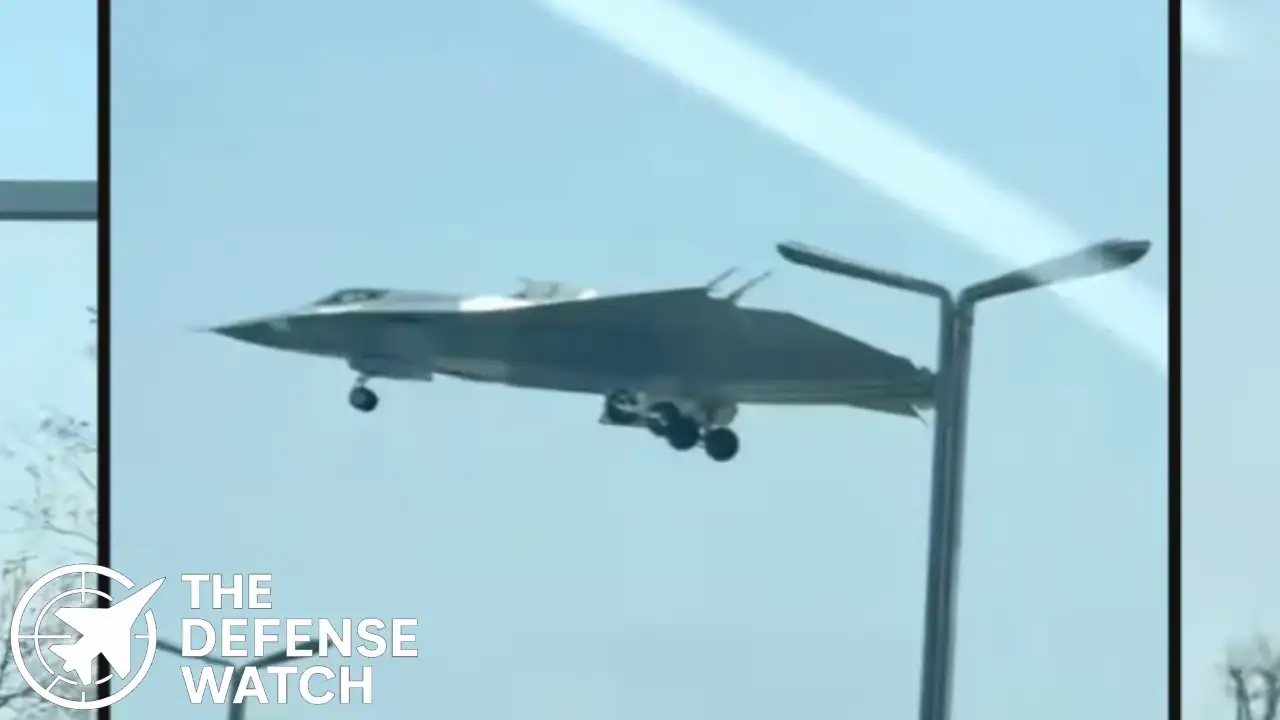
New video has emerged showing China’s largest of two new tailless stealth fighter prototypes, commonly referred to as the J-36, as it makes a final approach to land at its manufacturer’s factory airfield in Sichuan Province. The aircraft is still unconfirmed in official sources.
The jet is spotted over a freeway near the Chengdu Aircraft Corporation (CAC) facility, sweeping low as it approaches touchdown. Key visible features include:
- Heavy-duty landing gear: Twin wheels on each unit are deployed.
- Twin split ruddervons (outboard control surfaces) serving as airbrakes or stabilizing surfaces.
- Three-engine configuration: Two side intakes and one dorsal intake. The dorsal intake appears to use a diverterless supersonic inlet (DSI) design.
- Cockpit/nose shape: A broad nose section, streamlined forward fuselage, and what looks like a side-by-side seating arrangement (or possibly a very wide single seat cockpit) — based on visible helmet or headrest silhouette. This appears to rule out the tandem seat layout.
- Camouflage / surface treatments: Splinter-type camouflage, lighter-colored panels around dorsal intake and aft, and lighter leading-edge panels likely for optical/IR sensors. Some areas could feature mirror-like coatings used during testing.
These visual details align with earlier sightings: first flight on Dec. 26, a second appearance some months later, and increasing public exposure via images and video.
Design Features & Capabilities: What This Suggests
From the recent footage and earlier analyses, the following design attributes are increasingly supported:
- Tailless, flying-wing / blended wing-body influences: Absence of vertical stabilizers, use of split control surfaces at wing edges.
- Trijet powerplant configuration, which is rare among modern fighter prototypes. Could confer increased thrust or redundancy.
- Large internal volume / weapon bays: Earlier speculation suggests substantial internal weapons capacity (long-range missiles, precision strike munitions) as well as electronic warfare and sensor payloads.
- Advanced sensor suite and stealth shaping: Broad nose suggests sizable radome; optical/IR apertures; leading-edge shaping; camouflage indicating both visual concealment and possibly radar signature management.
Status & Strategic Context
The footage is part of a mounting body of evidence for the J-36’s development: multiple flights, public sightings, geolocated videos, and confirmation (though unofficial) from defense watchers and analysts.
Strategically, the J-36 seems intended as a next-generation heavy stealth tactical aircraft for the People’s Liberation Army Air Force (PLAAF), possibly serving roles beyond pure air superiority:
- Long-range strike / stand-off capability
- Sensor fusion and electronic warfare
- Command & control for drone / UCAV / loyal-wingman operations
- Expanding China’s ability to project airpower deep into the Pacific, consistent with its anti-access/area denial (A2/AD) strategy.
Analysis: Implications & Comparisons
Potential Impact on Airpower Balance
If the J-36 achieves operational capability with the features suggested by this footage and other sightings, it would mark a significant leap in PLA airpower. Its size, trijet layout, stealth characteristics and internal bays place it in a heavier class than many current fighters. This could shift regional power dynamics, particularly in the Indo-Pacific, by strengthening China’s ability to contest air superiority at greater ranges.
Comparisons with U.S. Sixth-Generation Fighter Development
At the same time, the U.S. is developing its Next Generation Air Dominance (NGAD) family (sometimes referred to in press as F-47 or otherwise), emphasizing modular payloads, distributed sensing, AI, and human-machine teaming. The J-36 seems to follow a parallel trajectory in some respects: more sensors, greater autonomy potential, stealth, emphasis on greater mission flexibility. However, important questions remain:
- Will it achieve genuine “supercruise”—sustained supersonic flight without afterburners?
- How good will its avionics, electronic warfare, and stealth be in operational conditions?
- What will be its service entry timeline, and how will China integrate a platform of this presumed size into its maintenance, training, and deployment infrastructure?
What’s Still Unknown / Monitoring Points
While new footage brings clarity, many aspects remain speculative or unverified:
- The official designation (is it definitively “J-36”?), and whether it will be dual-use or have variants (e.g., naval version).
- Exact crew configuration — side-by-side vs single pilot is still debated.
- Performance metrics: speed, range, payload, avionics, radar cross-section.
- Operational role: will it be air superiority only, or multi-role with strike, EW, C2, unmanned escort?
Conclusion
The latest video of the J-36 offers the most detailed public view yet of China’s ambitious stealth fighter project. The combination of design features—tailless layout, three engines, side-by-side cockpit shape, advanced stealth shaping—suggests China is pushing aggressively toward a next-generation platform capable of challenging Western air dominance. But many key performance and operational traits remain unconfirmed.
As analysts and militaries continue monitoring imagery, flight tests, and technical disclosures, the J-36 could become a major factor in the future airpower balance of East Asia and beyond.
FAQs
No; as of now, there is no definitive public confirmation of the designation “J-36” or full specifications from official Chinese sources. Designation and many details remain based on leaked images, open-source analysis, and media reporting.
Tailless designs can reduce radar cross-section by eliminating vertical stabilizers, and potentially improve aerodynamic efficiency. But they also place greater burden on flight control systems to maintain stability and maneuverability. Sensor placement, control surface layout, and inlet/exhaust design are critical.
If confirmed, a side-by-side layout could suggest dual-crew roles such as pilot + weapon/sensor or mission systems operator. That would align with the tasks of modern air dominance platforms which manage many sensors, drones, EW and networked combat assets. However, it could also be a wide single-seat cockpit; evidence is not yet conclusive.
No credible reporting yet provides a firm timeline. Given current stage (flight tests, prototype spotting, incremental imaging), it may be several years before operational deployment, if all goes well.
They seem to share priorities: stealth, sensor fusion, payload flexibility, possible teaming with UAVs, etc. The exact capabilities will determine whether the J-36 narrows or shifts any advantage. U.S. efforts are ahead in some tested systems and industrial base, but China’s rapid prototyping and testing suggest it may close some gaps sooner than expected.
Get real time update about this post category directly on your device, subscribe now.

10 comments
[…] reflectivity. Some analysts note that the modifications echo earlier treatments applied to the J-20 stealth fighter, though at a less extensive scale given the J-10’s conventional […]
[…] the program delivers, the Air Force may enter the 2030s with not only stealth fighters but also a loyal wingman fleet capable of reshaping air […]
[…] and M249 SAW. With improved lethality, range, and penetration against modern body armor, the NGSW offers a decisive edge in close and mid-range […]
[…] Multirole Stealth Fighter […]
[…] the Military Implications of Chinese Control of Taiwan, Jonathan Caverley and colleagues argue that China’s ability to generate “kill chains” (find, fix, finish) may not be significantly improved by holding Taiwan, compared […]
[…] Beyond radar, China is reportedly exploring novel detection methods—such as satellite-based signal disturbance detection (e.g. via Starlink interference experiments) —and even a stratospheric airship with infrared sensors targeting the thermal signature of stealth fighters. […]
[…] acceleration of China’s sixth-generation fighter development raises several […]
[…] deployment of stealth drones such as the GJ-11 may also influence regional air power dynamics, offering China a means to project force while minimizing pilot risk. Autonomous drones capable of operating in […]
[…] F-35, by contrast, is a dedicated 5th-generation stealth fighter. Its design emphasizes radar-evading geometry, internal weapons bays, and advanced sensor fusion. […]
[…] imagery indicates the J 36 maintains a tailless or near tailless configuration, consistent with sixth generation fighter design trends focused on reduced radar signature, improved aerodynamic efficiency, and enhanced […]