
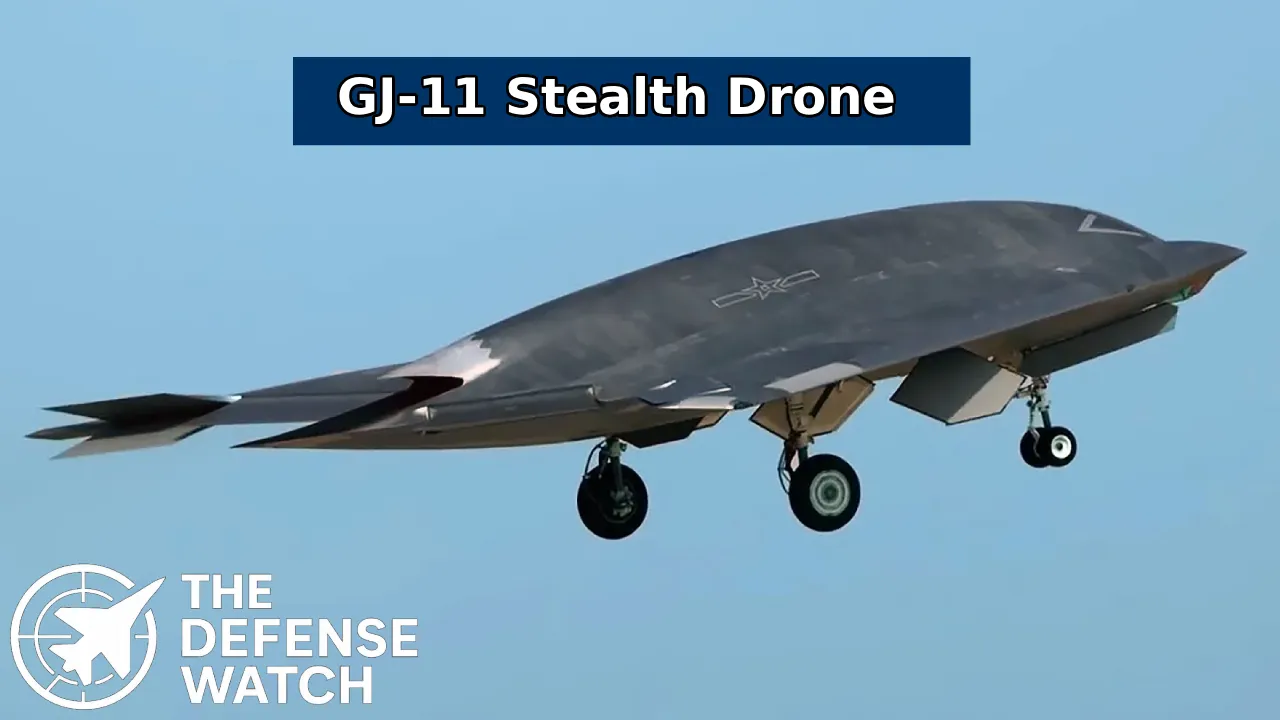
China Unveils GJ-11 “Mysterious Dragon” Stealth Drone
China has officially revealed its long-rumored GJ-11 unmanned combat air vehicle (UCAV), now formally named “Mysterious Dragon”. The People’s Liberation Army Air Force (PLAAF) released the first official video of the aircraft in flight, showing it operating alongside the J-20 stealth fighter and the J-16D electronic attack aircraft. This marks a significant milestone in Beijing’s push to integrate advanced unmanned systems into its air combat fleet.
The GJ-11, previously known in Western circles as the Sharp Sword, has been in development for over a decade. Analysts believe the aircraft is designed for a mix of penetrating air-to-surface strikes, intelligence, surveillance, and reconnaissance (ISR) missions, with potential for electronic warfare and air-to-air operations.
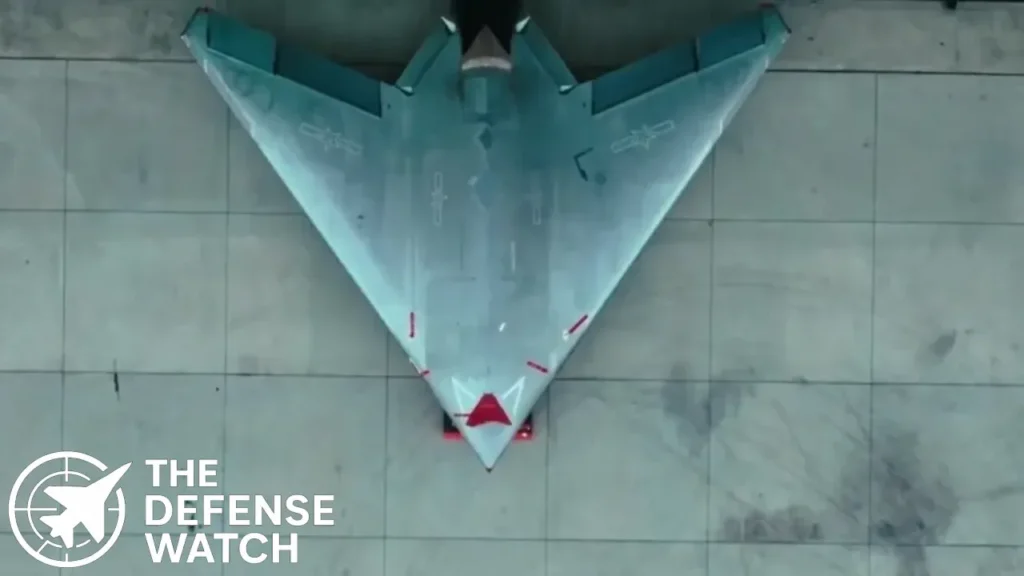
First Official PLAAF Footage
The PLAAF video, released to commemorate the 76th anniversary of its founding, runs nearly 30 minutes and showcases the GJ-11 in several key sequences:
- Formation flight with J-20 and J-16D: Demonstrates potential for cooperative operations between crewed and uncrewed platforms.
- Takeoff and maneuvering footage: Highlights its stealthy flying-wing design optimized for low radar cross-section.
- Air-to-air combat context: Shows a J-20 launching a PL-15 medium-range air-to-air missile from its internal weapons bay, illustrating the synergy between UCAVs and fifth-generation fighters.
This coordinated display signals China’s commitment to autonomous and semi-autonomous drone integration within its modernized air force.
Capabilities and Strategic Context
The China GJ-11 stealth drone is assessed to carry a relevant weapons payload while maintaining longer endurance than crewed tactical jets. Its stealthy design allows for deep penetration missions in contested airspace, while also performing ISR and electronic attack tasks. Experts suggest it could serve as a force multiplier, working in tandem with aircraft like the J-20 to extend sensor coverage, suppress air defenses, and execute precision strikes.
China’s development of the GJ-11 comes amid a global trend of pairing unmanned systems with advanced manned fighters, a strategy aimed at increasing survivability and operational flexibility. The PLAAF’s public release of the drone underscores its intent to showcase technological progress and bolster deterrence messaging.
Analysis: Implications for Regional Airpower
The emergence of the China GJ-11 stealth drone may have notable implications for the airpower balance in the Indo-Pacific region. With long-range stealth UCAVs entering service, China could expand its strike and ISR reach while reducing risk to human pilots. Moreover, integration with J-20 fighters hints at the potential for networked warfare, where drones act as forward sensors, decoys, or electronic attack platforms in complex combat scenarios.
While precise numbers and operational readiness remain classified, the GJ-11’s appearance signals that China is moving toward deployable stealth drones capable of integrated, high-end combat operations, a domain previously dominated by the United States.
FAQs
It is China’s stealth unmanned combat air vehicle (UCAV), designed for air-to-surface, ISR, and potential electronic warfare missions.
The first official video was released in November 2025, coinciding with the 76th anniversary of the PLAAF.
The GJ-11 was seen alongside the J-20 stealth fighter and the J-16D electronic attack aircraft.
Yes, it can carry a relevant payload for precision strikes, though specific armaments are not publicly disclosed.
The UCAV enhances China’s ability to conduct long-range stealth strikes, ISR missions, and integrated drone-fighter operations in contested airspace.
Chinese GJ-11 Stealth Drone – Full Specifications
- Maximum Speed: ~1,000 km/h
- Endurance: ~6–8 hours
- Operational Range: 1,500+ km
- Payload Capacity: ~400–500 kg
Chinese GJ-11 Stealth Drone
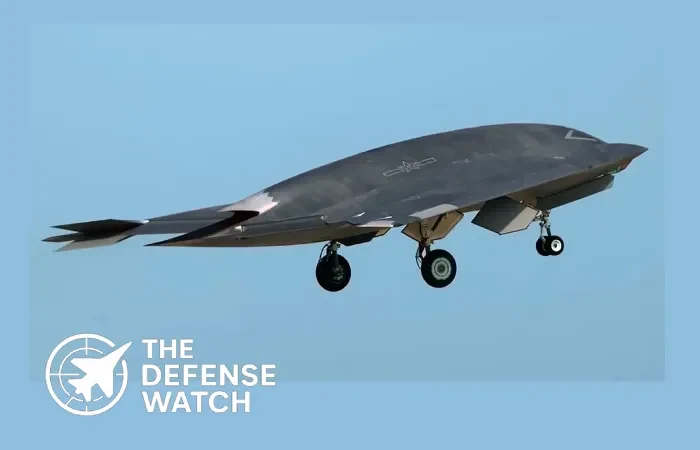
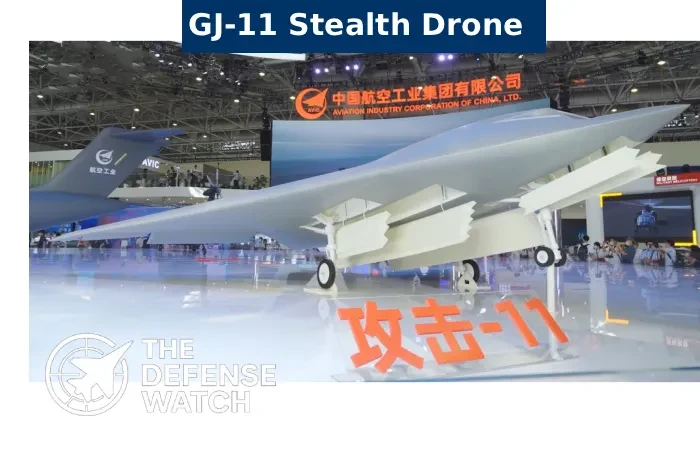
Full Specifications
1. General Information
| Manufacturer | Chengdu Aircraft Industry Group |
| Country of Origin | China |
| Type / Role | Stealth Attack / Reconnaissance UAV |
| First Flight / Introduced | 2013 |
| Status | In Service / Limited Deployment |
| Unit Cost | Classified |
2. Performance
| Maximum Speed | ~1,000 km/h |
| Cruise Speed | ~700 km/h |
| Operational Range | 1,500+ km |
| Endurance | 6–8 hours |
| Service Ceiling | 15,000 m (~49,000 ft) |
3. Dimensions
| Length | ~8 m |
| Wingspan | ~12 m |
| Height | ~1.8 m |
| Maximum Takeoff Weight (MTOW) | ~4,500 kg |
4. Payload & Armament
| Payload Capacity | 400–500 kg |
| Hardpoints | Internal bays |
| Weapons | Precision-guided missiles & bombs |
| Sensors | EO/IR, SAR, laser designator |
| Avionics | Satellite link, GPS/INS, targeting pod |
5. Propulsion
| Engine Type | Turbofan (Exact type classified) |
| Engine Power | Estimated 2,000–2,500 kgf thrust |
6. Communication & Control
| Control Type | Remote / Autonomous |
| Data Link Range | Satellite beyond line-of-sight |
| Navigation | GPS / INS |
7. Operational Use
| Primary Users | PLAAF |
| Combat Proven | Limited |
| Notable Operations | Classified / Testing Phase |
PROS
- Low-observable stealth design
- Long-range strike capability
- Advanced sensor and ISR suite
- Autonomous and manned-control operation modes
- Integration with fifth-generation fighter jets
CONS
- Limited operational history and combat-proven data
- Subsonic speeds may restrict rapid response
- High development and production costs
- Reliance on satellite communication vulnerable to jamming
- Payload capacity lower than larger UCAVs
GJ-11 Stealth Drone: China’s Advanced Unmanned Strike Platform
The Chinese GJ-11 Stealth Drone, also known as the “Sharp Sword,” represents China’s cutting-edge foray into stealth unmanned aerial vehicles (UAVs) designed for precision strike and reconnaissance missions. Developed by the Chengdu Aircraft Industry Group, the GJ-11 integrates low-observable airframe design, advanced sensors, and autonomous operational capabilities, making it a key asset for modern asymmetric warfare.
Manufacturer and Origin
- Manufacturer: Chengdu Aircraft Industry Group
- Country of Origin: China
- Purpose: Long-range strike, reconnaissance, and support for manned fighter jets like the J-20.
Capabilities and Performance
The Chinese GJ-11 Stealth Drone is optimized for deep penetration into contested airspace. Featuring a tailless, flying-wing design, it minimizes radar signature while carrying a variety of precision-guided munitions. Its estimated operational range exceeds 1,500 km, with a subsonic cruise speed allowing extended mission endurance. The drone can be deployed both autonomously and via remote control, enabling flexible operational profiles.
Technology and Armament
Equipped with advanced EO/IR sensors, synthetic aperture radar (SAR), and satellite communication links, the GJ-11 can conduct both intelligence gathering and precision strikes. Its internal weapons bay supports guided missiles and bombs, maintaining stealth while delivering combat payloads. The platform is compatible with drone swarm operations and networked warfare strategies, reflecting China’s emphasis on integrated unmanned systems.
Operational Use
Though primarily operated by the People’s Liberation Army Air Force (PLAAF), the GJ-11 is expected to supplement China’s fifth-generation fighter fleet. Its missions include suppression of enemy air defenses, strategic strikes, and reconnaissance in contested environments.
Get real time update about this post category directly on your device, subscribe now.
Reviews
Get real time update about this post category directly on your device, subscribe now.


1 comment
[…] weapons disruptive. Their ability to maneuver unpredictably at these velocities is what gives China an emerging military advantage and stretches the limits of existing U.S. detection and interception […]