

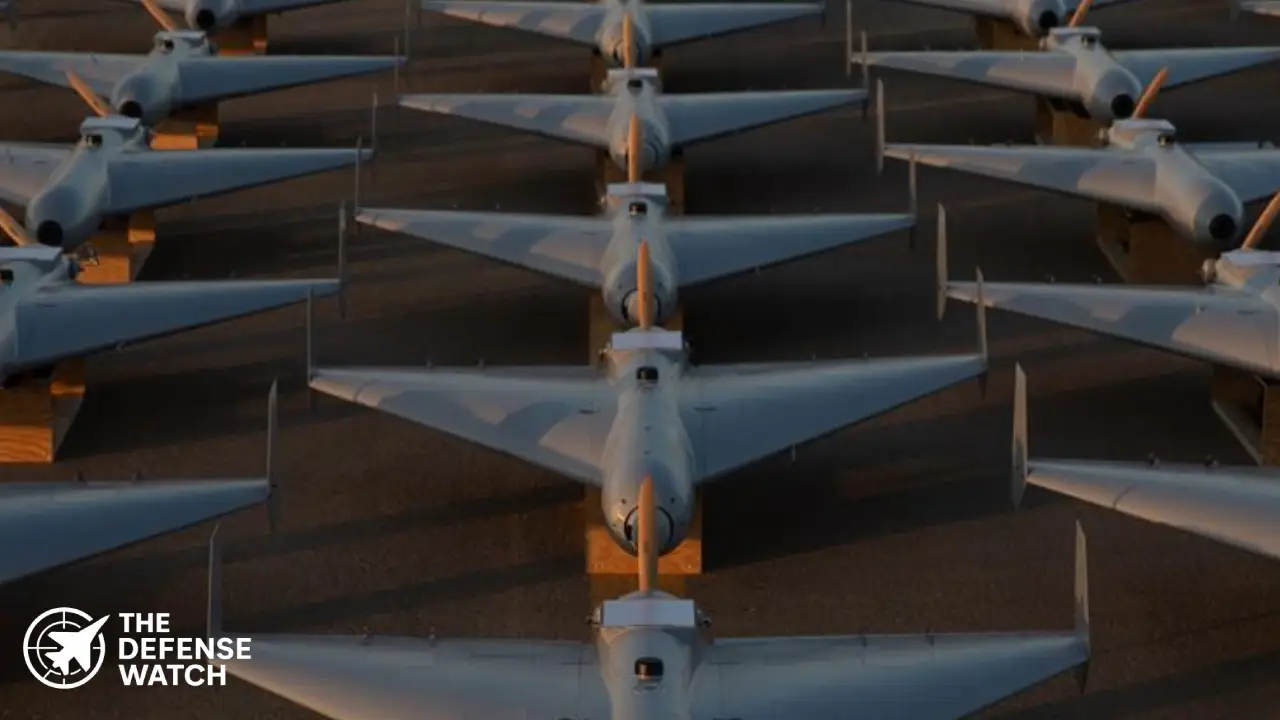
United States Central Command (CENTCOM) announced the activation of its first one-way attack drone squadron — a dedicated unit built around a new drone design derived from the Iranian HESA Shahed 136. The new force, dubbed Task Force Scorpion Strike (TFSS), immediately deployed low-cost strike drones to the Middle East, signaling a major shift in U.S. drone strategy.
Background: Shahed-136 and Low-Cost Drone Warfare
The Shahed-136 is an Iranian-designed loitering munition — commonly described as a “kamikaze drone” — that has been widely used by Tehran, its allied militias and Russia (under the designation Geran-2) in various conflicts, including in Ukraine.
Measuring roughly 3.5 m in length, with a 2.5 m wingspan, weighing about 200 kg and carrying a warhead of 30–50 kg, the Shahed-136 features a delta-wing configuration, rear-mounted pusher propeller, and uses GNSS/INS guidance.
Because of its relatively low cost and simple design — in stark contrast to expensive, sophisticated U.S. or NATO missiles — the Shahed-136 has become a symbol of a shift toward scale: saturation attacks with many cheap drones rather than fewer high-cost precision munitions.
What Happened: Deployment of the LUCAS Squadron
CENTCOM Unveils Task Force Scorpion Strike
According to CENTCOM, Task Force Scorpion Strike was activated on 3 December 2025. The new force is built around one-way, expendable attack drones derived from the Shahed-136 design. These drones, known as Low-cost Unmanned Combat Attack System (LUCAS), have already been deployed to the Middle East.
In remarks accompanying the activation, CENTCOM commander Admiral Brad Cooper described the new task force as a demonstration of rapid innovation and deterrence: “This new task force sets the conditions for using innovation as a deterrent,” he said.
LUCAS Drones Mirror Shahed-136 Design, Offer Low-Cost Strike Option
Visual evidence released by CENTCOM shows rows of LUCAS drones situated at an undisclosed base in its area of responsibility. The design strongly resembles the Shahed-136: delta wing, rear-mounted propeller, vertical stabilizers and compact airframe.
Though CENTCOM has not released full specifications, the LUCAS drones are described as having “extensive range” and autonomous operation capability. Launch methods include catapults, rocket-assisted takeoff, or mobile vehicle-based launchers — enabling flexible deployment in austere environments.
Industry sources and media reporting associate LUCAS closely with the product line developed by Arizona-based uncrewed aircraft manufacturer SpektreWorks, specifically its “FLM 136” family originally designed to emulate Shahed drones for threat testing.
Cost and Strategic Trade-Offs
Each LUCAS drone reportedly costs approximately USD 35,000 — a fraction of what legacy U.S. strike systems or precision missiles cost. mint+1
By comparison, traditional U.S. strike assets such as strike jets or guided missiles can cost tens of thousands to millions of dollars per shot. The economics of LUCAS reverses that equation: expend cheap drones en masse, rather than expend expensive missiles one at a time.
Analysis: Strategic Implications of the New Drone Squadron
A Shift From Defense to Low-Cost Offense
Historically, U.S. drone efforts have prioritized surveillance, precision strikes, and high-value targets — using expensive, reusable platforms. The deployment of a dedicated one-way attack drone squadron signals a doctrinal shift, embracing the notion that “quantity has a quality all its own.” The LUCAS drones allow the Pentagon to field large numbers of inexpensive kamikaze UAVs capable of saturating air defenses or striking dispersed or hardened targets.
Catching Up With Adversaries’ Playbook
This move can be seen in part as a reaction to the widespread use of Shahed-type drones by adversaries, including state and non-state actors, which has challenged U.S. and allied defenses in recent years. By reverse-engineering the Shahed-136 and deploying LUCAS, the U.S. military closes the gap — developing the capability to use low-cost one-way drones offensively, not just defend against them.
Lowering the Entry Barrier for Drone Warfare
At USD 35,000 per drone, LUCAS makes drone strikes accessible for tactical units. The modular launch mechanism (catapults, rocket assist, vehicle-based launchers) simplifies deployment. This could enable small ground units — not only air or special-forces — to leverage drone strikes as a regular part of their toolbox.
Potential Risks and Considerations
Because these drones are expendable, ethical and collateral-damage risks may increase. Moreover, adversary forces may respond by upgrading inexpensive counter-UAS systems, leading to a renewed arms race. The autonomous nature of LUCAS (loitering then diving onto targets) also raises command, control, and risk-of-fratricide challenges, especially in complex environments.
What’s Next: Wider Rollout and Operational Use
According to CENTCOM, the establishment of Task Force Scorpion Strike is just the first step. The Pentagon has launched a multiyear initiative to acquire hundreds of thousands of low-cost, one-way drones, with purchase orders beginning in early 2026.
Over the next 18–24 months, this could mean widespread deployment not only in the Middle East but potentially other theaters deemed high-risk or strategically vital.
In practical terms, we may see LUCAS drones used in saturation strikes, suppression of enemy air defenses, targeting of hardened infrastructure, or rapid response strikes — shifting small drones from auxiliary roles to frontline offensive tools.


3 comments
[…] forces have relied heavily on Shahed-131 and Shahed-136 drones to strike Ukrainian energy infrastructure, logistics hubs, and urban centers. These low-cost UAVs […]
[…] conventional UAVs that need runways or catapult systems, the V-BAT’s vertical takeoff design reduces logistical […]
[…] Bayi pilots noted the squadron’s 2026 deployment differs from their last Singapore visit, with in-flight refueling enabling a direct long-range […]