

Table of Contents
The Rise of AI Logistics in Defense
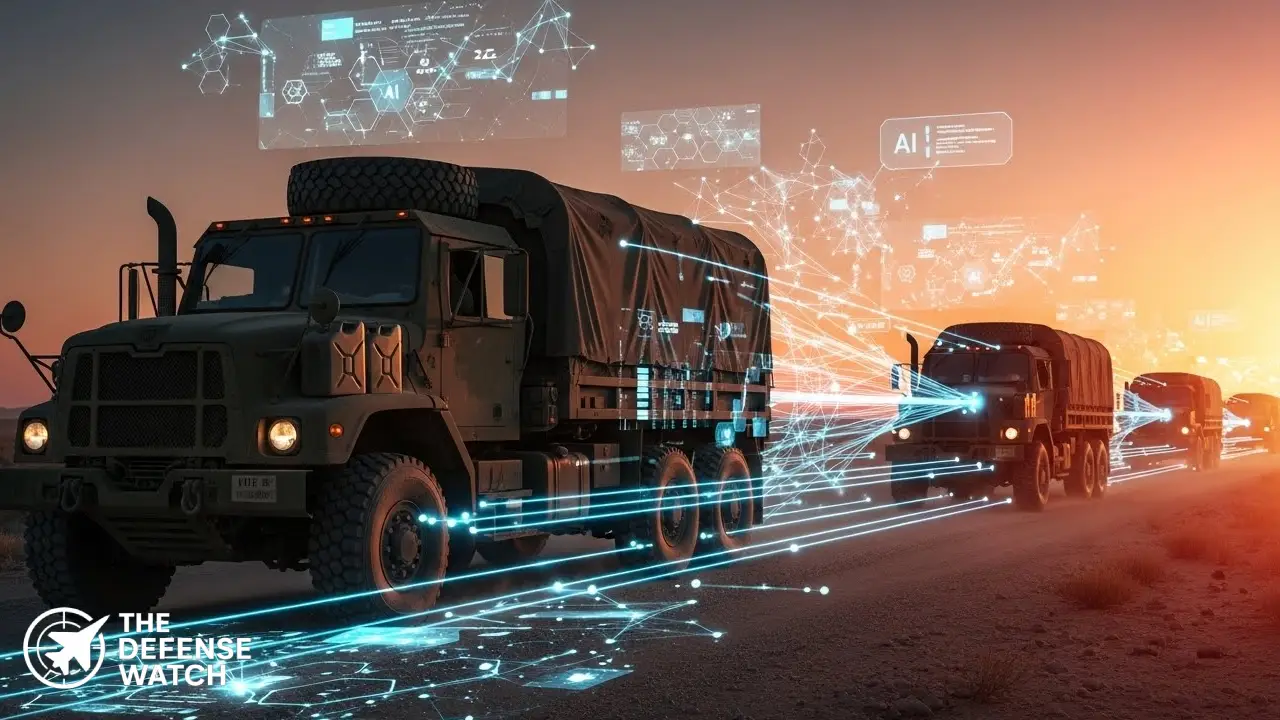
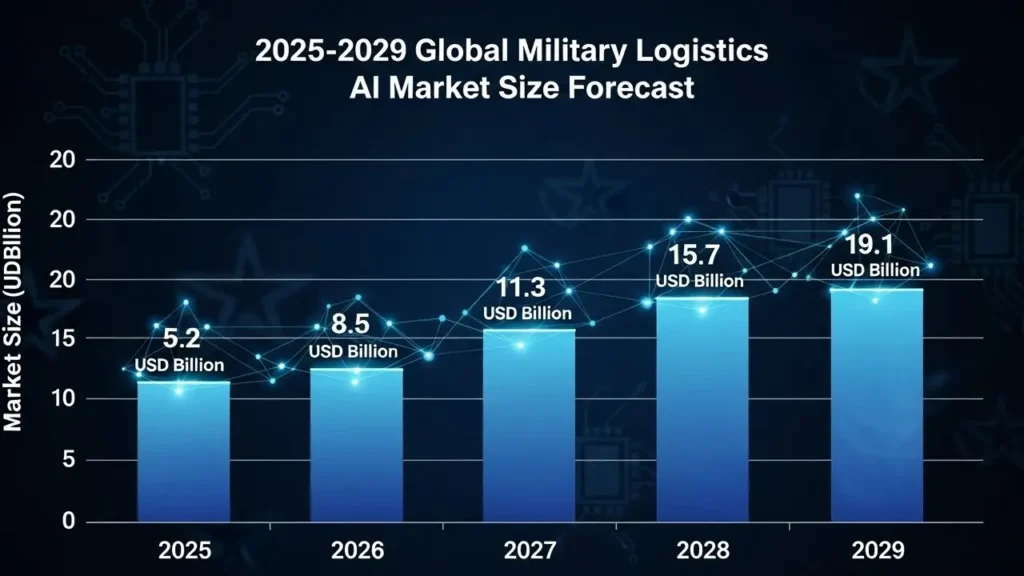
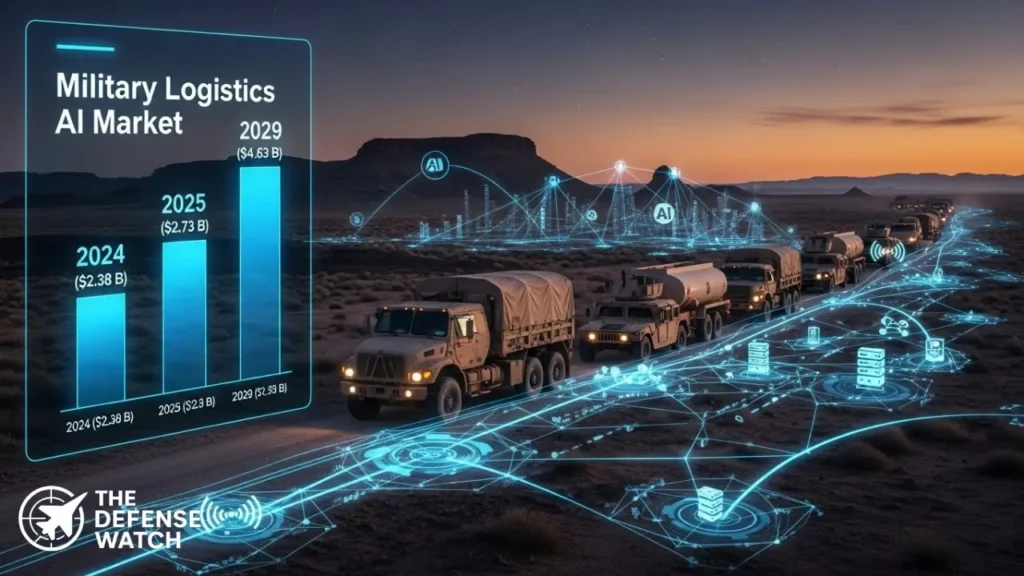
The global military logistics AI market — integrating automation, data analytics, and secure information flows — is projected to reach $4.63 billion by 2029, rising from an estimated $2.38 billion in 2024, representing a compound annual growth rate (CAGR) of 14.1%.
As defense organizations worldwide race to streamline supply chains, reduce delays, and tighten cybersecurity, this surge in adoption underscores the growing strategic importance of AI-driven logistics.
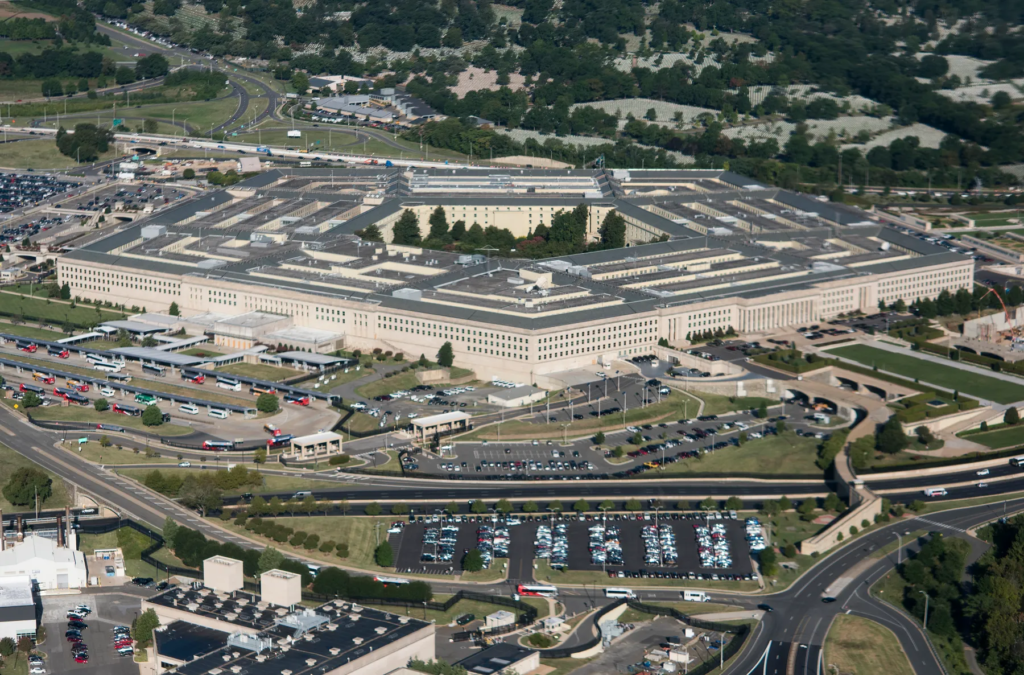
In that context, the United States — led by the U.S. Department of Defense (DoD) — appears to hold a structural advantage over peer challengers such as DeepSeek in China, thanks to deeper funding, broader integration, and stronger safeguards around secure data flows.
What Drives the $4.63B Forecast? Autonomous Supply Chains and Cyber‑Secure Data Flows
Evolving Scope: From Predictive Maintenance to Fully Autonomous Logistics
Within the “military logistics AI” market, AI is applied across software, hardware, and services layers — deployed by ground, naval, and air forces. Use cases span:
- Inventory management and warehousing, using predictive analytics to anticipate demand and optimize stock levels.
- Fleet management and transportation, where AI helps route convoys, schedule vehicle maintenance, and dynamically allocate transport assets.
- Supply-chain optimization, enabling autonomous or semi‑autonomous supply deliveries — by ground vehicles or drones — particularly important in contested or remote environments.
- Maintenance and repair logistics, using predictive analytics and condition monitoring to reduce downtime and improve readiness.
On the hardware side, the forecast expects increased deployment of autonomous ground and aerial logistics vehicles, sensors and robotics systems, and edge‑processing data‑flow architectures.
Cyber‑Secure Data Flows, Resilience, and Readiness
Beyond automation, a critical driver is secure data exchange — military logistics are not just about moving materiel, but doing so with real-time visibility, resilience, and integrity across networks. The 2029 market forecast explicitly cites “secure data exchange within logistics systems” as a key growth factor.
That includes adoption of AI‑enabled risk‑assessment platforms, supply‑chain monitoring tools, and possibly technologies like blockchain or authenticated digital‑twin replicas for inventory tracking and verification.
The result: AI logistics promises far more responsive, resilient, and secure supply networks — vital for fast-moving, contested, or multi-domain operations.
Why the DoD Has an Edge Over China’s DeepSeek‑Led Push
Massive, Concentrated Investments in AI by the DoD
- According to a 2025 analysis, DoD AI‑related contract commitments surged from roughly $355 million (as of August 2022) to $4.6 billion (August 2023), a nearly 1,200% year-on-year increase.
- As of 2024, across the wider US defense and security apparatus, some $700 million had been awarded in AI‑project contracts since the launch of major commercial generative AI tools — covering hundreds of firms and a variety of AI applications, including logistics, cyber defense, and operations support.
- Recent 2025 contracts continue the push: the DoD has awarded AI development contracts to leading firms including OpenAI, Google, Anthropic and xAI, explicitly aimed at scaling advanced AI capabilities for national security.
This level of concentrated funding and contracting creates a large, stable base for deploying end-to-end AI logistics solutions — from concept to fielding — under DoD oversight.
DeepSeek Gains, But With Structural Constraints
On the Chinese side, DeepSeek (founded 2023) has rapidly drawn attention for its low-cost, inference‑optimized AI models. Western analysts and U.S. officials have flagged DeepSeek as aiding China’s military and intelligence operations, including bypassing export controls via shell companies and foreign data centers.
However, despite these steps, DeepSeek faces structural headwinds:
- China’s military budget remains substantial but constrained: in 2025, Beijing increased defense spending by 7.2% to approximately 1.78 trillion yuan (~US$249 billion).
- R&D investment is rising — China plans to spend about $55 billion in 2025 on science and technology, including semiconductors, AI, quantum, and related fields.
But even combined, those investments — across broad R&D, infrastructure, and defense — lack the concentrated, logistics‑specific contracting scale seen in the U.S. defense ecosystem.
Moreover, skepticism remains over how effectively DeepSeek’s inference-level AI models can replicate the end-to-end logistical orchestration — delivering secure data flows, integrating autonomous vehicles across domains, and meeting classification, integrity, and assurance standards required for frontline military logistics.
In contrast, the DoD’s growing portfolio of AI contracts and its adoption strategy (spanning hardware, software, and cyber-secure logistics pipelines) gives it a structural advantage in turning investment into deployable capability.
US–China Investments & Strategy: A Comparative Snapshot
| Category | United States (DoD) | China (DeepSeek / PLA-linked AI & R&D) |
|---|---|---|
| AI‑Logistics Market Share | Significant portion of global $4.63 B 2029 forecast | Likely a smaller share — global forecast dominated by North America as of 2024. |
| AI Contracts (2022–2023) | Jump from ~$355M to ~$4.6B in commitments — 1,200% increase | No public equivalent scale of PLA-specific AI contracts disclosed |
| Defense Budget (2025) | U.S. military budget ~ US$850B (widely cited) | 1.78 trillion yuan ≈ US$249B for 2025, with 7.2% YoY growth |
| National R&D / Science & Tech Budget (2025) | N/A (R&D largely via defense contracts) | ~US$55B allocated to science, semiconductors, AI, quantum — supports broader AI ecosystem |
| AI‑Logistics Capability Integration | Rapid adoption across supply‑chain, fleet, maintenance, autonomous logistics; growing edge‑computing, data‑secure pipelines | Focus on low‑cost inference AI (via DeepSeek), general AI ecosystem — but limited visibility on full-scale autonomous logistics deployments |
Analysis: Why DoD’s Structure Likely Outpaces DeepSeek’s Gains
- Scale + Concentration Matters
The explosion in DoD AI contracts — billions in committed funding, dozens of vendors, and high-dollar deals — suggests a high baseline for delivering integrated logistics systems. The U.S. can draw on both legacy defense‑industry firms and dynamic AI startups. That breadth and depth matters when rolling out complex, end‑to‑end logistics solutions across domains (land, air, sea, cyber). - Assurance, Security, and Compliance
Military logistics — especially in contested or austere environments — require secure data flows, resilience, supply‑chain integrity, and adherence to classification and compartmentalization. The DoD’s contracting, procurement, and oversight frameworks provide standards and accountability. Meanwhile, commercially driven firms like DeepSeek may optimize for cost and inference performance, but may lack equivalent integration with secure logistics pipelines. - Holistic Systems vs. Standalone Models
Using AI solely for reasoning or inference (as with DeepSeek) is different from deploying a full logistics ecosystem — combining sensors, autonomous vehicles, edge computing, predictive analytics, cybersecurity, and supply-network orchestration. The DoD appears to be funding that full-stack ecosystem. - Momentum & Institutionalization
The rapid rise in U.S. AI‑logistics adoption coincides with a broader strategic push: DoD strategy, increased contracts in 2024–2025, and mainstreaming of AI across logistics, planning, and maintenance. This institutional momentum is hard to match with startup-driven efforts — especially when export controls, supply-chain constraints, and data‑sovereignty concerns complicate cross-border transfer of advanced logistic AI.
That said, the presence of DeepSeek — and China’s rising science/AI funding — means Beijing may pursue a different model: lower-cost, scalable AI deployments that could incrementally improve logistics efficiency, especially in dual-use or non-frontline contexts.
But based on current public data — especially market forecasts, DoD contracting, and China’s budgeting — the U.S. appears positioned to retain a lead in full-spectrum AI defense logistics through at least the remainder of this decade.
Broader Implications: Geopolitics, Readiness, and the Logistics Advantage
- As strategic competition with China intensifies — especially across the Indo-Pacific — AI logistics becomes a force multiplier. Faster resupply, predictive maintenance, robust data flows, and secure distribution networks all enhance operational readiness.
- A strong AI‑logistics backbone allows for multi-domain flexibility and resilience: ground, naval, and air forces can sustain operations across remote, denied, or contested environments.
- For China, the challenge is not just developing low-cost AI models, but scaling them into a secure, coordinated military logistics network that matches complexity, security, and readiness demands.
In effect, while the AI arms race draws headlines, the real strategic advantage may come from which side can transform AI investment into reliable, integrated logistics capacity under real-world conflict conditions.
FAQs
AI logistics encompasses software (analytics, predictive maintenance, ERP/WMS), hardware (autonomous vehicles, sensors, drones), and services (system integration, cybersecurity, maintenance) supporting supply‑chain, inventory, transport, fleet, and maintenance operations.
Much faster — while the broader traditional military logistics market is expanding at roughly 3–5% annually, AI logistics is compounding at double‑digit rates, reflecting both modernization and growing reliance on digital transformation.
Unlikely in the short term — while DeepSeek is generating cheaper AI inference models and China is increasing R&D funding, there is limited public evidence of large-scale deployment of secure, autonomous military logistics networks comparable to DoD’s efforts.
Security, data integrity, supply‑chain vulnerabilities, and system assurance are key challenges. For example, unverified suppliers, cyber‑intrusion, or AI errors could disrupt logistics — potentially compromising readiness. This is especially critical in contested or degraded environments. Research into assurance frameworks for AI-enabled systems is ongoing.
Not necessarily — smaller militaries can adopt niche AI logistics tools (inventory management, predictive maintenance, fleet scheduling) to improve efficiency without needing full autonomous logistics networks. However, the biggest gains are likely for forces operating across large scale, multi-domain operations.

1 comment
[…] decades under the Taiwan Relations Act. The law obliges Washington to provide Taipei with defensive arms and services necessary to maintain a sufficient self defense […]