• Home
  • About
  • Defense Systems
  • Manufacturer
  • Comparisons
  • Compare 
  • Tools
TheDefenseWatch.com
  • Aerospace & Aviation
  • Military & Ordnance
  • Naval & Maritime
  • Cyber & Space Defense
  • Policy & Strategy
  • Global News
  • Tools Library
    • Smart Calculator
    • Drone Flight Time Calculator
    • Drone Range Calculator
    • Counter-Drone Jammer Effective Range Calculator
    • Counter-Battery Radar Detection Calculator
    • Artillery Fire Correction Calculator
    • Thermal Camera Detection Range Calculator
    • Missile Range & Time-of-Flight Calculator
    • Radar Detection Range Calculator
    • FPV Strike Drone Payload vs Range Calculator
    • Loitering Munition Endurance Calculator
    • Sniper Ballistic Drop & Windage Calculator
    • Bullet Drop Calculator
    • U.S. Army Combat Fitness Test (ACFT) Calculator
    • Military Pension Calculator
    • Military Retirement Calculator
    • Military Pension Calculator
    • Large Number Calculator
Font ResizerAa

TheDefenseWatch.com

The Defense Watch | U.S. & Global Defense News, Analysis & Military Updates

Search
  • Home
  • About
  • Defense Systems
  • Manufacturer
  • Comparisons
  • Compare 
  • Tools

Stay Updated

Get the latest update

Subscribe

Explore

  • Drone
  • Fighter Jets & Military Aircraft
  • Hypersonic Weapons
  • Aircraft Carriers
  • Strategic History & Missions
  • Tools Library
Home » Venezuela Mobilizes 200,000 Troops and Advanced Air-Defenses Amid Possible U.S. Air Strikes
Geopolitical & Strategic DoctrinesPolicy & Strategy

Venezuela Mobilizes 200,000 Troops and Advanced Air-Defenses Amid Possible U.S. Air Strikes

TeamDefenseWatch
Last updated: November 14, 2025 1:10 pm
TeamDefenseWatch
Share
2 Min Read
Venezuela mobilization
SHARE

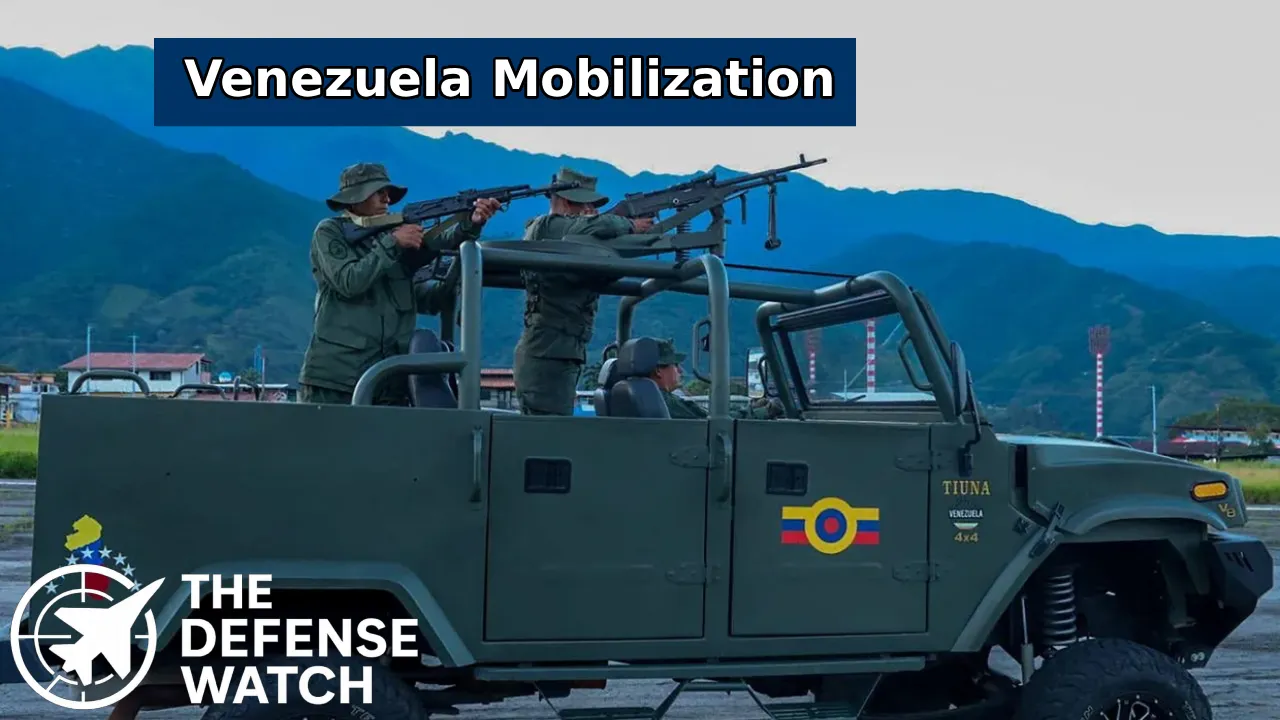
The government of Venezuela announced the mobilization of roughly 200,000 troops across the country, as part of a nationwide military exercise. The deployment includes ground, air and naval units and has been paired with the visible activation of advanced air-defense systems. The move comes amid mounting tensions with the United States and its military presence in the Caribbean region.

Contents
  • Background: context of the event
  • Details of the mobilization
    • Troop scale and scope
    • Air-defense systems and hardware
    • U.S. military activity in the vicinity
  • Expert / policy perspective
  • What’s next: impact and potential trajectories

Background: context of the event

Venezuela’s mobilization must be viewed in the context of an increasingly assertive U.S. military posture in the region. The U.S. has conducted multiple strikes since September 2025 against vessels alleged to be involved in narcotics trafficking, with some analysts describing the campaign as part of Operation Southern Spear under the command of U.S. Southern Command.
Simultaneously, Venezuela has been bolstering its defense posture: sources say the military and associated militias are preparing for a possible guerrilla-style response in the event of a U.S. air or ground attack.
The multi-domain demonstration of force by Caracas underscores the heightened stakes between the two nations in the Western Hemisphere.

Details of the mobilization

Troop scale and scope

Defense Minister Vladimir Padrino López stated that the exercise involves roughly 200,000 personnel drawn from the armed forces and bolivarian militias. The deployments are nationwide, spanning coastal zones, riverine regions and the traditional northern defense belt of the country.
According to independent reporting, the exercise includes ground forces, air-assets, naval components and mobilized air-defense batteries.

Air-defense systems and hardware

Footage released by Venezuelan state media shows activation of Russian-supplied air-defense systems, notably an upgraded twin-barrel ZU-23-2 anti-aircraft gun and the mobile short-range air-defense (SHORAD) system TOR-M2E.
These systems augment Venezuela’s layered air-defense network and signal a shift toward more mobile, dispersed tactics. The deployment is timed to respond to what Venezuelan officials describe as possible U.S. air-strike threats.

- Advertisement -

U.S. military activity in the vicinity

The U.S. has recently moved major assets into the Caribbean, including the aircraft carrier USS Gerald R. Ford strike group, which entered the region under U.S. Southern Command’s operational area. The stated purpose of U.S. operations is to counter narcotics trafficking and safeguard regional security. Venezuelan authorities, however, characterize this as direct provocation.
Through social media and public announcements, U.S. defense officials have also acknowledged preparations for broader options, including land-based operations inside Venezuela, though no formal decision has been announced.

Expert / policy perspective

Analysts view Venezuela’s move as both defensive and deterrent. By mobilizing its forces and displaying modern air-defense systems, Caracas signals to Washington that any incursion could be costly and complicated.
One Reuters source noted that Venezuela may lack conventional war-fighting capacity relative to the U.S., but intends to rely on “prolonged resistance” and dispersed guerrilla tactics if attacked.
From the U.S. side, the buildup in the Caribbean represents the most significant regional deployment in decades. According to Reuters, experts say the U.S. effort extends beyond counter-narcotics and may aim at strategic pressure on the Maduro government.
Policy-wise, the mobilization raises questions about escalation control. The presence of mobile air-defense units like TOR-M2E in proximity to U.S. naval and air assets increases the risk of miscalculation or accidental conflict.

What’s next: impact and potential trajectories

The immediate impact of Venezuela’s mobilization is heightened regional military tension. With 200,000 troops on alert and visible air-defense deployments, the scenario of confrontation has moved from theoretical to operational.
For the U.S., the next steps may involve clarifying the limits of its Caribbean posture and how it intends to avoid escalation while delivering on counter-narcotics and strategic objectives.
For Venezuela, sustained mobilization imposes resource strains and places the military at the center of political signaling. If operations expand beyond exercises, the country may face rapid escalation.
Going forward, the international community—including neighboring Latin American states and the broader hemispheric security architecture—will likely look for diplomatic openings to prevent unintended conflict.


TAGGED:air-defence systemsmilitary exerciseRussian armsU.S.–Venezuela relationsVenezuela
Share This Article
Facebook Copy Link Print
ByTeamDefenseWatch
TeamDefenseWatch is the official editorial byline of TheDefenseWatch.com. Working under one umbrella, TheDefenseWatch.com, the team delivers verified, factual reporting on global defense, military technology, aerospace systems, and security developments. Articles are sourced from official statements, defense industry releases, and trusted media, with editorial review to ensure accuracy and clarity.Contact: info@TheDefenseWtach.com
6 Comments
  • Pingback: USS Gerald R. Ford Arrives in Caribbean, Marking Largest U.S. Naval Buildup Near Venezuela
  • Pingback: Ukraine Seeks More Drones and Better Drone Tactics, National Guard Commander Says
  • Pingback: US Space Force Awards 18 Contracts for Golden Dome Space-Based Missile Defense Prototypes
  • Pingback: US Army Tests Modular Wheel System to Turn Any Vehicle Into a Robotic UGV | TheDefenseWatch.com
  • Pingback: Illinois National Guard and Portugal Sign State Partnership Agreement | TheDefenseWatch.com
  • Pingback: Russia and China Expand Joint Arctic Patrols as NATO Raises Alarm | TheDefenseWatch.com

Leave a Reply Cancel reply

Your email address will not be published. Required fields are marked *

F-22 Reptor

Latest Defense Systems

  • B61 Nuclear Bomb B61 Nuclear Bomb
  • Japan E-767 Airborne Japan E-767 Airborne
  • Remington 870 Shotgun Remington 870 Shotgun
  • RUTA B1 Cruise Missile RUTA B1 Cruise Missile
  • XQ-67A Drone XQ-67A Drone
  • B-25 Mitchell Bomber B-25 Mitchell Bomber
  • F-100 Super Sabre F-100 Super Sabre
  • North American F-86 Sabre North American F-86 Sabre
  • North American XB-70 Valkyrie North American XB-70 Valkyrie

Recent Compares

  • J-10C vs JF-17 Thunder: Which Fighter Is More Capable? J-10C vs JF-17 Thunder: Which Fighter Is More Capable? View Comparison →
  • Tejas vs Gripen: Key Differences and Capabilities Tejas vs Gripen: Key Differences and Capabilities View Comparison →
  • Tejas vs MiG-21 Bison: How India Replaced Its Iconic Supersonic Fighter Tejas vs MiG-21 Bison: How India Replaced Its Iconic Supersonic Fighter View Comparison →
  • F-35 vs F-16: Stealth, Sensors and Combat Roles F-35 vs F-16: Stealth, Sensors and Combat Roles View Comparison →
  • Tejas Fighter Jet vs F-16 Fighting Falcon: Capability Compared Tejas Fighter Jet vs F-16 Fighting Falcon: Capability Compared View Comparison →
  • Rafale Fighter Jet vs F-16 Fighting Falcon : Which Fighter Has the Edge? Rafale Fighter Jet vs F-16 Fighting Falcon : Which Fighter Has the Edge? View Comparison →
  • Su-57 Fighter Jet vs J-20 Fighter Jet: Stealth and Air Combat Compared Su-57 Fighter Jet vs J-20 Fighter Jet: Stealth and Air Combat Compared View Comparison →
  • Mirage 2000 vs Tejas Mk1A: Legacy Combat Power vs Indigenous Modernization Mirage 2000 vs Tejas Mk1A: Legacy Combat Power vs Indigenous Modernization View Comparison →
  • Rafale Fighter Jet vs F-22 Raptor: Which Air Dominance Fighter Has the Edge? Rafale Fighter Jet vs F-22 Raptor: Which Air Dominance Fighter Has the Edge? View Comparison →
  • Tejas Fighter Jet vs. Rafale Fighter Jet: India’s Indigenous Fighter Meets France’s Proven Multirole Combat Aircraft Tejas Fighter Jet vs. Rafale Fighter Jet: India’s Indigenous Fighter Meets France’s Proven Multirole Combat Aircraft View Comparison →

Recent Posts

  • Remington 870 in Military Service: Mark 1 to MCS
  • Boeing Receives $16.9 Million Contract Modification for Japan’s E-767 AWACS Support
  • Lockheed Martin Wins $80 Million Air Force Mission Planning Software Contract
  • Pakistan Tests Indigenous Fa’az Air-to-Air Missile for First Time
  • Operation Unified Resolve Reports 70% Drop in Rio Grande Valley Border Crossings

You Might Also Like

Venezuela airspace closure
Global News

Trump Declares Venezuelan Airspace “Closed in Its Entirety” — Signals Major Escalation in U.S.–Venezuela Tensions

November 29, 2025
Air Force budget request
Defense Budgets & PolicyPolicy & Strategy

Air Force Budget Request Directs Record $338.8 Billion To Expand U.S. Air And Space Power

September 7, 2026
Cartel de los Soles
Global News

U.S. Designates Venezuela’s Cartel de los Soles as Foreign Terrorist Organization, Opening New Military Options

November 23, 2025
U.S. Army AH 64 Apache helicopter operating with ground combat forces during next generation battlefield network testing exercise
AI & Electronic WarfarePolicy & Strategy

U.S. Army Tests Next Generation Battlefield Network To Link Apache Helicopters And Ground Forces

September 7, 2026

Logo

Copyright © 2026 TheDefenseWatch.com

Helpful Links

  • Home
  • About Us
  • Privacy Policy
  • Terms of Use / Disclaimer
  • U.S. Privacy Notice – CCPA Compliance

Defense Systems

  • Defense Systems
  • Comparisons 
  • Manufacturer
  • Tactical Calculators

Popuplar

Which 5 Air Forces Possess the Costliest Fighter Jet Fleets in the World
Evolving Strategic Value: Carrier Strike Groups in the Indo-Pacific’s Future Security Architecture
Autonomous Weapon Systems Spark U.S. Ethics Debate Amid Rapid Military AI Integration

We report on developments involving military forces, governments, defense companies, research organizations, and security institutions around the world. 

Welcome Back!

Sign in to your account

Username or Email Address
Password

Lost your password?