• Home
  • About
  • Defense Systems
  • Manufacturer
  • Comparisons
  • Compare 
  • Tools
TheDefenseWatch.com
  • Aerospace & Aviation
  • Military & Ordnance
  • Naval & Maritime
  • Cyber & Space Defense
  • Policy & Strategy
  • Global News
  • Tools Library
    • Smart Calculator
    • Drone Flight Time Calculator
    • Drone Range Calculator
    • Counter-Drone Jammer Effective Range Calculator
    • Counter-Battery Radar Detection Calculator
    • Artillery Fire Correction Calculator
    • Thermal Camera Detection Range Calculator
    • Missile Range & Time-of-Flight Calculator
    • Radar Detection Range Calculator
    • FPV Strike Drone Payload vs Range Calculator
    • Loitering Munition Endurance Calculator
    • Sniper Ballistic Drop & Windage Calculator
    • Bullet Drop Calculator
    • U.S. Army Combat Fitness Test (ACFT) Calculator
    • Military Pension Calculator
    • Military Retirement Calculator
    • Military Pension Calculator
    • Large Number Calculator
Font ResizerAa

TheDefenseWatch.com

The Defense Watch | U.S. & Global Defense News, Analysis & Military Updates

Search
  • Home
  • About
  • Defense Systems
  • Manufacturer
  • Comparisons
  • Compare 
  • Tools

Stay Updated

Get the latest update

Subscribe

Explore

  • Drone
  • Fighter Jets & Military Aircraft
  • Hypersonic Weapons
  • Aircraft Carriers
  • Strategic History & Missions
  • Tools Library
Home » Northrop Grumman Wins $43.9 Million Contract for Trident II Rocket Motor Facilities
Defense ContractsMilitary & Ordnance

Northrop Grumman Wins $43.9 Million Contract for Trident II Rocket Motor Facilities

Samuel Drake | Defense Analyst
Last updated: October 24, 2026 5:42 am
Samuel Drake | Defense Analyst
Share
6 Min Read
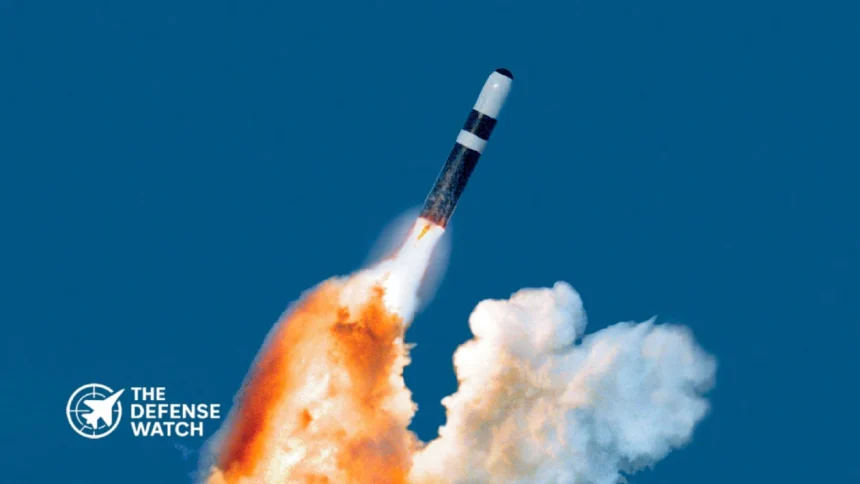
Northrop Grumman Trident II contract
SHARE

Northrop Grumman Systems Corp. has received a $43.86 million U.S. Navy contract to design new rocket motor dry and grind production facilities and associated equipment at the Naval Industrial Reserve Ordnance Plant (NIROP) in Magna, Utah.

Contents
  • Why the Navy is investing in rocket motor infrastructure
  • What dry and grind production facilities mean
  • Sole-source award and funding details
  • Implications for the U.S. sea-based nuclear deterrent

The firm-fixed-price award supports the Navy’s Trident II (D5) Strategic Weapon System. Work is scheduled for completion by Aug. 31, 2028, according to the contract announcement. The Navy will fund the full award through fiscal 2026 weapons procurement funds.

The contract, numbered N0003027C2002, was awarded by the Navy’s Strategic Systems Programs office as a sole-source acquisition under 10 U.S. Code 2304(c)(1), which permits noncompetitive procurement under specified circumstances.

The award covers facility and equipment design. The announcement does not establish the total cost of subsequent construction, when the new facilities will become operational, or whether the project will increase missile production capacity.

- Advertisement -

Why the Navy is investing in rocket motor infrastructure

The contract concerns an industrial element of the United States’ submarine-launched nuclear deterrent: the production infrastructure needed to support the Trident II D5 missile.

The D5 is a three-stage, solid-fuel ballistic missile deployed aboard U.S. Ohio-class ballistic missile submarines. It is also part of the planned weapons capability of the Columbia-class submarine fleet, which is being developed to replace the aging Ohio-class force.

According to the Department of Defense’s fiscal 2026 weapons budget documentation, the Trident II program includes procurement of solid rocket motors and replacement of legacy tooling and test support equipment. The same budget identifies missile life-extension work as necessary to address component obsolescence and sustain the system over an extended service life.

The Magna design contract fits within this wider requirement to maintain the industrial and technical infrastructure supporting the strategic weapon system. However, the available award details do not explicitly identify the project as a production expansion, a replacement for existing facilities, or a response to a specific manufacturing bottleneck.

That distinction matters. Designing new facilities can support future production needs, but it does not by itself demonstrate that manufacturing output will increase.

What dry and grind production facilities mean

The Navy’s announcement identifies dry and grind production facilities as the project’s purpose but provides no detailed description of the planned equipment or manufacturing processes.

In solid rocket motor manufacturing, production infrastructure must support tightly controlled processes involving propellant materials, motor components, specialized machinery and quality assurance. The precise functions of the proposed Magna facilities, including the materials to be processed and the equipment to be installed, have not been publicly specified in the contract description.

The award therefore should not be interpreted as confirmation of a new rocket motor design or a change to the Trident II missile’s performance. Its stated scope is facility and equipment design, rather than missile development or flight testing.

- Advertisement -

The distinction also affects the project’s likely schedule. The contract’s August 2028 completion date applies to the awarded work, but the announcement does not provide a separate construction schedule or a date for the start of production at the proposed facilities.

Sole-source award and funding details

The Navy awarded the contract to Northrop Grumman without a competitive procurement. The cited legal authority, 10 U.S. Code 2304(c)(1), permits an exception to full and open competition when only one responsible source is available and no other supplies or services will satisfy the agency’s requirements.

The public contract notice does not provide the detailed justification for selecting Northrop Grumman or explain why another supplier could not perform the work.

The financial terms are more specific. The Navy obligated $43,856,500 in fiscal 2026 weapons procurement funds at the time of the award. The announcement states that none of those funds will expire at the end of the current fiscal year.

The contract is administered by Strategic Systems Programs in Washington, D.C., the Navy organization responsible for the sea-based strategic weapons program.

Implications for the U.S. sea-based nuclear deterrent

The Trident II D5 remains a central component of the United States’ sea-based nuclear deterrent. Its operational role depends not only on the missiles carried aboard submarines, but also on the continued availability of manufacturing, maintenance, testing and support infrastructure.

The Navy’s fiscal 2026 budget describes ongoing efforts to sustain the existing D5 and develop its D5 Life Extension 2 successor effort, which is intended to support the future force and extend the system’s service life into the coming decades.

Industrial facilities are part of that long-term requirement. Specialized equipment and production infrastructure must remain available as components age, legacy tooling requires replacement and the submarine fleet transitions toward the Columbia class.

For Northrop Grumman, the award adds a defined facility-design task to its defense manufacturing work. For the Navy, the immediate outcome is a funded design effort with a completion deadline in 2028.

The larger production implications remain uncertain. The contract announcement does not disclose planned facility capacity, expected manufacturing throughput, construction costs or the number of rocket motors that the proposed infrastructure would support.

Those details will be needed to assess whether the project primarily sustains existing production capabilities or creates additional capacity for the Trident II program.


TAGGED:missile productionNorthrop GrummanTrident II D5U.S. Navy
Share This Article
Facebook Copy Link Print
BySamuel Drake | Defense Analyst
Follow:
Samuel Drake is a defense analyst at TheDefenseWatch.com covering naval warfare, military ordnance, maritime technology, fleet modernization, and defense procurement. His reporting focuses on documented capabilities, procurement programs, and military technology.

Latest Defense Systems

  • F-100 Super Sabre F-100 Super Sabre
  • North American F-86 Sabre North American F-86 Sabre
  • North American XB-70 Valkyrie North American XB-70 Valkyrie
  • Northrop YF-23 Fighter Northrop YF-23 Fighter
  • P-51 Mustang Fighter Aircraft P-51 Mustang Fighter Aircraft
  • Rafale F5 Fighter Rafale F5 Fighter
  • Tomahawk Block V Missile Tomahawk Block V Missile
  • Tomahawk Block IV Missile Tomahawk Block IV Missile
  • SU-57 Felon Stealth Fighter SU-57 Felon Stealth Fighter

Recent Compares

  • J-10C vs JF-17 Thunder: Which Fighter Is More Capable? J-10C vs JF-17 Thunder: Which Fighter Is More Capable? View Comparison →
  • Tejas vs Gripen: Key Differences and Capabilities Tejas vs Gripen: Key Differences and Capabilities View Comparison →
  • Tejas vs MiG-21 Bison: How India Replaced Its Iconic Supersonic Fighter Tejas vs MiG-21 Bison: How India Replaced Its Iconic Supersonic Fighter View Comparison →
  • F-35 vs F-16: Stealth, Sensors and Combat Roles F-35 vs F-16: Stealth, Sensors and Combat Roles View Comparison →
  • Tejas Fighter Jet vs F-16 Fighting Falcon: Capability Compared Tejas Fighter Jet vs F-16 Fighting Falcon: Capability Compared View Comparison →
  • Rafale Fighter Jet vs F-16 Fighting Falcon : Which Fighter Has the Edge? Rafale Fighter Jet vs F-16 Fighting Falcon : Which Fighter Has the Edge? View Comparison →
  • Su-57 Fighter Jet vs J-20 Fighter Jet: Stealth and Air Combat Compared Su-57 Fighter Jet vs J-20 Fighter Jet: Stealth and Air Combat Compared View Comparison →
  • Mirage 2000 vs Tejas Mk1A: Legacy Combat Power vs Indigenous Modernization Mirage 2000 vs Tejas Mk1A: Legacy Combat Power vs Indigenous Modernization View Comparison →
  • Rafale Fighter Jet vs F-22 Raptor: Which Air Dominance Fighter Has the Edge? Rafale Fighter Jet vs F-22 Raptor: Which Air Dominance Fighter Has the Edge? View Comparison →
  • Tejas Fighter Jet vs. Rafale Fighter Jet: India’s Indigenous Fighter Meets France’s Proven Multirole Combat Aircraft Tejas Fighter Jet vs. Rafale Fighter Jet: India’s Indigenous Fighter Meets France’s Proven Multirole Combat Aircraft View Comparison →

Recent Posts

  • Pratt & Whitney Begins $100 Million Polish Expansion for F-35 Engine Parts
  • Northrop Grumman Wins $43.9 Million Contract for Trident II Rocket Motor Facilities
  • Ukraine Drone Strikes Disrupt Russian Data Centers, Raising Questions About AI Infrastructure Security
  • Lockheed Martin Wins $114.6 Million Contract to Redesign F-35 Navigation Systems
  • Project Agincourt Pushes Pentagon to Speed Up Autonomous Weapons Fielding

You Might Also Like

NAVFAC Northwest construction contract
Defense Contracts

Navy Awards $9 Billion Northwest Construction Contract

October 1, 2026
U.S. Air Force repair services contract
Defense Contracts

U.S. Air Force Awards $300 Million Repair Services Contracts To 17 Companies To Strengthen Sustainment Capability

July 31, 2026
Daniel Defense MK18
Conventional Weapons & ModernizationMilitary & Ordnance

The Daniel Defense MK18: CQBR Heritage Meets Modern Residential Defense

September 13, 2026
Cheongeom missile system South Korea
Artillery & Missile SystemsMilitary & Ordnance

South Korea Completes Cheongeom Missile Final Certification For Light Armed Helicopters

September 7, 2026

Logo

Copyright © 2026 TheDefenseWatch.com

Helpful Links

  • Home
  • About Us
  • Privacy Policy
  • Terms of Use / Disclaimer
  • U.S. Privacy Notice – CCPA Compliance

Defense Systems

  • Defense Systems
  • Comparisons 
  • Manufacturer
  • Tactical Calculators

Popuplar

Which 5 Air Forces Possess the Costliest Fighter Jet Fleets in the World
Evolving Strategic Value: Carrier Strike Groups in the Indo-Pacific’s Future Security Architecture
Autonomous Weapon Systems Spark U.S. Ethics Debate Amid Rapid Military AI Integration

We report on developments involving military forces, governments, defense companies, research organizations, and security institutions around the world. 

Welcome Back!

Sign in to your account

Username or Email Address
Password

Lost your password?