• Home
  • About
  • Defense Systems
  • Manufacturer
  • Comparisons
  • Compare 
  • Tools
TheDefenseWatch.com
  • Aerospace & Aviation
  • Military & Ordnance
  • Naval & Maritime
  • Cyber & Space Defense
  • Policy & Strategy
  • Global News
  • Tools Library
    • Smart Calculator
    • Drone Flight Time Calculator
    • Drone Range Calculator
    • Counter-Drone Jammer Effective Range Calculator
    • Counter-Battery Radar Detection Calculator
    • Artillery Fire Correction Calculator
    • Thermal Camera Detection Range Calculator
    • Missile Range & Time-of-Flight Calculator
    • Radar Detection Range Calculator
    • FPV Strike Drone Payload vs Range Calculator
    • Loitering Munition Endurance Calculator
    • Sniper Ballistic Drop & Windage Calculator
    • Bullet Drop Calculator
    • U.S. Army Combat Fitness Test (ACFT) Calculator
    • Military Pension Calculator
    • Military Retirement Calculator
    • Military Pension Calculator
    • Large Number Calculator
Font ResizerAa

TheDefenseWatch.com

The Defense Watch | U.S. & Global Defense News, Analysis & Military Updates

Search
  • Home
  • About
  • Defense Systems
  • Manufacturer
  • Comparisons
  • Compare 
  • Tools

Stay Updated

Get the latest update

Subscribe

Explore

  • Drone
  • Fighter Jets & Military Aircraft
  • Hypersonic Weapons
  • Aircraft Carriers
  • Strategic History & Missions
  • Tools Library
Home » USS Abraham Lincoln CO Addresses Crew Welfare Concerns After 322-Day Deployment
Aircraft CarriersNaval & Maritime

USS Abraham Lincoln CO Addresses Crew Welfare Concerns After 322-Day Deployment

Samuel Drake | Defense Analyst
Last updated: October 8, 2026 11:00 pm
Samuel Drake | Defense Analyst
Share
3 Min Read
USS Abraham Lincoln deployment
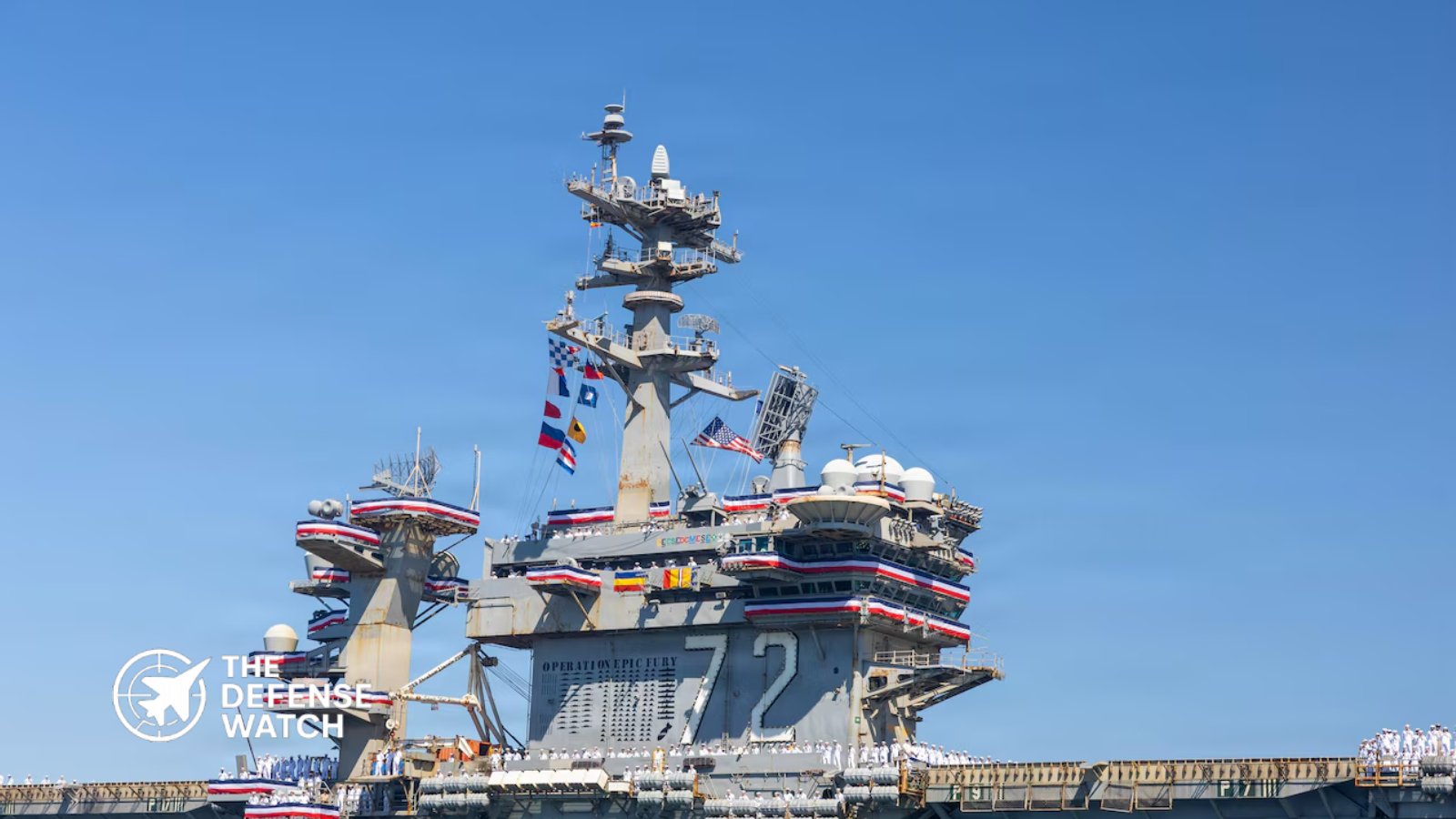
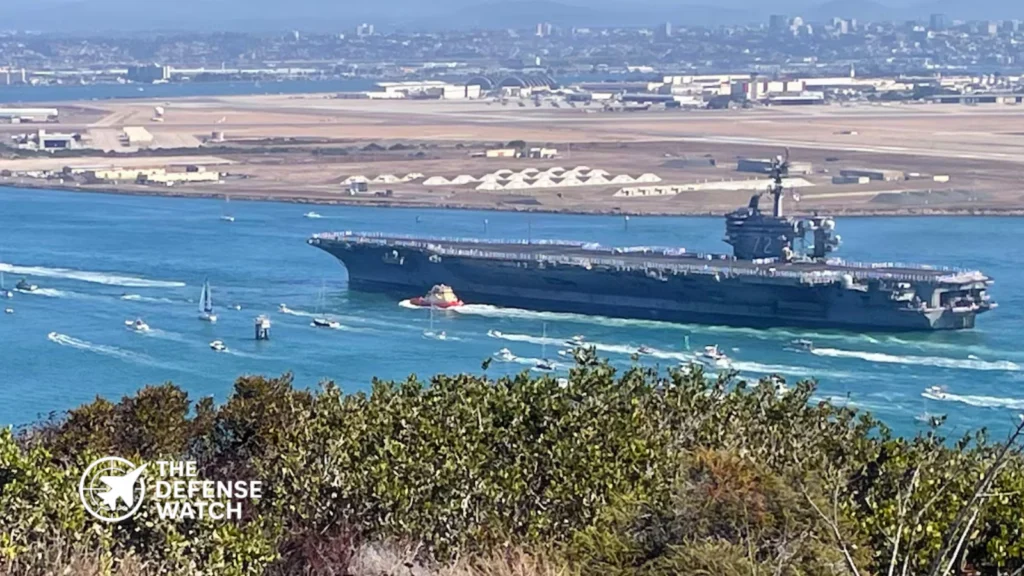
The aircraft carrier USS Abraham Lincoln returns to its home station at Naval Air Station North Island, Calif., Oct. 8, 2026. (Image: DoW)
SHARE
Follow The Defense Watch on Google:

USS Abraham Lincoln CO Addresses Crew Welfare Concerns After Extended Deployment

The commanding officer of the USS Abraham Lincoln said temporary supply constraints and plumbing disruptions aboard the aircraft carrier occurred primarily during March and April, when the ship was supporting U.S. combat operations against Iran. His comments came on October 8, as the carrier returned to Naval Air Station North Island, California, after an extended deployment that renewed scrutiny of sailor welfare and the Navy’s ability to sustain forces at sea.

Contents
USS Abraham Lincoln CO Addresses Crew Welfare Concerns After Extended DeploymentWhat the commanding officer said about conditions aboard LincolnCombat logistics tested the carrier strike group’s supply chainThe deployment’s duration raises wider personnel concernsWhat the Navy’s account establishes, and what remains unresolved

Capt. Daniel Keeler said the ship maintained its combat mission despite the logistical pressures. However, his account also placed the reported problems within a wider operational challenge: keeping thousands of sailors supplied during a prolonged deployment with limited opportunities to return to port.

The Department of War described the deployment as lasting 322 days. Independent reporting by USNI News counted 321 days from the carrier’s departure on November 21, 2025, to its return on October 8, 2026. The difference reflects a discrepancy in how the duration was reported, rather than a reason to treat the two figures as interchangeable.

  • USS Abraham Lincoln Aircraft Carrier

    USS Abraham Lincoln Aircraft Carrier

    • Large Flight Deck: 330+ meters for CATOBAR operations
    • Onboard Air Wing: F/A-18E/F, E-2 Hawkeye, MH-60 helicopters
    • Advanced Command & Control: Integrated CIC, air ops management
    • Defensive Weapon Systems: CIWS, Sea Sparrow, electronic warfare
    • View Details →
    8.3

    What the commanding officer said about conditions aboard Lincoln

    Responding to questions about reports of shortages of food and potable water, along with plumbing problems, Keeler said the most difficult period occurred while the carrier strike group was conducting combat operations in the spring.

    He told reporters that the crew had been informed that some supplies could become limited temporarily because of operational demands. Keeler nevertheless rejected the suggestion that the ship lacked the food necessary to carry out its mission.

    According to the commanding officer, the carrier continued to conduct its assigned operations without missing a mission. He said the ship served four meals a day, with between 14,000 and 16,000 meals provided daily across the crew.

    USS Abraham Lincoln deployment
    The aircraft carrier USS Abraham Lincoln, the flagship of Carrier Strike Group 3, returns to its home port of San Diego, Oct. 8, 2026, following a 10-month deployment to the U.S. 5th and 7th Fleet areas of operations. (Image: DoW)

    Those remarks establish the command’s account of food service and operational continuity. They do not, on their own, independently resolve every reported concern about the availability of particular food items, drinking water or other everyday necessities during the deployment.

    Keeler also addressed plumbing disruptions, describing clogged toilets and similar maintenance problems as recurring issues aboard a large warship. He said trained sailors repaired equipment when it failed and characterized the problems experienced during the deployment as falling within what he considered the normal range for an aircraft carrier, despite the additional demands of combat.

    The distinction matters. A carrier can remain operationally effective while individual systems or services experience temporary interruptions. Mission completion is an important measure of military performance, but it does not by itself establish that every aspect of crew living conditions remained satisfactory throughout an unusually long deployment.

    Combat logistics tested the carrier strike group’s supply chain

    Rear Adm. Robert E. Loughran, commander of Carrier Strike Group 3, said Operation Epic Fury required the Navy to adapt how it supplied deployed forces in the Middle East.

    Loughran described a rapid expansion of the logistical burden after combat began, with supply lines extending while the number of forces operating in the theater increased. He said the Navy adjusted its approach to supplying deployed ships rather than relying solely on requests made by individual vessels as needs arose.

    The comments point to a central difficulty in sustaining carrier strike groups during extended operations. A carrier depends on a continuous flow of food, fresh water, spare parts, fuel and other supplies. Its escorts have their own requirements, and the entire formation must remain supported while operating at a distance from established bases.

    Replenishment at sea allows the Navy to transfer essential supplies without requiring a ship to enter port. But replenishment schedules, available cargo, weather, operational movements and the location of supporting logistics vessels all affect what can be delivered and when.

    Combat can make those calculations more difficult. Ships may need to remain on station, follow changing tasking or operate in areas where routine logistics movements are constrained. When deployments extend beyond their planned duration, the Navy must also manage the cumulative effect on personnel, maintenance and resupply requirements.

    Loughran’s remarks suggest that the Navy intends to apply lessons from the operation to future supply planning. His public comments, however, did not provide detailed figures showing how much the revised logistics approach improved delivery times or reduced shortages.

    • USS Abraham Lincoln Aircraft Carrier

      USS Abraham Lincoln Aircraft Carrier

      • Large Flight Deck: 330+ meters for CATOBAR operations
      • Onboard Air Wing: F/A-18E/F, E-2 Hawkeye, MH-60 helicopters
      • Advanced Command & Control: Integrated CIC, air ops management
      • Defensive Weapon Systems: CIWS, Sea Sparrow, electronic warfare
      • View Details →
      8.3

      The deployment’s duration raises wider personnel concerns

      Lincoln’s return also closes a demanding period for its crew and illustrates the pressure that extended carrier deployments can place on sailors and their families.

      USNI News reported that the carrier spent 265 consecutive days at sea before making a logistics stop in Thailand in September and subsequently stopping in Guam. The deployment had initially been intended for the Indo-Pacific but shifted toward the Middle East as operational requirements changed.

      The deployment also prompted concerns about mental health. USNI News reported that eight sailors attempted suicide during the deployment, underscoring that personnel welfare extends beyond food service and maintenance. The report does not establish that any single onboard condition caused those incidents, and that distinction should be preserved in coverage of the issue.

      The Navy now faces the task of returning the carrier and its crew to their regular cycle of maintenance, training and preparation. Extended operations can complicate that schedule, particularly when a ship has already spent substantial time deployed before being redirected to a new theater.

      The Lincoln’s experience also raises questions about how the Navy plans for contingencies that extend deployments well beyond their original schedules. Adequate food and water, functioning sanitation systems, access to medical and mental health care, and reliable communication with families remain essential requirements, even when operational demands are high.

      What the Navy’s account establishes, and what remains unresolved

      Keeler’s remarks provide the command’s explanation for the reported supply and plumbing problems. They also establish that Navy leadership considers the deployment an example of maintaining operational performance under difficult logistical conditions.

      However, the public statements cited here do not provide a detailed, independent accounting of the duration or frequency of supply shortages, water availability or plumbing failures. Nor do they quantify the effects of those problems on individual sailors.

      That information would help distinguish temporary disruptions associated with combat operations from more persistent shortcomings in deployment planning or onboard support. It would also help establish whether the changes described by Loughran will reduce the likelihood of similar problems during future extended missions.

      For now, the carrier’s return demonstrates the Navy’s ability to sustain a major combat platform through a prolonged deployment. Assessing the full outcome requires considering both the missions completed and the conditions under which the crew carried them out.

Enjoying our coverage?

Make The Defense Watch a preferred source on Google to see more of our geopolitical and defense insights when relevant to you.


TAGGED:Naval LogisticsOperation Epic FuryU.S. NavyUSS Abraham Lincoln
Share This Article
Facebook Copy Link Print
BySamuel Drake | Defense Analyst
Follow:
Samuel Drake is a defense analyst at TheDefenseWatch.com covering naval warfare, military ordnance, maritime technology, fleet modernization, and defense procurement. His reporting focuses on documented capabilities, procurement programs, and military technology.
Leave a Comment

Leave a Reply Cancel reply

Your email address will not be published. Required fields are marked *

Search Defense Systems

Latest Defense Systems

  • Ilyushin Il-20 Coot Aircraft Ilyushin Il-20 Coot Aircraft
  • FGM-148 Javelin Anti-Tank Missile FGM-148 Javelin Anti-Tank Missile
  • F-104 Starfighter F-104 Starfighter
  • F-15J Eagle Fighter Jet F-15J Eagle Fighter Jet
  • China’s GJ-21 Stealth Drone China’s GJ-21 Stealth Drone
  • China’s GJ-11 Stealth Drone China’s GJ-11 Stealth Drone
  • F-15EX Eagle Fighter Jet F-15EX Eagle Fighter Jet
  • TRML-4D Radar TRML-4D Radar
  • F-47A Fighter Jet F-47A Fighter Jet

Recent Compares

  • J-10C vs JF-17 Thunder: Which Fighter Is More Capable? J-10C vs JF-17 Thunder: Which Fighter Is More Capable? View Comparison →
  • Tejas vs Gripen: Key Differences and Capabilities Tejas vs Gripen: Key Differences and Capabilities View Comparison →
  • Tejas vs MiG-21 Bison: How India Replaced Its Iconic Supersonic Fighter Tejas vs MiG-21 Bison: How India Replaced Its Iconic Supersonic Fighter View Comparison →
  • F-35 vs F-16: Stealth, Sensors and Combat Roles F-35 vs F-16: Stealth, Sensors and Combat Roles View Comparison →
  • Tejas Fighter Jet vs F-16 Fighting Falcon: Capability Compared Tejas Fighter Jet vs F-16 Fighting Falcon: Capability Compared View Comparison →
  • Rafale Fighter Jet vs F-16 Fighting Falcon : Which Fighter Has the Edge? Rafale Fighter Jet vs F-16 Fighting Falcon : Which Fighter Has the Edge? View Comparison →
  • Su-57 Fighter Jet vs J-20 Fighter Jet: Stealth and Air Combat Compared Su-57 Fighter Jet vs J-20 Fighter Jet: Stealth and Air Combat Compared View Comparison →
  • Mirage 2000 vs Tejas Mk1A: Legacy Combat Power vs Indigenous Modernization Mirage 2000 vs Tejas Mk1A: Legacy Combat Power vs Indigenous Modernization View Comparison →
  • Rafale Fighter Jet vs F-22 Raptor: Which Air Dominance Fighter Has the Edge? Rafale Fighter Jet vs F-22 Raptor: Which Air Dominance Fighter Has the Edge? View Comparison →
  • Tejas Fighter Jet vs. Rafale Fighter Jet: India’s Indigenous Fighter Meets France’s Proven Multirole Combat Aircraft Tejas Fighter Jet vs. Rafale Fighter Jet: India’s Indigenous Fighter Meets France’s Proven Multirole Combat Aircraft View Comparison →

Recent Posts

  • Russia Uses Cold War-Era Il-20 Spy Plane to Monitor Ukrainian Radar From Belarus
  • Boeing Receives $11.7 Million Air Force Contract Modification for VC-25B Parts Repair
  • U.S. Navy Awards DRS Systems $19.8 Million to Expand DAIRCM Testing Capacity
  • Lockheed Martin Wins $47.9 Million Navy Combat System Integration Contract
  • Florida National Guard Builds Flood Barrier to Protect Sanford Hospital

You Might Also Like

UK Carrier Strike Group
Aircraft CarriersNaval & Maritime

UK Carrier Strike Group Expands NATO Maritime Capability In Arctic Under Arctic Sentry Mission

September 8, 2026
MH-60R helicopter delivery
Aerospace & AviationFighter Jets & Military Aircraft

Lockheed Martin Delivers 350th MH-60R Helicopter to U.S. Navy, Marking Major ASW Milestone

January 13, 2026
US submarine sinks Iranian warship
Naval & MaritimeSubmarines

US Submarine Sinks Iranian Warship In Indian Ocean, First Torpedo Kill Since World War II

September 7, 2026
KC-135 tanker crash Iraq
Global News

US KC-135 Tanker Crash In Iraq During Operation Epic Fury Raises Questions About Air Campaign Tempo

September 7, 2026

Logo

Copyright © 2026 TheDefenseWatch.com

Helpful Links

  • Home
  • About Us
  • Privacy Policy
  • Terms of Use / Disclaimer
  • U.S. Privacy Notice – CCPA Compliance

Defense Systems

  • Defense Systems
  • Comparisons 
  • Manufacturer
  • Tactical Calculators

Popuplar

Which 5 Air Forces Possess the Costliest Fighter Jet Fleets in the World
Evolving Strategic Value: Carrier Strike Groups in the Indo-Pacific’s Future Security Architecture
Autonomous Weapon Systems Spark U.S. Ethics Debate Amid Rapid Military AI Integration

We report on developments involving military forces, governments, defense companies, research organizations, and security institutions around the world. 

Welcome Back!

Sign in to your account

Username or Email Address
Password

Lost your password?

Enjoying our coverage?

Make The Defense Watch a preferred source on Google to see more insights.