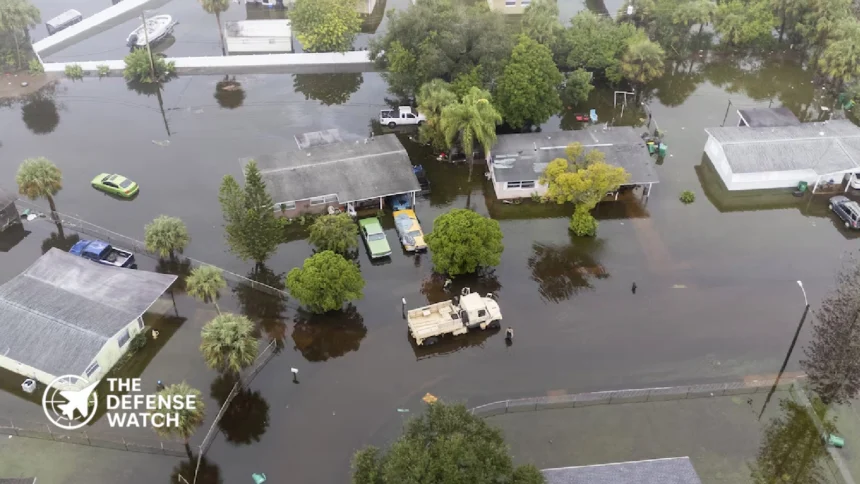
SANFORD, Florida, November 24, 2026: Florida Army National Guard soldiers have joined local emergency responders to install a temporary flood barrier outside a hospital in Sanford, Florida, as persistent heavy rainfall threatens critical infrastructure across the state.
The operation involved soldiers from Battery A, 1st Battalion, 265th Air Defense Artillery Regiment, who helped construct a modular flood containment system on November 20. The barrier was positioned between rising water and the hospital to reduce the risk of flooding and preserve access for patients, medical personnel and emergency vehicles.
According to the U.S. Army, the soldiers worked alongside county emergency management personnel, public works crews and hospital staff during the installation.
Tiger Dam system provides an alternative to sandbags
The flood protection effort used a Tiger Dam system, a reusable barrier made from interconnected, water-filled tubes.
Unlike conventional sandbags, which require substantial quantities of filled bags and significant manpower to position, modular barriers can be connected and arranged to follow different site configurations.
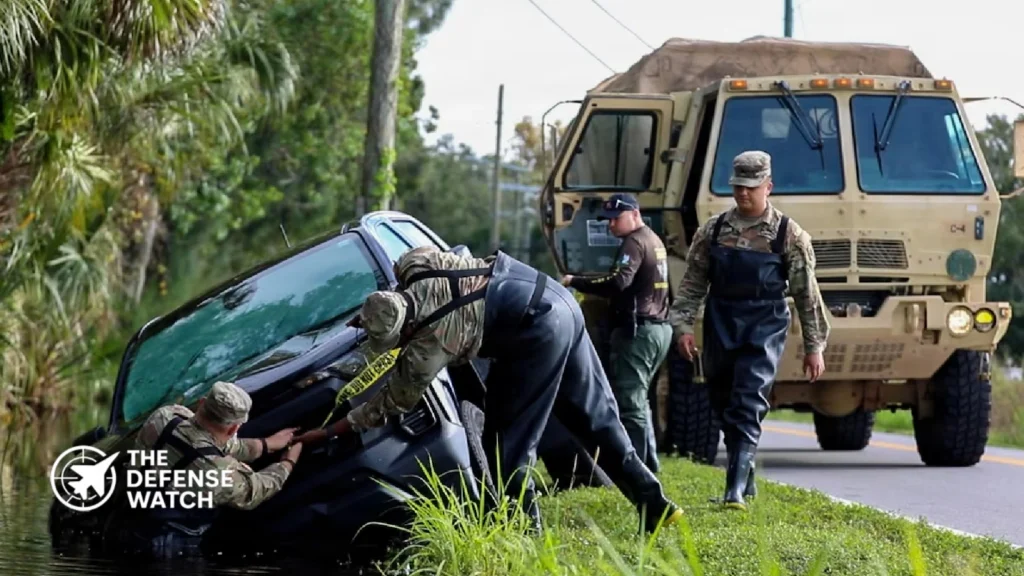
First Lt. Adam Szlembarski, an air defense artillery officer assigned to the unit, explained that the system could be fastened, folded and bent up to 90 degrees to accommodate the hospital’s surrounding terrain.
The Florida National Guard emphasized that Tiger Dams are not standard military equipment. Instead, soldiers provided manpower and installation support to civilian authorities using equipment intended for flood mitigation.
This distinction is important. The operation demonstrates the Guard’s ability to apply military personnel and organizational capabilities to civilian emergency requirements without relying exclusively on military-specific equipment.
Protecting hospital access during flooding
Hospitals are particularly vulnerable during severe flooding because their operations depend on uninterrupted electricity, medical supplies, staff availability and emergency transportation routes.
Even when a hospital building remains operational, surrounding roadways and access points can become unusable as water levels rise.
Sgt. Maxwell Worthington, an air and missile defense crewmember assigned to the same battalion, said maintaining access for patients, employees and emergency vehicles was a central objective of the operation.
The installation therefore addressed more than the risk of water entering the hospital building. It also sought to preserve the movement of people and emergency services around the facility.
Florida state officials subsequently identified the protected facility as HCA Florida Lake Monroe Hospital in Sanford. The governor’s November 23 emergency response update confirmed that flood barriers had been deployed around the hospital.
Florida expands its National Guard disaster response
The Sanford operation is part of a wider state response to extensive flooding across central and southern Florida.
According to the Florida governor’s November 23 update, the Florida National Guard had mobilized 421 personnel, completed 417 welfare checks and deployed 54 high-water vehicles across six counties.
State agencies had also completed nearly 500 floodwater rescues, while more than 10,000 feet of Tiger Dam barriers had been deployed to protect critical infrastructure.
The state reported that parts of Florida received between 15 and 20 inches of rainfall during the preceding week. Flooding affected multiple communities, creating additional demands for rescue operations, infrastructure protection and recovery assistance.
The deployment reflects the National Guard’s dual state and federal responsibilities. Under state authority, Guard personnel can support civilian agencies during emergencies, including natural disasters, infrastructure protection and public safety operations.
This role is commonly described as Defense Support of Civil Authorities (DSCA).
Why the operation matters for U.S. military readiness
The Florida mission illustrates an important part of domestic military readiness that receives less attention than combat deployments and weapons modernization.
National Guard formations maintain military capabilities while also serving as a readily available resource for state emergency management.
Air defense artillery personnel, for example, are trained for military missions involving air and missile defense. During a domestic emergency, however, their personnel, organizational discipline and ability to operate alongside other agencies can support entirely different requirements.
The Sanford operation also demonstrates the importance of interagency coordination. National Guard personnel, local public works teams, emergency management officials and hospital employees had to coordinate the placement and securing of the temporary barrier.
However, the operation should not be interpreted as evidence that military air defense units are being reorganized for disaster relief. Their primary military roles remain unchanged.
The more immediate lesson is that National Guard formations can provide additional manpower and operational support when civilian emergency services face demands beyond their normal capacity.
For Florida, maintaining hospital access during flooding is a practical public safety requirement. The effectiveness of the response will depend on changing water levels, the condition of surrounding infrastructure and continued coordination between state and local authorities.
The Sanford deployment provides a clear example of how military personnel can support critical civilian infrastructure during a natural disaster, even when the equipment being installed is not designed for military operations.
Enjoying our coverage?
Make The Defense Watch a preferred source on Google to see more of our geopolitical and defense insights when relevant to you.