
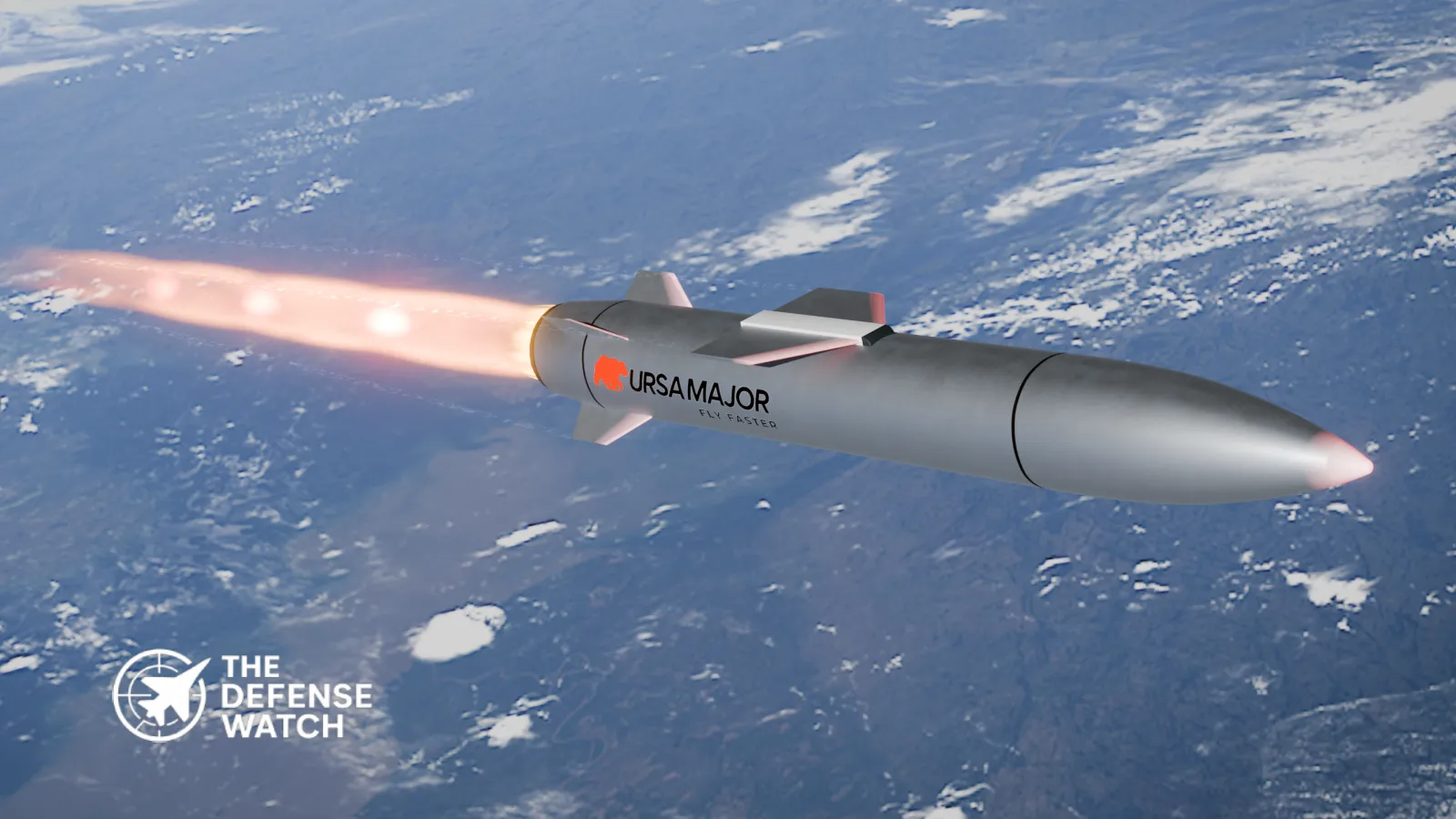
- ► Ursa Major has introduced the HAVOC hypersonic missile system, focused on scalable and affordable military production.
- ► The system is powered by the Draper liquid rocket engine, designed to be storable and throttleable.
- ► HAVOC is designed to operate in and above the atmosphere and integrate with multiple launcher types.
- ► The company draws on prior hypersonic propulsion work, including its Hadley engine program.
- ► The modular design supports potential launch from air, ground, and vertical systems.
New Hypersonic Missile System Debuts With Focus on Scale and Cost
Ursa Major’s HAVOC hypersonic missile system stands out as a new medium-range hypersonic capability positioned to meet the U.S. military’s demand for scalable, cost-aware strike options. The announcement, made February 24, 2026, highlights a complete missile system designed for rapid production and multi-domain use.
Hypersonic weapons fly at speeds greater than five times the speed of sound and can maneuver during flight, complicating defense efforts against them. In recent years, the United States has sought to advance its hypersonic arsenal amid global developments from Russia and China. HAVOC enters this landscape as a system engineered to balance capability with manufacturability.
Draper Engine Power and Modular Design
At the core of HAVOC is the Draper liquid rocket engine, a storable and throttleable propulsion unit developed by Ursa Major. The engine’s design aims to provide the control and flexibility that traditional solid rockets lack, while easing storage and handling challenges associated with liquid fuels.
The missile’s modular architecture allows integration with a range of booster options. This flexibility could allow launch from tactical aircraft, strategic bombers, ground-based systems, or vertical launch cells without extensive reconfiguration.
Ursa Major emphasizes affordability through advanced additive manufacturing and design choices that reduce reliance on heavy thermal protection systems often required for hypersonic flight. These choices align with broader U.S. priorities to produce more units at lower cost.
Built on Hypersonic Development Experience
Ursa Major brings to HAVOC a decade of work on hypersonic engines and demonstrators. The company previously developed the Hadley liquid rocket engine, which achieved sustained hypersonic speeds on flight tests with Stratolaunch’s TA-2 testbed, showing practical propulsion performance at extreme conditions.
That experience supports Ursa Major’s push to field complete hypersonic systems rather than standalone propulsion units. The Affordable Rapid Missile Demonstrator program with the Air Force Research Laboratory also reflects the company’s efforts to deliver complete all-up rounds for evaluation and potential integration.
Strategic Context and Production Emphasis
The U.S. defense community has signaled urgency in fielding hypersonic capabilities to match or outpace competitors. A recent hypersonic engine contract from the Air Force Research Laboratory underscores government investment in propulsion technologies like Draper, which could be key to both offensive and defensive programs.
By designing HAVOC for manufacturability and modularity, Ursa Major aims to provide the joint force with options that can be scaled more effectively than earlier, bespoke hypersonic programs. The ability to throttle and restart the engine throughout flight could enhance both mission flexibility and survivability against evolving defense systems.
What Comes Next
Ursa Major’s announcement at the Air and Space Forces Association’s Air Warfare Symposium underscores industry focus on delivering practical hypersonic systems. While official details on range and specific deployment timelines remain limited, HAVOC’s entry signals a shift toward more production-oriented hypersonic solutions.