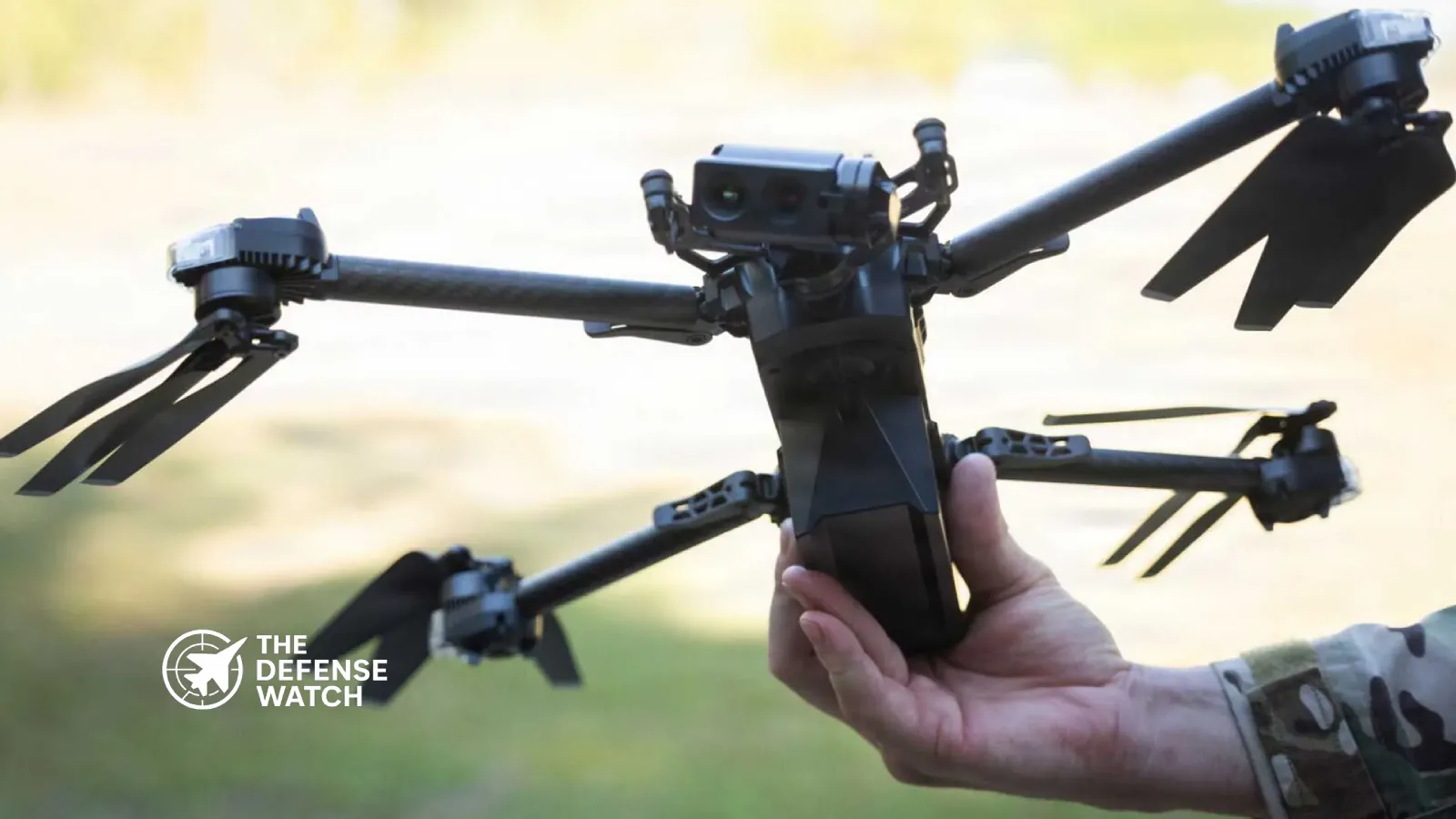
US Air Force Tests Backpack Drones To Support Bomb Disposal Ops
The US Air Force backpack drones reached simulated explosive hazards faster than a tracked ground robot in field testing on February 10, 2026, providing early situational awareness during explosive ordnance disposal missions, Department of War officials said.
At Hurlburt Field, Florida, explosive ordnance disposal (EOD) airmen from the 1st Special Operations Wing conducted a head-to-head comparison between a lightweight unmanned aerial system and a traditional ground robot. The small UAV was carried in a pack, launched quickly, and reached a test objective within seconds, sending live overhead video before the ground system covered half the distance.
The trials explored key operational differences between the two platforms, focusing on mobility, deployment time, and reconnaissance capability. Rapid aerial imagery gave the EOD team a view of the simulated casualty area without requiring close approach.
Portable Drones Complement EOD Tools
EOD units have long depended on heavy ground robots to inspect suspected explosive threats and maintain distance from hazards. Those machines offer physical manipulation capabilities but require transport, setup, and slower transit across terrain. Portable drones carried in backpacks can be readied and airborne within minutes, offering real-time optical and thermal feeds for day and night operations.
Newer systems also include 3D scanning, which can generate precise digital models of blast sites or large areas like runways in minutes. This data supports documentation, hazard assessment, and airfield recovery planning after incidents.
How Backpack UAVs Are Changing EOD Recon
The aerial perspective from compact drones keeps operators farther from potential danger during initial assessment. AI-enabled flight functions such as obstacle avoidance, target tracking, and position holding reduce the operator workload during critical reconnaissance phases.
Officials stressed that portable drones do not replace ground-robot manipulator tasks like lifting, cutting, or flipping suspicious items. Instead, they augment EOD capabilities by speeding early site evaluation and giving teams more data to plan next steps.
Integration Challenges And Next Steps
Integrating small UAVs into EOD workflows requires updates to procedures, training, and shared airspace risk management. Operating drones close to conventional aircraft or in shared environments demands coordination and policy approvals at unit and command levels.
Local testing has helped units identify performance limits and refine methods before broader fielding, Air Force personnel involved in the trials said. The emphasis remains on using portable drones as complementary tools for reconnaissance and initial hazard assessment.