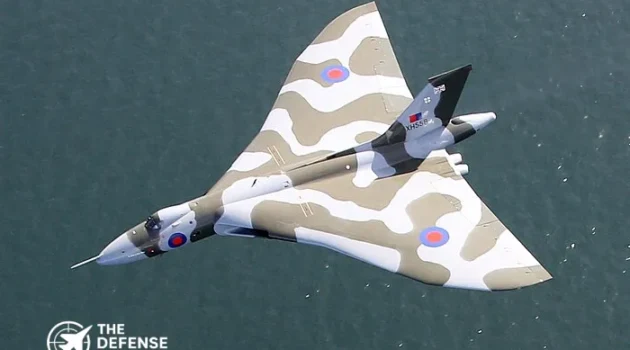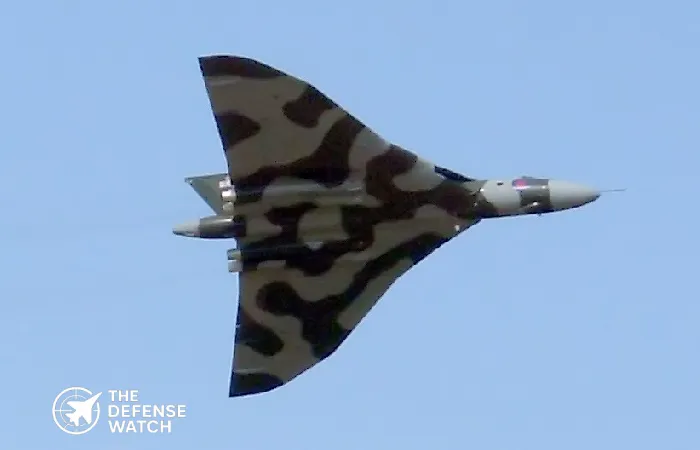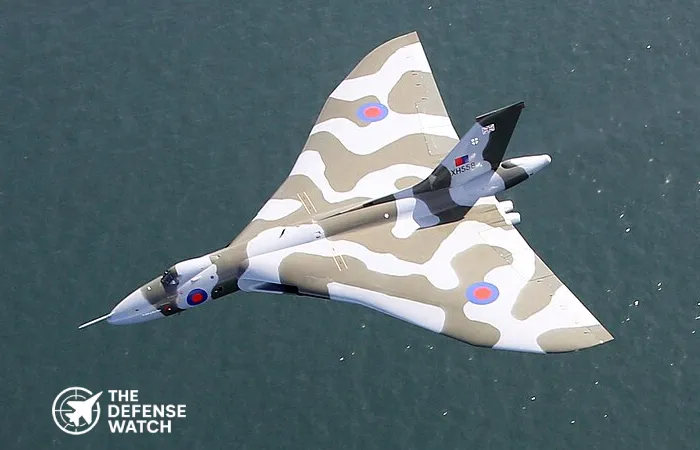

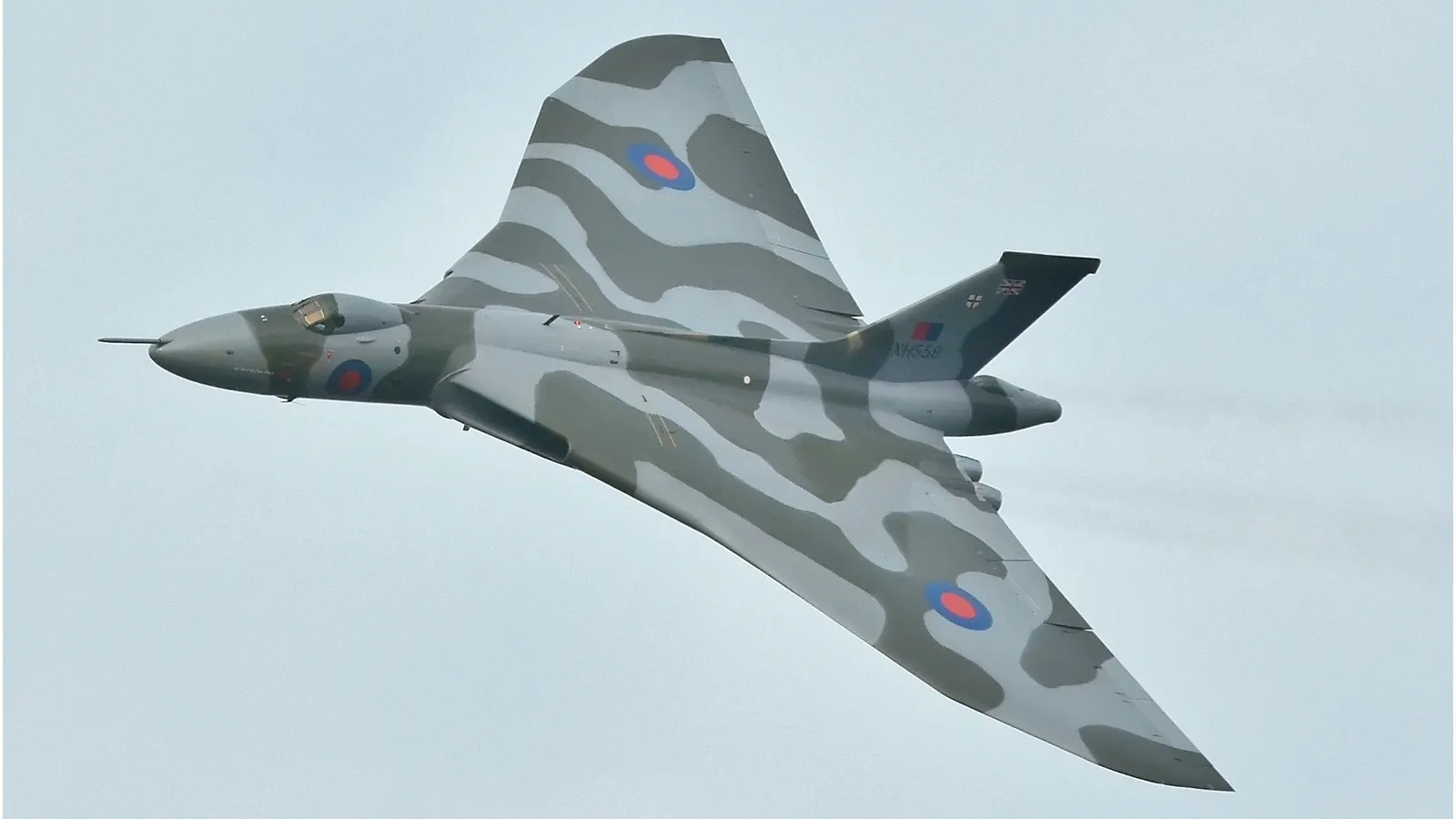
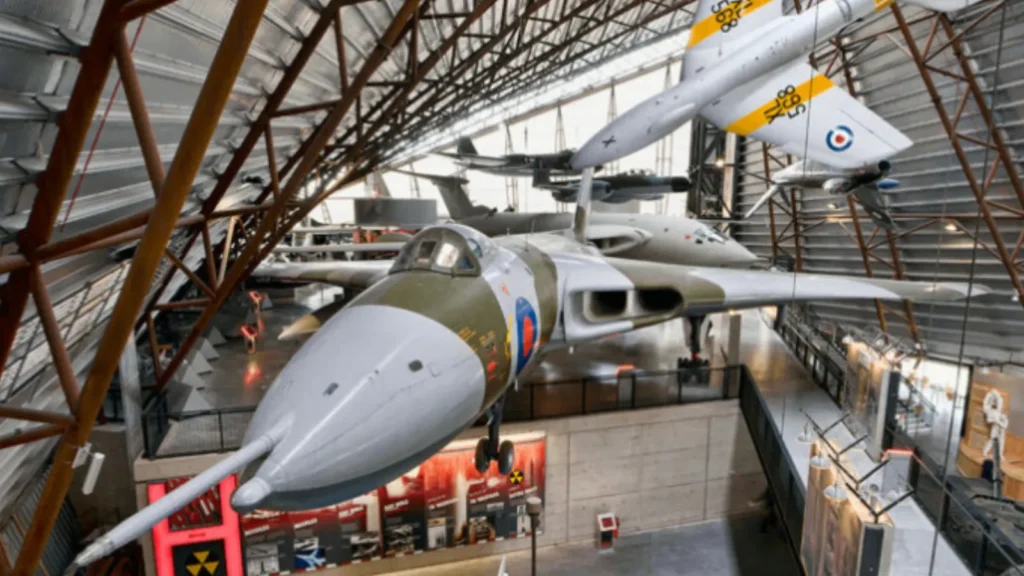
Shortly before midnight on 30 April 1982, a delta-winged relic of the Cold War lifted off a borrowed American runway on a speck of volcanic rock in the mid-Atlantic and turned south, toward an airfield most of its crew had never heard of three weeks earlier. The Avro Vulcan, built to deliver a nuclear strike on Moscow and scheduled for retirement within months, was about to fly the longest bombing raid in history — not against a superpower, but against a single runway on a British sheep-farming colony that Argentina had just invaded. What followed became known as Operation Black Buck, and it remains one of the most improbable examples of Cold War hardware being repurposed, mid-crisis, for a mission its designers never imagined.
| Strategic Brief | Details |
|---|---|
| Codename / Mission | Operation Black Buck (Black Buck 1–7; five missions flown to completion) |
| Date / Theater | 30 April – 12 June 1982, South Atlantic (Ascension Island to Falkland Islands) |
| Executing Force(s) | RAF Waddington Wing (Nos. 44, 50 and 101 Squadrons, Avro Vulcan B.2), supported by Victor K.2 tanker squadrons of RAF Marham |
| Primary Target | Port Stanley Airport runway and associated Argentine air-defense radar network |
| Key Platforms & Tech | Avro Vulcan B.2, Handley Page Victor K.2 tankers, 1,000 lb iron bombs, AGM-45 Shrike anti-radiation missiles, Westinghouse ALQ-101-10 ECM pod |
| Mission Outcome | Limited tactical damage, significant strategic and psychological effect on Argentine air planning |
Strategic Background & Operational Context
When Argentine forces occupied the Falkland Islands on 2 April 1982, Britain’s task force was still weeks from arriving in the South Atlantic. The nearest usable airstrip under British-friendly control was Wideawake Airfield on Ascension Island — itself roughly 3,900 miles from the Falklands and, at the time, leased to the United States Air Force. Britain’s War Cabinet, under Prime Minister Margaret Thatcher, approved the raid concept on 27 April, giving aircrew barely two weeks between the start of specialized training and departure for Ascension.
The tactical bottleneck was straightforward but severe: Port Stanley Airport’s runway was the only airstrip in the islands capable of eventually taking Argentine fast jets, and Royal Navy planners were anxious that if it were lengthened or reinforced, Argentina could rotate high-performance aircraft directly onto the islands rather than flying long-range sorties from the mainland. No aircraft in the RAF inventory except the Vulcan — originally built as a V-force nuclear deterrent bomber — had anything close to the range and payload to reach Stanley and return, and even the Vulcan could only do it with a refueling chain that dwarfed the strike itself. The operation was less a demonstration of overwhelming force than a calculated gamble: a single obsolete bomber, propped up by eleven Victor tankers, sent to put one bomb on a runway 8,000 miles from home to shape Argentine assumptions before the amphibious landings even began.
Engineering & Technological Innovation
The Vulcan B.2 selected for Black Buck had been designed in the 1950s for high-altitude nuclear strike, and by 1982 its conventional bombing systems had atrophied from disuse — 44, 50 and 101 Squadrons had to relearn iron-bomb delivery and, critically, air-to-air refueling techniques the crews had rarely practiced. Engineers fitted underwing pylons, in some aircraft, to carry AGM-45 Shrike anti-radiation missiles supplied by the United States after the RAF’s own anti-radar Martel missile proved unsuitable, alongside a Westinghouse ALQ-101-10 electronic countermeasures pod for self-protection on the early raids.

The real engineering triumph, however, was the refueling architecture built around each strike. A single Vulcan carrying twenty-one 1,000 lb bombs internally needed roughly eleven Handley Page Victor K.2 tankers and multiple in-flight refuelings on the outbound leg alone, with the tanker force itself refueling other tankers in a cascading formation to sustain the lead aircraft’s fuel state across nearly 4,000 miles each way. This “chain refueling” concept, executed at night and in the case of Black Buck 1 through an active electrical storm, was arguably a more significant technical achievement than the bombing run itself — a logistics problem solved almost entirely through airmanship rather than new technology.
For the anti-radar missions, Black Buck 5 and 6, crews had to develop attack geometry from scratch: locating a mobile Westinghouse AN/TPS-43 three-dimensional radar that Argentine operators intelligently repositioned and switched off during Vulcan approaches, then closing to an optimal firing range of roughly 6.9 miles before ripple-firing Shrikes in a shallow dive from a “sanctuary height” near 12,000 feet.
Mission Execution & Key Sorties
Black Buck 1 (30 April–1 May 1982): Two Vulcans departed Wideawake, XM598 as primary and XM607 as reserve under Flight Lieutenant Martin Withers. Shortly after takeoff, XM598’s cabin lost pressurization, and Withers’ XM607 became the primary aircraft with almost no notice. Refueled repeatedly by a chain of Victor tankers commanded in part by Squadron Leader Bob Tuxford, XM607 pressed on through worsening weather to release twenty-one 1,000 lb bombs across Port Stanley’s runway and dispersal areas. One bomb struck the runway directly, cratering it enough to prevent fast-jet operations for the remainder of the conflict, though Argentine crews patched it sufficiently for smaller transport aircraft within days. The round trip covered close to 8,000 miles and roughly sixteen hours in the air — at the time, the longest bombing raid ever flown. Withers received the Distinguished Flying Cross.
Black Buck 2 (3–4 May 1982): A repeat runway attack, again using conventional bombs, with results assessed as less precise than the first mission.
Black Buck 3: Cancelled before launch due to adverse weather.
Black Buck 4 (planned late May): Aborted mid-flight after a tanker refueling-system fault, five hours into the mission — a reminder of how fragile the entire chain-refueling concept was to any single equipment failure.
Black Buck 5 (30–31 May 1982): The first completed anti-radar mission. Squadron Leader Neil McDougall’s crew in XM597 fired two Shrikes at the Westinghouse AN/TPS-43 radar; the missile impacted roughly ten meters from the antenna, causing only minor damage before Argentine operators shut the radar down.
Black Buck 6 (2–3 June 1982): McDougall’s crew returned in XM597, now carrying four Shrikes. After loitering nearly forty minutes hoping the TPS-43 would re-emit, the crew instead engaged and destroyed a Skyguard fire-control radar belonging to the Argentine Army’s 601 Anti-Aircraft Battalion, killing several radar operators. On the return leg, a damaged refueling probe forced XM597 to divert and land at Rio de Janeiro, where Brazilian authorities briefly held the crew and confiscated an unfired Shrike.
Black Buck 7 (12 June 1982): A final conventional strike against Argentine positions near Stanley, using airburst-fused bombs against troop concentrations rather than the runway, flown just two days before Argentina’s surrender.
Tactical Outcome & Operational Assessment
Judged purely by bomb damage, Black Buck’s tactical yield was modest: a single well-placed crater on Black Buck 1, minor damage to secondary fire-control radars, and no destruction of the primary AN/TPS-43 search radar, which survived the entire conflict. Post-war analysis has generally concluded that the runway damage did prevent Argentina from basing fast jets like the A-4 Skyhawk or Mirage III directly on the islands, forcing every Argentine strike sortie to fly from the mainland with reduced loiter time and fuel reserves over the task force — an outcome with real operational consequences even if the physical damage was limited.
The raids’ more debated value was strategic and psychological. They demonstrated, before a single British soldier landed, that the RAF could strike the Argentine mainland’s approaches to the islands at will, complicating Buenos Aires’ calculations about escalation and forcing Argentina to retain fighters at home in case of an attack on the mainland itself — aircraft that were consequently unavailable to contest the Falklands directly. Critics, including some within the RAF and Royal Navy at the time, argued the raids consumed a disproportionate share of scarce tanker assets for uncertain return, and noted that carrier-based Sea Harriers ultimately did more to suppress Stanley’s runway through repeated follow-on strikes. Both assessments are defensible; Black Buck’s significance lies less in tonnage delivered than in the fact that it was attempted at all.
The Modern Connection: Lineage to 21st-Century Warfare
Black Buck’s anti-radar missions, Black Buck 5 and 6, were an early and improvised form of what is now formalized as SEAD/DEAD — Suppression and Destruction of Enemy Air Defenses. The core problem the Vulcan crews faced in 1982, locating a mobile, intermittently-emitting radar and closing to a firing solution before it went dark, is the same targeting problem that modern anti-radiation missiles like the AGM-88 HARM and its successors, and increasingly autonomous loitering munitions, are designed to solve with far greater persistence and reaction time. Where a 1982 Vulcan crew had to loiter for forty minutes hoping a single radar would re-emit, a modern loitering munition or unmanned SEAD platform can remain over a target area for hours, correlating multiple emitters and reattacking without risking a seven-man crew and a irreplaceable Cold War airframe.
The refueling chain that made Black Buck possible also foreshadows a persistent modern constraint: long-range precision strike remains fundamentally a tanker and logistics problem as much as a weapons problem, a lesson visible today in discussions of how the KC-46 Pegasus and MQ-25 Stingray unmanned tanker are meant to extend carrier and land-based strike range in a potential Indo-Pacific contingency against a peer competitor. In that sense, Black Buck’s true legacy is less about the Vulcan itself than about the enduring truth that range, not just ordnance, decides whether a strategic bomber can reach a target at all.
Key Takeaways
- Operation Black Buck sent Cold War-era Avro Vulcan bombers roughly 8,000 miles round trip from Ascension Island to strike Port Stanley Airport — the longest bombing raids in history at the time.
- Each strike required a cascading chain of up to eleven Victor K.2 tankers refueling one another to sustain a single bomber over nearly 4,000 miles each way.
- Of seven planned missions, five were flown to completion: three conventional runway/troop strikes and two AGM-45 Shrike anti-radar missions against Argentine air-defense radars.
- Physical damage was limited, but the raids denied Argentina the ability to base fast jets on the islands and pioneered SEAD tactics still reflected in today’s anti-radiation missile and loitering munition doctrine.
From the Cockpit to the Command Console: A Strategy-Game Parallel
For readers who have spent time in flight or strategy simulators, Black Buck maps almost exactly onto the classic “overextended supply line” dilemma familiar from titles like Command: Modern Operations or Wargame: Red Dragon — committing a single high-value unit deep into enemy territory while spending the majority of your logistics pool just keeping it fueled. A player who tried to route eleven tanker aircraft to sustain one bomber strike, accepting the risk that a single tanker malfunction (as happened on the aborted Black Buck 4) could scrub the entire mission, would be making the same range-versus-risk trade the RAF’s planners made for real in April 1982 — except with squadron losses that couldn’t simply be reloaded from a save file.
FAQs
How far did the Vulcan bombers fly during Operation Black Buck?Each completed mission covered approximately 8,000 miles round trip between Ascension Island and the Falkland Islands, taking roughly sixteen hours, making it the longest bombing raid in history at the time.
How many Victor tankers were needed to support one Vulcan bomber?A single Vulcan required support from as many as eleven Handley Page Victor K.2 tankers, refueling each other in sequence so that enough fuel remained to sustain the lead bomber over the full distance.
Did Operation Black Buck actually destroy the runway at Port Stanley?Only Black Buck 1 achieved a direct hit on the runway, cratering it enough to prevent fast-jet operations, though Argentine engineers patched the crater for smaller transport aircraft within days.
What happened during the Black Buck anti-radar missions?Black Buck 5 and 6 used AGM-45 Shrike missiles against Argentine radar. The primary Westinghouse AN/TPS-43 search radar survived the war, but Black Buck 6 destroyed a secondary Skyguard fire-control radar, and a damaged refueling probe forced the Vulcan to divert to Rio de Janeiro.
Why did the RAF use the Vulcan instead of a more modern aircraft?In 1982 the Vulcan B.2 was the only aircraft in the RAF inventory with the range and payload, once supported by aerial refueling, to reach the Falklands from the nearest usable British airfield on Ascension Island.