
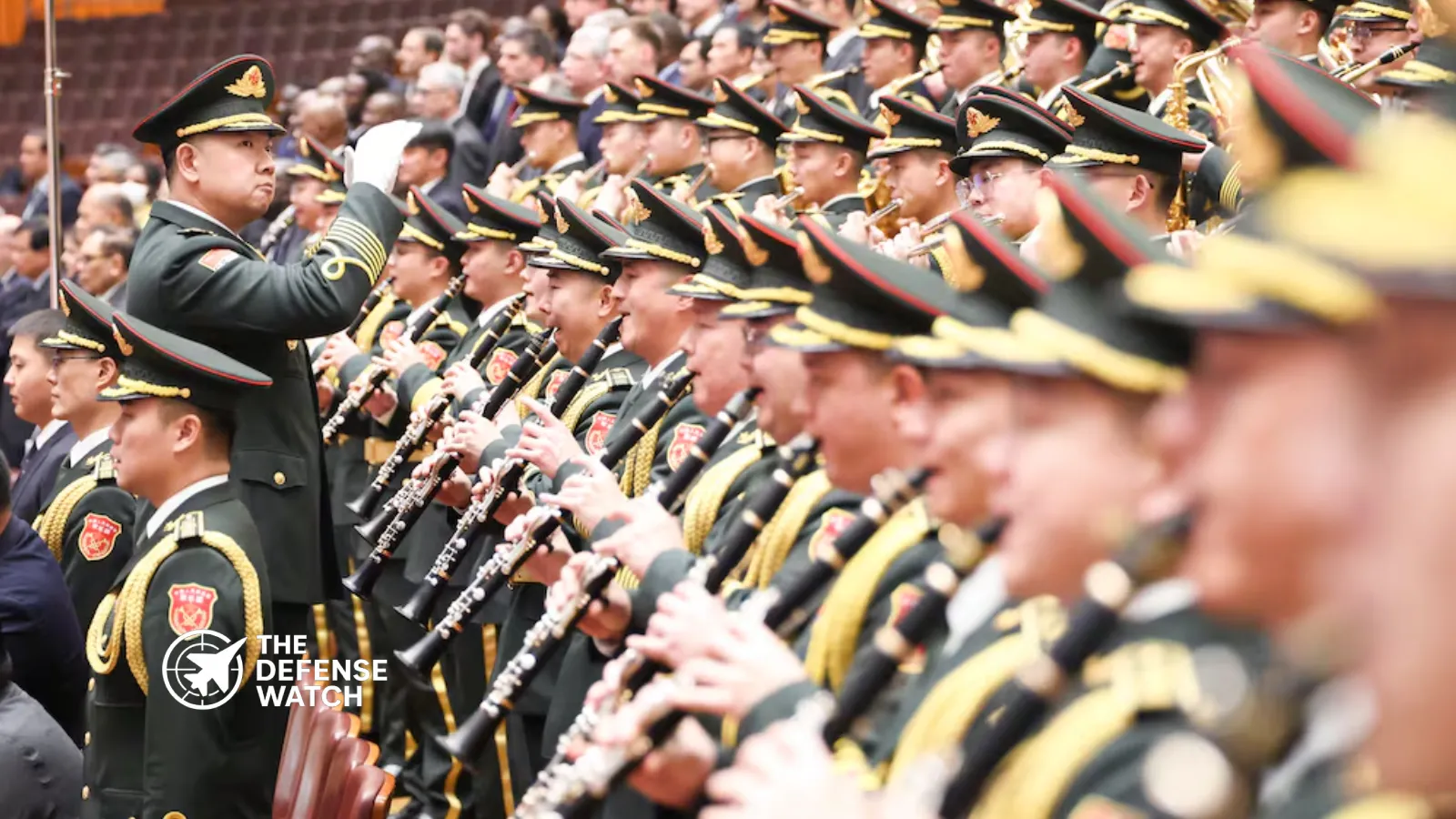
- China increased its 2026 defense budget by 7% to roughly 1.91 trillion yuan, about $277 billion.
- The increase marks the 11th consecutive year of single digit growth in Chinese military spending.
- The budget expansion comes alongside a sweeping purge of senior People’s Liberation Army generals.
- Analysts estimate actual Chinese defense spending may be significantly higher than the official figure.
- China now accounts for roughly 44% of total military expenditure across Asia.
China Defense Budget 2026 Reflects Continued Military Modernization
The China defense budget 2026 will increase by 7% bringing total military spending to approximately 1.91 trillion yuan, or about $277 billion, according to figures released during China’s annual National People’s Congress in Beijing.
The budget announcement highlights Beijing’s continued focus on modernizing the People’s Liberation Army (PLA) while President Xi Jinping simultaneously pursues one of the most extensive purges of senior military leadership in decades.
Chinese officials say the increase supports national security requirements and ongoing efforts to modernize the armed forces. The spending growth follows three consecutive years of 7.2% increases and represents the 11th straight year of single digit budget growth for China’s military.
Despite the modest percentage increase, China’s defense budget remains the second largest in the world after the United States.
The Big Picture
China’s steady defense spending growth reflects a long term strategy to transform the PLA into a fully modern military by 2035.
The modernization campaign includes large investments in advanced missile systems, naval expansion, stealth aircraft, cyber capabilities, and space based military assets. Analysts also link these efforts to Beijing’s objective of achieving a “world class military” capable of projecting power beyond its immediate region.
Regional security concerns, particularly tensions surrounding Taiwan and broader competition with the United States in the Indo Pacific, continue to shape Beijing’s defense priorities.
China conducted a record 5,709 military aircraft sorties near Taiwan’s air defense identification zone in the past year, highlighting the increasing operational tempo of PLA forces in the region.
At the same time, the country’s economic growth is slowing, forcing Beijing to balance military investment with domestic economic pressures.
What’s Happening
Chinese authorities announced the 7 percent defense spending increase on March 5 during the opening of the National People’s Congress, the country’s annual legislative session.
The new China defense budget 2026 brings the official figure to approximately $277 billion.
However, several defense analysts and U.S. government assessments suggest that China’s actual military spending may be substantially higher than its declared budget.
The U.S. Department of Defense has previously estimated that China’s true defense expenditures could be 32 to 63 percent greater than the publicly released figure.
Some military related costs, including certain research and development programs, internal security activities, and mobilization efforts, are not fully included in the official defense budget.
Meanwhile, China’s leadership is conducting a sweeping anti corruption campaign across the PLA. The purge has removed a large number of senior officers, including top generals and members of the Central Military Commission.
According to the Center for Strategic and International Studies, more than 100 senior PLA leaders have been purged since 2022.
Why It Matters
The simultaneous increase in military spending and purge of senior commanders signals a major restructuring inside China’s armed forces.
Xi Jinping has repeatedly emphasized political loyalty and centralized control over the military. Analysts say the purge is intended to eliminate corruption while reinforcing the Chinese Communist Party’s authority over the PLA.
This approach reflects Beijing’s long standing doctrine that the military must remain firmly under party control.
However, removing large numbers of senior officers also creates leadership gaps across the command structure. Such disruptions could temporarily slow operational planning, procurement decisions, and modernization programs.
Even so, the broader objective remains clear. Beijing wants a more disciplined and technologically advanced military capable of conducting high intensity joint operations.
Strategic Implications
China’s defense spending trajectory continues to reshape the regional military balance in Asia.
According to the International Institute for Strategic Studies, China now accounts for nearly 44 percent of total military expenditure across Asia, far exceeding the defense budgets of neighboring countries.
Japan’s military spending, for example, is roughly one fifth of China’s budget, while Taiwan’s defense spending is approximately one ninth of Beijing’s total.
China’s expanding naval fleet, long range missile forces, and rapidly advancing aerospace capabilities are particularly significant for regional deterrence dynamics.
The PLA Navy already operates the world’s largest fleet by ship count, while China continues to field advanced anti ship ballistic missiles and next generation fighter aircraft.
Taken together, these capabilities strengthen China’s ability to project power across the Western Pacific.
Competitor View
Strategic competitors are watching China’s defense spending trends closely.
The United States views the PLA’s modernization drive as a central component of great power competition in the Indo Pacific. Washington’s own defense strategy increasingly focuses on maintaining technological and operational advantages over China.
Regional partners including Japan, Australia, and South Korea have also expanded defense budgets in response to China’s growing military capabilities.
Taiwan in particular monitors PLA activity carefully. Increased Chinese military flights near the island and ongoing modernization of amphibious and missile forces directly affect Taiwan’s defense planning.
For many regional governments, China’s rising defense spending reinforces the need for stronger alliances and improved military interoperability.
What To Watch Next
Several developments will shape the future trajectory of China’s military modernization.
First, analysts will monitor how Beijing restructures the PLA leadership after the ongoing purge of senior officers. Filling key command positions will be essential to maintaining operational readiness.
Second, the next phase of China’s defense investments will likely focus on emerging technologies, including artificial intelligence, hypersonic weapons, and advanced unmanned systems.
Third, observers will watch for changes in PLA operational activity around Taiwan and in the South China Sea, where Chinese military deployments have increased in recent years.
Upcoming military exercises and equipment announcements may provide additional insight into Beijing’s modernization priorities.
Capability Gap
China’s expanding defense budget addresses several operational gaps identified by Chinese military planners over the past two decades.
Historically, the PLA lagged behind Western militaries in areas such as joint operations, long range power projection, and advanced command and control systems.
Modernization efforts aim to close those gaps by integrating networked battlefield systems, improving naval aviation capabilities, and expanding strategic missile forces.
At the same time, the recent purge of senior commanders highlights ongoing institutional challenges within the PLA, including corruption risks and bureaucratic inefficiencies that can complicate large scale military reform.
The Bottom Line
China’s rising defense spending and sweeping leadership purge reflect a single strategic objective, building a modern, politically loyal military capable of competing with the world’s most advanced armed forces.
Get real time update about this post category directly on your device, subscribe now.
