
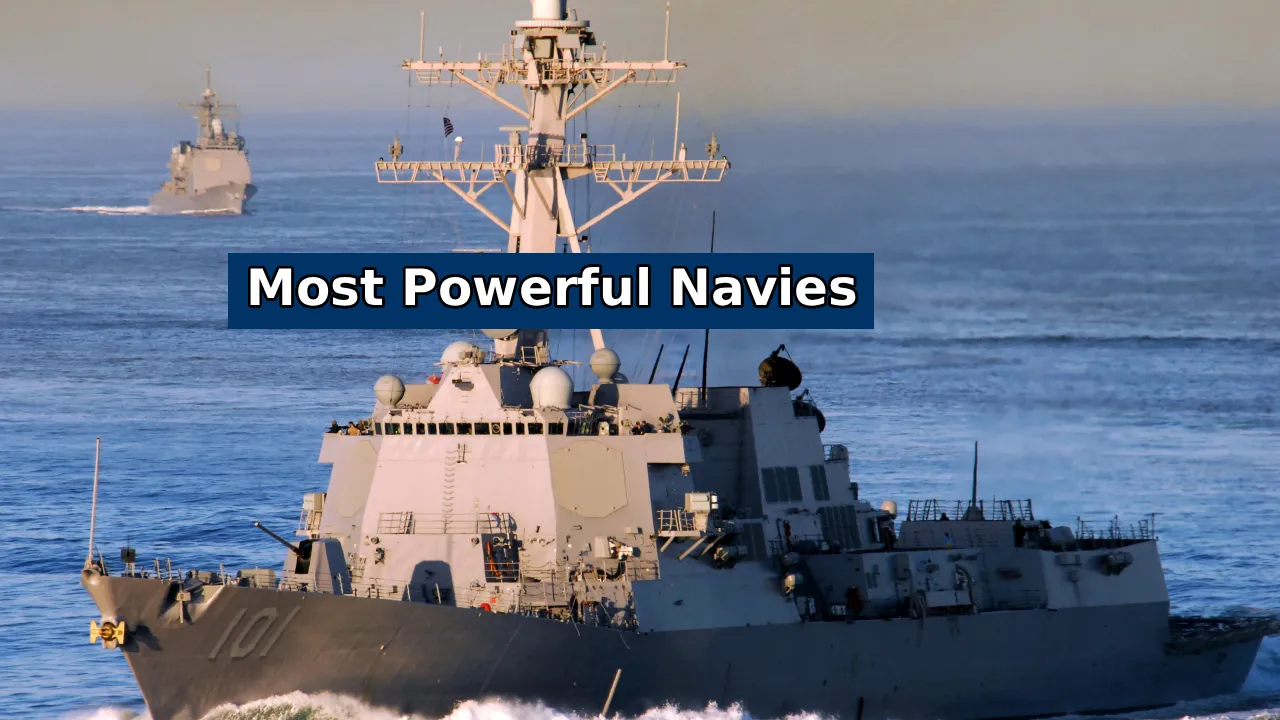
In 2026, the landscape of the most powerful navies in the world continues to evolve amid heightened geopolitical rivalries, from the Indo-Pacific to the Arctic. Aggregate displacement—measuring the total tonnage of a fleet’s warships, submarines, and support vessels—serves as a robust indicator of naval strength, balancing quantity with quality and projection capabilities. This metric captures not just the sheer size of vessels but their potential for sustained operations, firepower delivery, and deterrence. Drawing from comprehensive trackers like those maintained by defense analysts, the top 10 most powerful navies in 2026 reflect a mix of established superpowers and rising maritime players, underscoring shifts in global navy rankings 2026.
As tensions simmer in key chokepoints like the South China Sea and the Black Sea, these fleets play pivotal roles in securing trade routes, enforcing alliances, and countering hybrid threats. This analysis delves into each navy’s core assets, modernization efforts, and strategic posture, providing a snapshot of maritime power analysis 2026.
Understanding the Ranking Methodology
Assessing the most powerful navies in 2026 requires more than counting hulls; it demands a holistic view of fleet composition. Aggregate displacement, as used in this ranking, aggregates the tonnage of surface combatants, submarines, replenishment ships, and auxiliaries, offering a proxy for operational endurance and combat heft. Unlike raw ship counts—which favor prolific builders like China—this approach penalizes smaller patrol craft while rewarding blue-water assets like aircraft carriers and nuclear submarines.
Data for these global navy rankings 2026 stems from open-source intelligence, including shipbuilding logs, commissioning records, and decommissions up to mid-2026. Factors like technological integration, logistical reach, and combat experience further refine the picture, aligning with evaluations from platforms such as Global Firepower and the World Directory of Modern Military Warships (WDMMW). While no single formula is infallible, displacement highlights how the top naval forces world prepare for peer-level contests.
1. United States Navy: Unrivaled Global Projection
The United States Navy (USN) tops the list of most powerful navies 2026with an imposing 7.168 million tonnes of aggregate displacement, a testament to its role as the preeminent force for power projection. This fleet’s backbone includes 11 nuclear-powered Nimitz- and Ford-class aircraft carriers, each displacing over 100,000 tonnes and capable of launching 75+ aircraft for strikes across oceans. Complementing these are 70+ Arleigh Burke-class destroyers and Ticonderoga-class cruisers, armed with Aegis systems for ballistic missile defense.
Submarine forces add stealthy lethality: 14 Ohio-class ballistic missile submarines (SSBNs) ensure nuclear deterrence, while 50+ attack submarines like the Virginia-class hunt adversaries underwater. Recent additions, such as the USS HII (San Antonio-class amphibious transport dock) and USS Jack H. Lucas (Flight III destroyer), bolstered the fleet by net +2 vessels this year, offsetting retirements of aging cruisers. The USN’s edge lies in its forward-deployed carrier strike groups, which maintain presence in every theater, from the Mediterranean to the Western Pacific.
Modernization drives sustainment: The Columbia-class SSBN program, with lead boat delivery eyed for 2027, promises quieter, longer-endurance platforms. Budget allocations exceeding $250 billion annually fuel innovations like directed-energy weapons and unmanned surface vessels (USVs), ensuring the USN remains the benchmark in maritime power analysis 2026.
2. People’s Liberation Army Navy: Rapid Expansion in the Indo-Pacific
China’s People’s Liberation Army Navy (PLAN) claims second place at approximately 3 million tonnes, closing the gap with the US through sheer industrial momentum. Boasting over 730 warships—the largest fleet by count—the PLAN emphasizes area-denial capabilities in the South China Sea. Key assets include three aircraft carriers: Liaoning (refitted ex-Soviet), Shandong (indigenous conventional), and Fujian (electromagnetic catapults for J-35 stealth fighters).
Destroyers like the Type 055 (12,000 tonnes each) number 10+, offering layered air defense with 112 VLS cells for hypersonic missiles. Submarines form a growing shadow fleet: six Type 094 Jin-class SSBNs for nuclear patrols, plus 60+ diesel-electric Yuan- and Song-class boats optimized for littoral ambushes. In 2026, launches of Type 076 amphibious assault ships and up to three Type 093B nuclear attack submarines (SSNs) added 74,350 tonnes, including frigate and corvette infusions.
This surge aligns with Beijing’s “far seas” doctrine, evidenced by anti-piracy patrols in the Gulf of Aden and joint exercises with Russia. Challenges persist in engine reliability and crew training, but the PLAN’s output—rivaling U.S. SSN production—positions it as the fastest-evolving among top naval forces world.
3. Russian Navy: Arctic Focus Amid Operational Strain
Russia’s Navy registers 2.1 million tonnes, prioritizing strategic deterrence despite attritional losses in Ukraine. The fleet’s crown jewels are four Borei-class SSBNs and seven Delta IV holdovers, totaling 11 strategic submarines for second-strike capability under the sea ice. Oscar II and Yasen-class SSGNs (cruise-missile submarines) deliver Kalibr and Zircon hypersonics, with the fifth Yasen-M commissioned in 2026 adding precision over-the-horizon strikes.
Surface forces include the Admiral Gorshkov-class frigates (five operational) and Kirov-class battlecruisers, though maintenance backlogs limit readiness. Black Sea Fleet losses—two corvettes and an landing ship sunk—were partially offset by new Project 20380 corvettes and a second Lada-class diesel submarine. Aggregate growth was modest at +0.17%, reflecting sanctions’ bite on shipyards.
Moscow’s strategy pivots to the Arctic, where icebreakers and Northern Fleet bases secure Northern Sea Route claims. Integration of Poseidon nuclear torpedoes enhances asymmetric threats, keeping Russia third in global navy rankings 2026 despite fiscal pressures.
4. Royal Navy: Streamlined for High-End Warfare
The United Kingdom’s Royal Navy holds 1.5 million tonnes, a blue-water force honed for NATO interoperability. Two Queen Elizabeth-class carriers (65,000 tonnes each) anchor operations, embarking F-35B Lightning IIs for expeditionary strikes. Astute-class SSNs (seven building) provide seven operational hunter-killers, with the eighth due in 2026.
Frigates and destroyers—six Type 45 air-warfare ships and eight Type 23 general-purpose—total 13 major escorts, though Type 26 and Type 31 programs aim to replace retiring hulls by 2030. Decommissions of two Type 23s and minehunters in 2026 trimmed 11,072 tonnes, signaling a leaner posture amid crew shortages.
London’s emphasis on carrier-enabled power projection shines in exercises like Steadfast Defender, reinforcing AUKUS ties. Investments in Spear 5 missiles and unmanned systems position the RN for distributed lethality.
5. Japan Maritime Self-Defense Force: Defensive Depth in Contested Waters
Japan’s JMSDF weighs in at 760,000 tonnes, a defensive powerhouse evolving toward offensive capabilities. Four helicopter destroyers (including Izumo-class conversions for F-35Bs) mimic light carriers, while 12 Aegis-equipped Kongo- and Maya-class destroyers shield against missiles. Submarines dominate: 22 Soryu- and Taigei-class diesel boats, with the latest Taigei adding stealth for East China Sea patrols.
A +2.01% tonnage bump in 2026 came from two Mogami-class frigates and a Taigei SSK, amid fleet reorganization into surface battle groups. Tokyo’s 2026 defense white paper highlights hypersonic countermeasures, aligning with Quad partnerships.
6. Indian Navy: Blue-Water Ambitions Realized
India’s 620,000-tonne fleet bridges regional security and global outreach. Two aircraft carriers—INS Vikramaditya and Vikrant—enable Malabar exercises, backed by 10 destroyers and 13 frigates like the Kolkata-class. Nuclear triad completion arrived with INS Arighat, the second Arihant-class SSBN, plus six Scorpene SSKs.
Modest +0.88% growth included the seventh Talwar frigate and last Visakhapatnam destroyer, slated for January commissioning. New Delhi’s focus on Andaman bases counters Chinese encirclement.
7. French Navy: Expeditionary Versatility
France’s Marine Nationale at 550,000 tonnes excels in power projection across empires. The Charles de Gaulle carrier (42,500 tonnes) leads, with 11 FREMM frigates and five Suffren-class SSNs enhancing Atlantic and Indian Ocean ops. A +4.2% surge featured the third Suffren and first Jacques Chevallier replenisher.
Paris leverages overseas territories for forward basing, integrating Rafale-M fighters for hybrid threats.
8. Republic of Korea Navy: Technological Leap Forward
South Korea’s ROKN crossed 420,000 tonnes with +7.6% growth, driven by the Jeongjo the Great destroyer and Chungnam frigate. Three Dosan Ahn Changho SSNs bolster anti-submarine warfare against Pyongyang, while KDX-III Aegis ships defend sea lines.
Seoul’s light carrier program eyes 2033 entry, amplifying U.S. alliance ops.
9. Italian Navy: Mediterranean Anchor
Italy’s 380,000 tonnes feature the Trieste LHD (33,000 tonnes), enabling EUFOR deployments. Eight FREMM frigates and U212 submarines provide balanced punch, with +6.1% from the fourth PPA frigate offsetting retirements.
Rome’s focus on migrant interdiction and Libyan stability underscores NATO roles.
10. Turkish Naval Forces: Indigenous Surge
Turkey rounds out at 340,768 tonnes, up 14.6% via the Istanbul frigate and Reis SSK. MILGEM corvettes and TF-2000 destroyers fuel export ambitions, overtaking Indonesia.
Ankara’s Black Sea dominance aids Ukraine aid corridors.
Strategic Implications: Trends Shaping Naval Power in 2026
The 2026 rankings reveal a bipolar contest between U.S. qualitative superiority and China’s quantitative ascent, with allies like Japan and the UK forming a counterweight network. Hypersonic integration and unmanned systems are common threads, but crewing shortages plague Western fleets, while sanctions hobble Russia. As climate change opens Arctic routes, expect intensified investments in ice-capable vessels.
In geopolitical terms, these most powerful navies 2026 will dictate freedom of navigation, with Indo-Pacific flashpoints testing deterrence. For policymakers, the message is clear: maritime alliances must evolve to match asymmetric innovations, ensuring balanced global navy rankings 2026.
Ranking Methodology: Aggregate Displacement as the Core Metric
Assessing the most powerful navies in 2026 relies primarily on aggregate displacement tonnage—a comprehensive metric that totals the full-load weight of all commissioned warships, submarines, replenishment vessels, and major auxiliaries, serving as a reliable proxy for operational endurance, logistical sustainment, and overall combat potential. Unlike simple vessel counts that favor smaller patrol craft, this approach prioritizes blue-water capabilities such as aircraft carriers, nuclear submarines, and large surface combatants, while incorporating qualitative factors like technological sophistication, crew readiness, and global deployment reach from open-source trackers including the World Directory of Modern Military Warships (WDMMW) and Global Firepower’s naval force index updated through mid-2026.
FAQs
Its unmatched carrier fleet, nuclear submarines, and global basing network enable unmatched power projection, as measured by 7.168 million tonnes displacement.
Through rapid shipbuilding, adding destroyers, carriers, and submarines, the PLAN reached 3 million tonnes, focusing on Indo-Pacific dominance.
It accounts for vessel size, endurance, and firepower potential, providing a more nuanced view than mere ship counts.
Combat losses, sanctions, and maintenance issues limit operations, despite strong submarine deterrence.
Yes, indigenous programs added 14.6% tonnage, positioning Turkey for regional influence and exports.
Get real time update about this post category directly on your device, subscribe now.

1 comment
[…] to Congressional Budget Office estimates, the Navy’s 2025 shipbuilding plan would cost an average of $40.1 billion per year over the 2025-2054 period—46 […]