
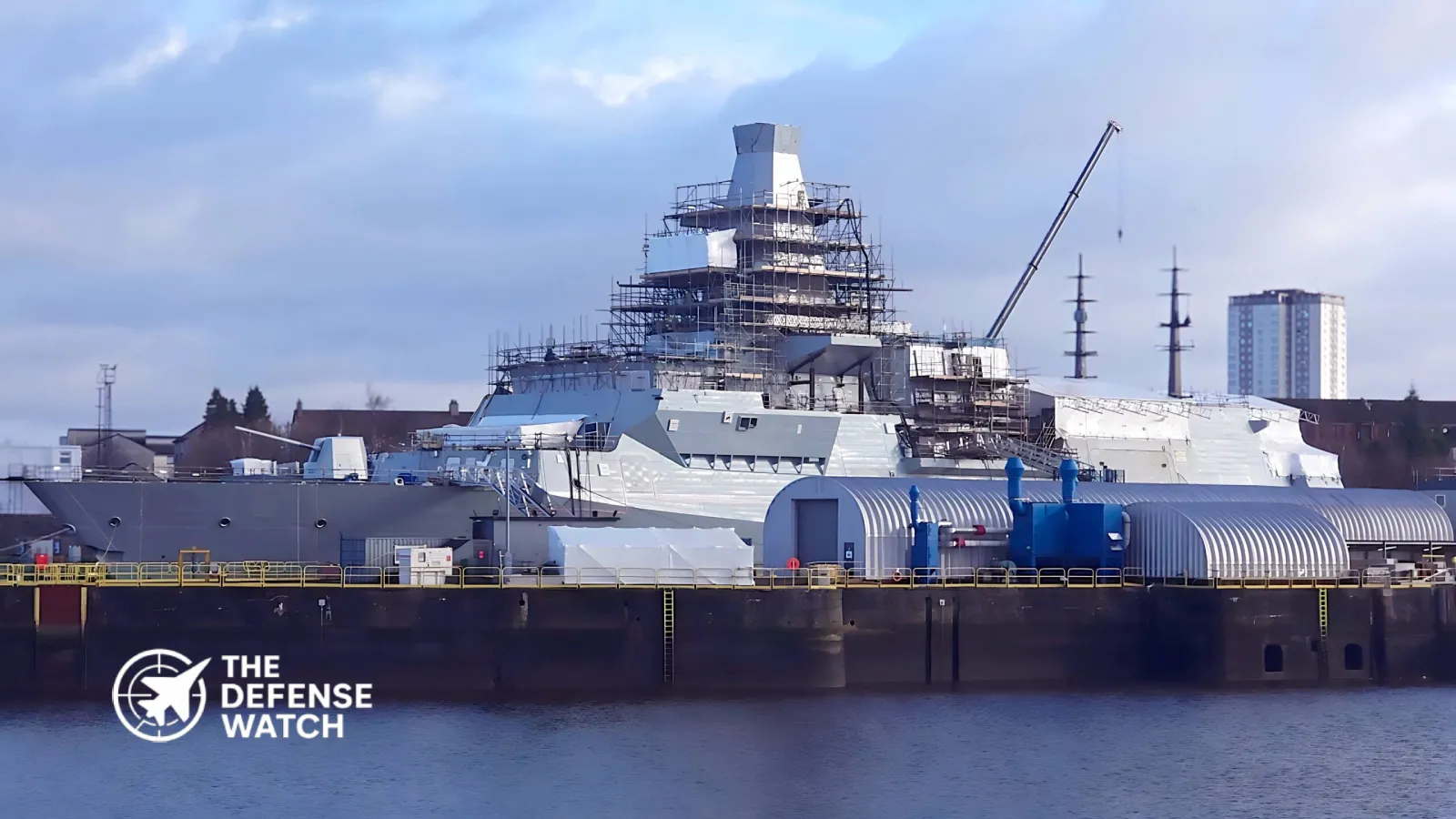
- ► New imagery shows HMS Glasgow’s hull and superstructure largely complete as outfitting advances at the Clyde. Source
- ► The first of eight UK Type 26 frigates has powered up onboard systems and is nearing sea trials.
- ► The City-class design emphasizes anti-submarine warfare with low acoustic signature sonar and hybrid propulsion.
- ► Armament includes Sea Ceptor air defense and MK-41 strike length VLS, plus a 127mm main gun and flight deck for helicopters.
- ► HMS Glasgow is on track for sea trials this year ahead of entry into Royal Navy service.
Type 26 Frigate HMS Glasgow Nears Sea Trials
HMS Glasgow, the Royal Navy’s first City-class Type 26 frigate, is progressing toward sea trials as major outfitting steps wrap up at the BAE Systems shipyard on the River Clyde. Imagery released this week shows the 8,000-ton warship with key systems installed and its silhouette largely complete, marking a significant milestone in the United Kingdom’s surface fleet modernization.
The Type 26 program aims to deliver eight advanced frigates designed around anti-submarine warfare as well as broader fleet escort missions. Glasgow, laid down and christened in recent years, reached a notable construction milestone with onboard power systems brought online late last year, enabling integrated systems testing ahead of sea trials slated for later in 2026.
Design and Capability
The City class blends specialized undersea detection systems with general combat capability. Glasgow’s hull and propulsion are engineered for low acoustic signature, a core enabler for anti-submarine operations in contested environments. Sonar suites include a bow-mounted set and a towed array for active and passive detection, augmented by torpedo warning sensors.
Outfitting visible in recent photos highlights a tall integrated mast, expansive flight deck, and enclosed mission bay. Flight deck space is sufficient for larger helicopters such as Merlin or even Chinooks, while the mission bay can support boats, containerized equipment, or specialist payloads based on tasking requirements.
Weapons and Systems
Glasgow’s combat systems reflect layered defensive and offensive options. The ship’s primary air defense is provided by Sea Ceptor missiles in a vertical launch system, offering local area protection against aircraft and missiles. A separate MK-41 strike length launcher adds flexibility for future long-range weapons such as the Anglo-Italian Future Cruise or Anti-Ship Weapon.
The main gun is a 127mm Mark 45, replacing the older 4.5-inch gun, supported by 30mm mounts, Phalanx close-in weapon systems, and machine guns. Electronic warfare and decoy systems are integrated to enhance survivability against modern threats.
Strategic Context
The Type 26 class forms a key element of the Royal Navy’s plan to renew its surface escort force and replace ageing Type 23 frigates. In addition to the Royal Navy’s eight ships, variants of the design have been selected by allied navies including Australia, Canada, and Norway, underscoring its broader export appeal.
HMS Glasgow’s imminent sea trials follow a pattern of stepped progress in the UK maritime program, which also includes newer frigate and submarine classes aimed at addressing 21st century security challenges across the Atlantic, the North Atlantic, and beyond.
What Happens Next
With power generation and major systems in place, Glasgow is expected to begin sea trials in the coming months. These trials will test propulsion, sensors, weapons, and other mission systems before the vessel is formally accepted for Royal Navy service, likely in 2027.
Get real time update about this post category directly on your device, subscribe now.
