
Table of Contents
The TOW anti-tank missile remains a central capability in the U.S. Army’s precision strike arsenal. Whether operated from tripods, light vehicles, or embedded within armored platforms such as the Stryker and Bradley, the missile continues to provide heavy anti-armor, anti-fortification, and anti-amphibious landing capabilities. The weapon’s reliability and adaptability, including recent wireless upgrades, reinforce its status as a cornerstone of ground combat lethality well into the mid-century.
TOW Missile Legacy and Ongoing Service
Evolution of a Combat-Proven System
Introduced in 1970, the BGM-71 TOW (“Tube-launched, Optically tracked, Wire-guided”) missile replaced earlier systems like SS.10 and ENTAC, delivering significantly greater range and enhanced warhead performance thanks to its advanced SACLOS guidance system. Today, the system continues to underpin U.S. and allied anti-armor capabilities globally.
Broad Deployment and Longevity
The TOW platform has seen extensive deployment: over 700,000 units produced, across more than 15,000 ground, vehicle, and helicopter platforms, and adopted by over 40 allied nations. With recent upgrades, the TOW system is projected to remain in service beyond 2050.
Upgrades and Modernization: TOW 2B and Wireless Guidance
Transition to Wireless Guidance
Emerging from its original wire-guided format, the TOW missile has been upgraded with radio-frequency (RF) and microwave wireless guidance, notably in the TOW 2B variant. The operator merely maintains sight alignment while the missile is steered automatically via a one-way data link.
Production Orders Reflect Sustained Demand
In early 2025, RTX Raytheon secured a substantial $322.5 million contract to manufacture TOW 2B missiles for the U.S. Army, bolstering the wireless-guided inventory. Earlier, production contracts for FY2023–2024 emphasized continued investment in the system.
Integration & Operational Platforms
Versatile Launch Platforms
TOW missiles are deployable from a wide range of platforms—from ground tripods to vehicle mounts on ITAS, Stryker ATGM vehicles, and Bradley Fighting Vehicles—ensuring flexible deployment across combat scenarios.
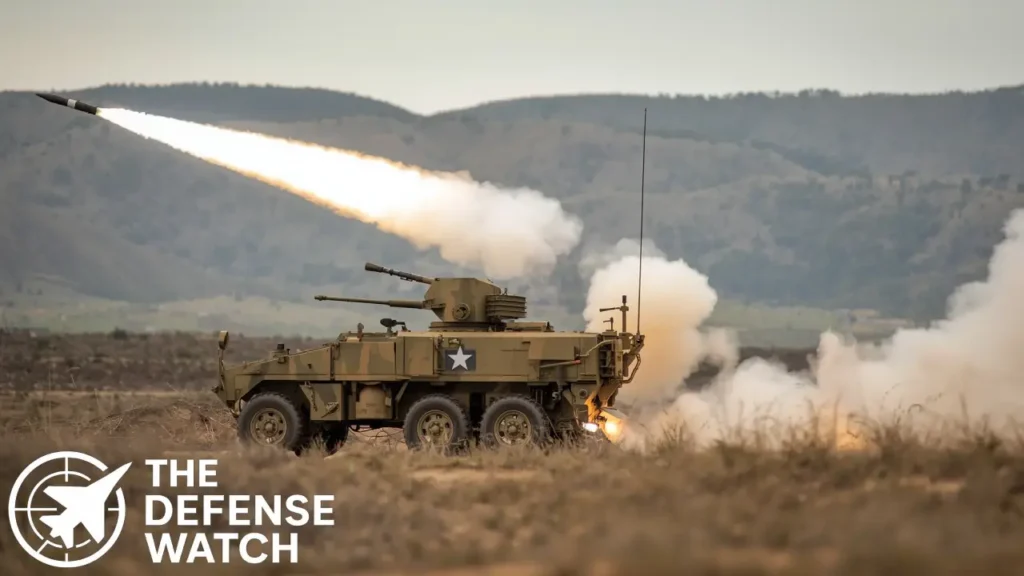
Stryker ATGM Vehicle Capabilities
The M1134 ATGM vehicle, a Stryker variant, serves as a mobile anti-tank platform firing TOW missiles at ranges up to 4 km. Its deployment strengthens brigade-level anti-armor overwatch and precision engagement lines.
Strategic Outlook and Context
Modern Relevance Amid Army Restructuring
Despite its longstanding service, the TOW missile faces potential procurement halts amid budget reallocation efforts. As part of the Army Transformation Initiative, officials are reviewing cuts—including the possibility of ending TOW missile buys to redirect funding toward emerging priorities like electronic warfare and counter-UAS systems.
Resilience and Adaptability
Still, the TOW’s upgraded capabilities, multi-role flexibility, and entrenchment in allied militaries suggest its continued relevance—especially as a cost-effective, proven solution in layered ground defense. Its capacity to counter armored threats, urban fortifications, and amphibious targets lends it strategic depth even as newer systems emerge.
FAQs
TOW stands for Tube-launched, Optically tracked, Wire-guided missile system.
Originally wire-guided, modern versions like the TOW 2B now use RF/microwave wireless guidance, simplifying operator workload and improving responsiveness.
It is launched from ground tripods, ITAS, Stryker ATGM vehicles, Bradley Fighting Vehicles, and even light armored vehicles and helicopters.
Upgrades have extended the system’s service life beyond 2050, affirming its long-term utility
Yes—new budget plans include proposals to halt TOW missile procurement as the Army shifts focus to electronic warfare and other emerging domains.
Get real time update about this post category directly on your device, subscribe now.

8 comments
[…] announced on August 29, 2025, plans to deploy both its upgraded Type-12 surface-to-ship missiles and the Hyper Velocity Gliding Projectile (HVGP)—a hypersonic glide vehicle—across northern, […]
[…] For the U.S., the ability to deploy unmanned vessels that can operate independently for extended periods could transform naval strategy—shifting from manpower-heavy operations to data-driven, adaptive fleets. Such systems could conduct surveillance, electronic warfare, or logistics missions autonomously, freeing manned warships for higher-priority combat roles. […]
[…] the precise technical nature of the modifications remains undisclosed, the report suggests the upgraded seekers significantly improve the missile’s ability to detect, track, and engage slow-flying, low-signature targets that were challenging for […]
[…] Combat & Strategic Role: […]
[…] includes a 25 mm Bushmaster automatic cannon, a coaxial 7.62 mm machine gun, and a twin-tube TOW anti-tank missile launcher. The A3 configuration integrates a digital architecture with thermal imagers, a […]
[…] 16 Griffon VBMR (Véhicule Blindé Multi-Rôles) vehicles will serve in command, logistics, and combat support roles. Built on a 6×6 chassis similar to the Jaguar, each Griffon carries a […]
[…] officials reiterated that American troops are no longer engaged in a direct combat role, instead supporting Iraqi forces in preventing a resurgence of extremist […]
[…] interest in integrating autonomy and precision strike for ground combat. The Chinese system’s missile armament moves robotic dogs farther into direct combat roles from earlier reconnaissance and support […]