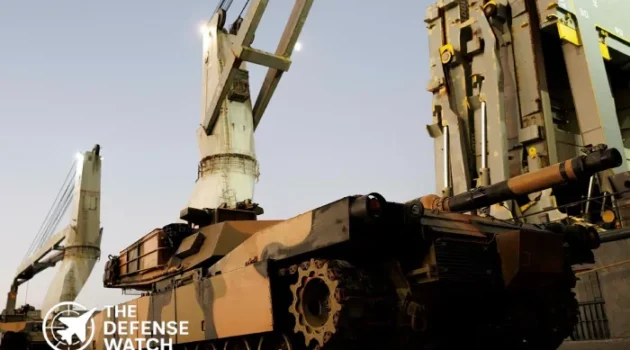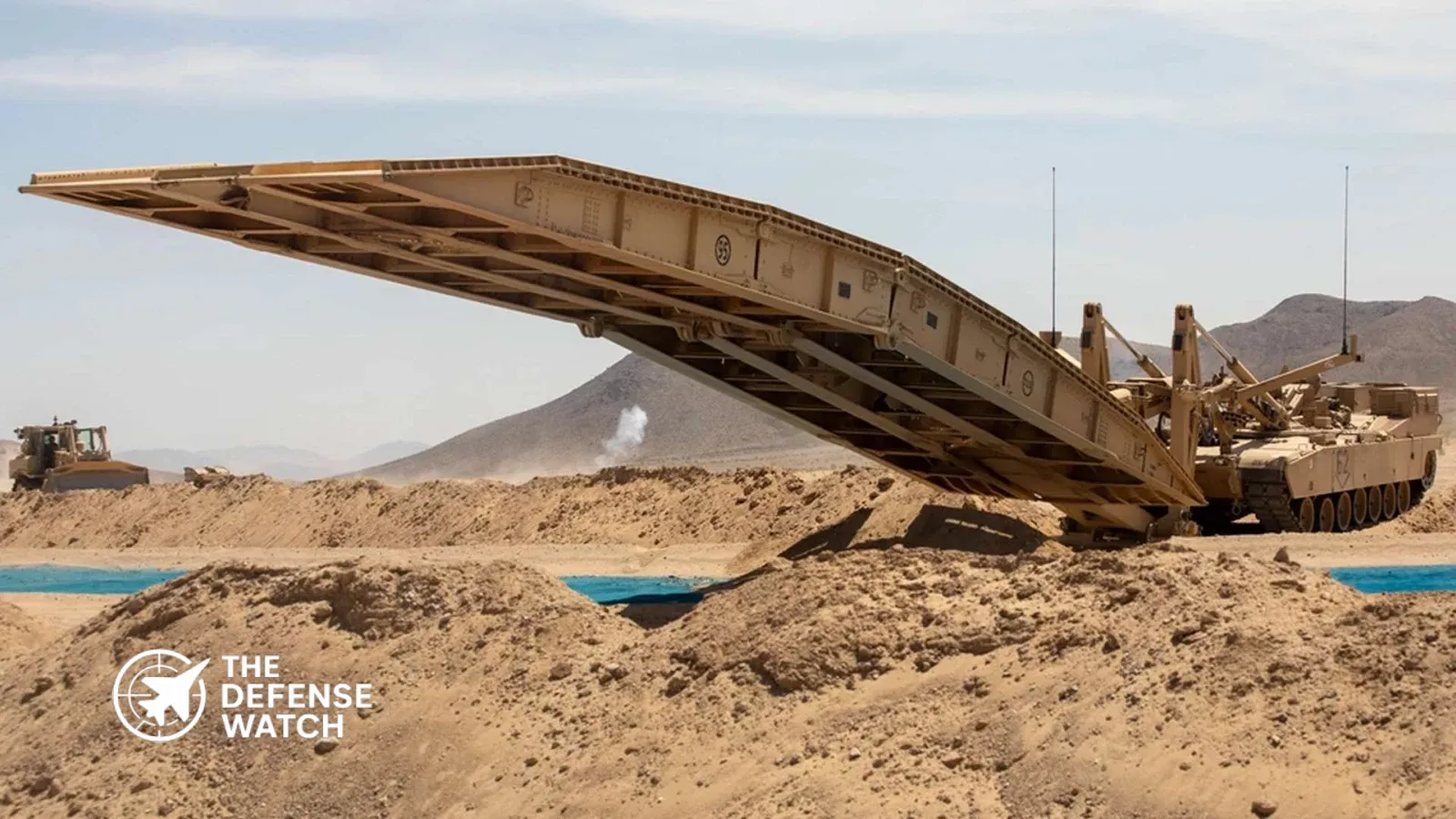
- U.S. Army is adding 20 M1074 Joint Assault Bridge systems to support M1 Abrams operations.
- The system is based on the M1 Abrams chassis and designed for rapid obstacle crossing.
- Bridges can span gaps of up to 18 meters and support heavy armored vehicles.
- The upgrade strengthens breaching and maneuver capabilities in contested environments.
- The move aligns with U.S. Army modernization priorities focused on mobility and survivability.
U.S. Army Expands M1 Abrams Breach Capability With M1074 Joint Assault Bridges
The U.S. Army is expanding M1 Abrams breach capability through the acquisition of 20 additional M1074 Joint Assault Bridge systems, reinforcing its ability to maneuver armored forces across complex battlefield obstacles.
The move is part of a broader effort to enhance combat engineering support for armored units, ensuring that main battle tanks can maintain operational momentum in high-intensity conflict environments.
The M1074 Joint Assault Bridge, built on the same chassis as the M1 Abrams, enables rapid deployment of armored bridges under combat conditions. This allows heavy vehicles to cross gaps, trenches, and other obstacles without delaying advancing forces.
Enhancing Armored Mobility In Contested Terrain
The expansion of M1 Abrams breach capability reflects a core operational requirement: maintaining mobility under fire. Modern battlefields, particularly in Europe and other potential theaters, are expected to feature extensive obstacles, including anti-tank ditches, destroyed infrastructure, and engineered defensive barriers.
The M1074 system addresses these challenges by deploying a scissor-type bridge capable of spanning gaps up to approximately 18 meters. Importantly, the bridge is designed to support the weight of heavy armored vehicles, including the Abrams itself.
Because the system shares the Abrams platform, it benefits from similar levels of armor protection and mobility. This reduces vulnerability during forward operations, where engineering units often operate close to enemy contact.
From an operational perspective, this significantly reduces the time required to breach obstacles, limiting exposure to enemy fires and preserving the tempo of armored advances.
Integration With M1 Abrams Formations
The decision to expand M1 Abrams breach capability is closely tied to how armored brigade combat teams are structured. Engineering assets such as the M1074 are integral to combined arms operations, enabling tanks and mechanized infantry to operate without interruption.
In practice, Joint Assault Bridges are deployed alongside Abrams units, allowing commanders to quickly respond to terrain challenges without waiting for follow-on engineering support.
This integration is especially relevant in large-scale maneuver warfare scenarios, where delays at obstacles can create bottlenecks and increase vulnerability to precision fires, drones, and artillery.
The additional 20 systems will likely be distributed across multiple units, improving redundancy and ensuring that breaching capability is available across a wider operational footprint.
Strategic Context: Lessons From Recent Conflicts
The emphasis on M1 Abrams breach capability aligns with lessons observed in recent conflicts, particularly in Eastern Europe. Combat operations have highlighted the critical importance of mobility, especially when facing layered defenses that combine mines, trenches, and anti-armor systems.
In Ukraine, for example, both Russian and Ukrainian forces have encountered significant challenges breaching fortified positions. These conditions have underscored the need for protected, rapid-deployment bridging systems that can operate under fire.
The U.S. Army’s investment in additional M1074 systems suggests a recognition that future conflicts will require not just firepower, but sustained maneuver capability in heavily contested environments.
Engineering Support As A Combat Multiplier
While often less visible than frontline platforms, combat engineering systems play a decisive role in determining battlefield outcomes. Expanding M1 Abrams breach capability effectively enhances the combat power of armored units without modifying the tank itself.
The ability to cross obstacles quickly can dictate whether a force maintains initiative or becomes stalled. In high-intensity warfare, even short delays can expose units to surveillance and targeting by advanced sensors and long-range fires.
By increasing the number of Joint Assault Bridges, the Army is strengthening a key enabler of maneuver warfare, ensuring that armored formations can adapt to terrain challenges in real time.
Industrial And Programmatic Considerations
The M1074 Joint Assault Bridge program builds on existing Abrams-based manufacturing and support infrastructure, which simplifies logistics and lifecycle management.
This commonality reduces training requirements and streamlines maintenance, as crews and support personnel are already familiar with the Abrams platform. It also ensures interoperability within armored formations.
While specific contract details were not disclosed in the report, the acquisition reflects ongoing investment in proven systems rather than entirely new platforms, a trend seen across several U.S. Army modernization efforts.
Operational Impact And Future Outlook
The expansion of M1 Abrams breach capability is likely to have immediate operational benefits, particularly for units preparing for deployment in regions where terrain and infrastructure present significant challenges.
Looking ahead, the integration of engineering systems with emerging technologies, such as autonomous breaching and remote bridge deployment, may further enhance capability. However, for now, the focus remains on fielding reliable, combat-proven systems at scale.
In the near term, the additional M1074 systems will improve the Army’s ability to sustain momentum in offensive operations, reinforcing the central role of mobility in modern warfare.
Get real time update about this post category directly on your device, subscribe now.