
Table of Contents
Netherlands Deploying Anti-Drone Net for PzH 2000NL Howitzers
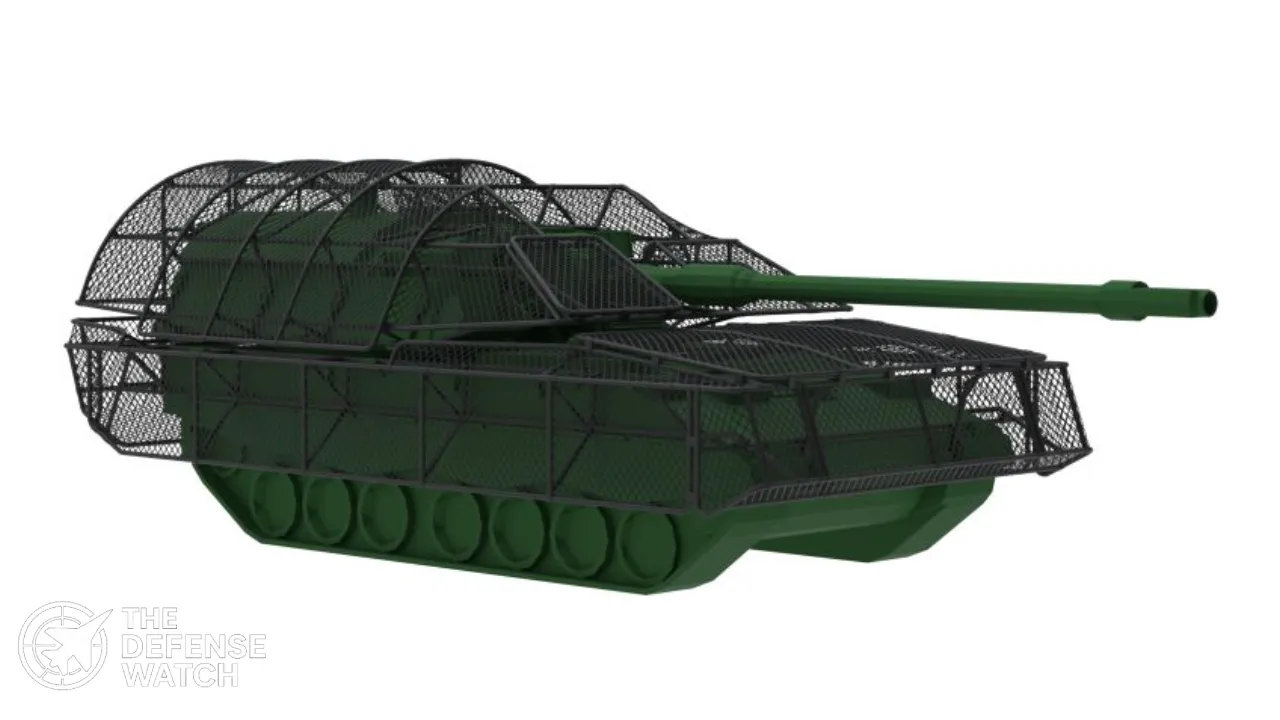
On 24 November 2025, Dutch defense contractor COBBS Industries BV announced it is developing the Netherlands’ first purpose-built anti-drone net system specifically designed for the Royal Netherlands Army’s PzH 2000NL self-propelled howitzers. The initiative aims to harden the heavy artillery platform against emerging threats posed by small unmanned aerial systems (sUAS).
Context: Rising Threats to Artillery from Drones
The move reflects a broader shift in modern land warfare, where even well-protected, long-range artillery faces increasing vulnerability from cheap, proliferating drones. First-person-view (FPV) quadcopters and loitering munitions have become common tools in surveillance and precision strikes, including against stationary or moving artillery.
Rather than relying on improvised “cope cages,” the Netherlands is investing in an engineered, standardized solution — signaling that drone protection is no longer ad hoc, but a core design consideration for modern artillery.
Technical Details of the Anti-Drone Net System
COBBS Industries’ design calls for a multi-layered, full-coverage mesh structure mounted around the PzH 2000NL’s turret and hull. According to renderings, the net forms a dome over the turret, with extended panels covering the glacis, side flanks, and rear.
Key features include:
- 360-degree coverage: Protects roof, flanks, and rear — the most exposed areas.
- Mesh architecture: The geometry forces incoming drones to engage the net, potentially snagging propellers or detonating prematurely.
- Material: Likely hardened steel or alloy mesh — strong enough to disrupt small drones, but optimized to minimize excessive weight.
- Thermal and airflow considerations: Open-lattice structure aids in ventilation and avoids over-burdening the engine deck.
These design choices aim to balance protective benefits against mobility and thermal management — critical for a 55-ton tracked howitzer.
Why the Netherlands Is Prioritizing This
1. Operational Lessons from Ukraine
Drones have played an outsized role in recent conflicts, especially in Ukraine, where FPV and loitering munitions have been used to target artillery from above. The Netherlands appears to be responding to these lessons by institutionalizing a passive, durable countermeasure rather than relying on field improvisation.
2. Complement to Active Air Defence
The anti-drone net is not the only element in Dutch counter-UAS planning. The Netherlands is also acquiring 22 Rheinmetall Skyranger 30 systems — mobile air-defense cannons mounted on tracked vehicles to counter aerial threats.
While Skyranger systems cover drones at long ranges, COBBS’ net provides a last-line, passive defense when threats penetrate deeper, offering an additional survivability layer for the howitzer.
3. Industrial & Strategic Implications
Choosing COBBS Industries, a Dutch SME specializing in tactical and unmanned systems, emphasizes national capability development. The program supports the Netherlands’ goal of retaining sovereign expertise in key land-warfare technologies and integrating such niche solutions into broader European defense supply chains.
The PzH 2000NL in Dutch Service
The PzH 2000NL is the Dutch variant of the German 155 mm Panzerhaubitze 2000, which remains one of the most capable modern howitzers. It has seen action in deployments such as Afghanistan (Operation Medusa) and has also been supplied, in part, to Ukraine.
With its long range, high rate of fire, and advanced automation, the PzH 2000NL is a critical strategic asset — making its protection from aerial drones increasingly vital.
Potential Challenges and Considerations
- Weight trade-off: Adding a mesh cage could affect mobility and maintenance, though COBBS appears to have optimized for that.
- Crew operations: Ensuring the cage allows for turret traverse, elevation, and crew access is key.
- Integration with other systems: How the net coexists with sensors, jammers, or active counter-UAS systems will be important.
- Export prospects: If proven, the system could be adopted by other PzH 2000 operators or nations facing similar drone threats — but export licensing, cost, and adaptation will matter.
What’s Next
- Testing and rollout: COBBS’ system will likely undergo trials with the Dutch Ministry of Defence to validate its effectiveness and durability under operational conditions.
- Integration with doctrine: The Netherlands may update its artillery employment doctrine to incorporate the anti-drone net into standard protective measures.
- Broader adoption: Success could lead to similar protective kits for other platforms — or even export to allied nations.
Bottom Line
By developing a dedicated anti-drone net for its PzH 2000NL howitzers, the Netherlands is making a forward-looking investment in artillery survivability. This program underlines a paradigm shift: in the modern battlefield, protecting heavy equipment isn’t just about out-firing the enemy — it’s also about outlasting aerial threats from low-cost drones.
Get real time update about this post category directly on your device, subscribe now.


4 comments
[…] AS9 Huntsman is the Australian variant of the South Korean K9 Thunder tracked self-propelled howitzer, acquired under a 2021 contract worth roughly AUD 1 billion. The agreement, part of the Land 8116 […]
[…] lost time and rising costs. “We have lost three to four years, and every year acquisitions of military equipment become more expensive,” he said. Tonin urged the government to continue prior procurement efforts […]
[…] acquiring air-deployable equipment and high-altitude parachute systems, China could mitigate some of these risks. Armored vehicles parachuted near Taiwan’s ports or […]
[…] upon the established framework created through Norway’s previous acquisition of 52 K9 VIDAR self-propelled howitzers and 14 K10 Ammunition Resupply Vehicles, delivered between 2017 and […]