
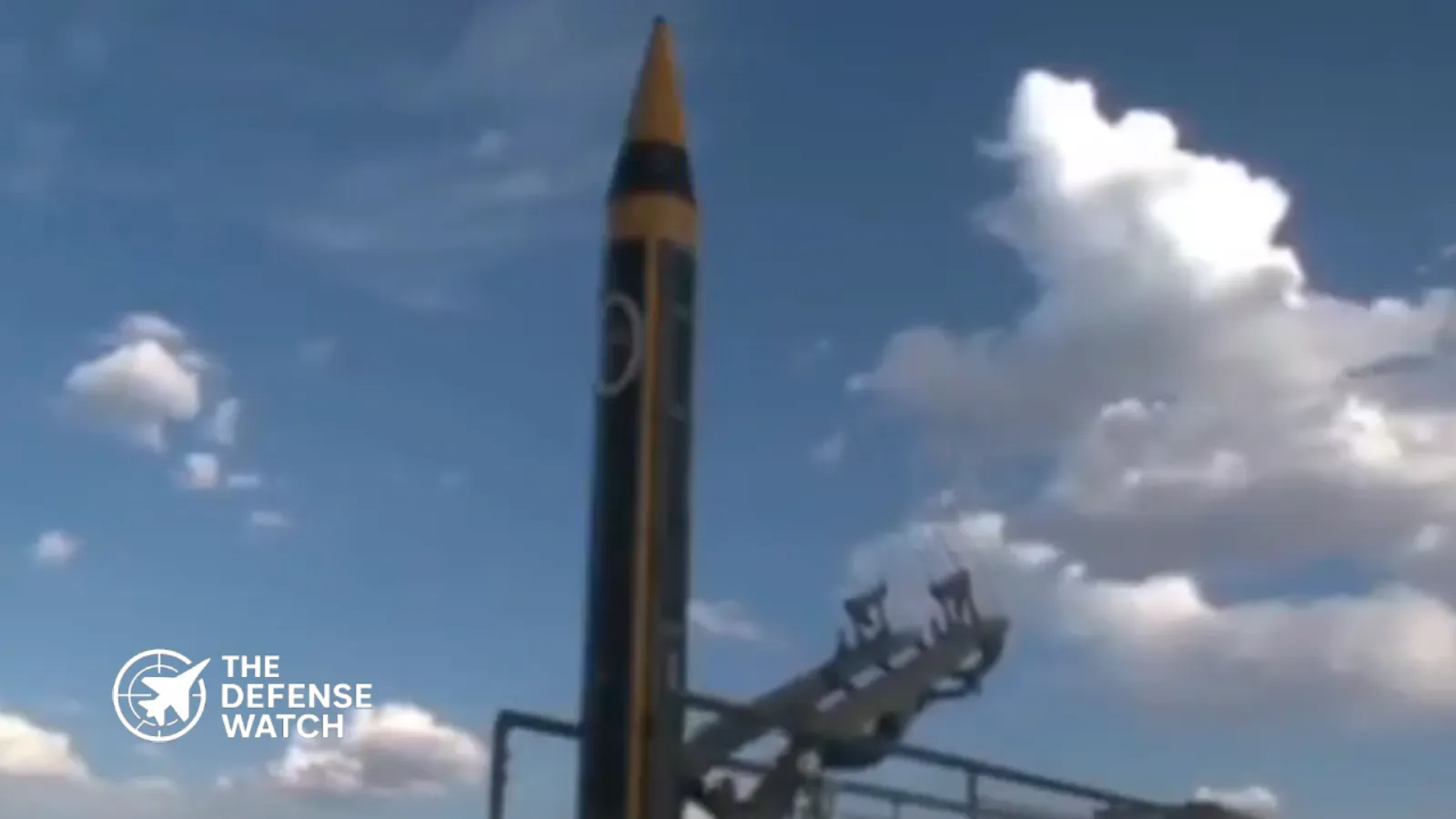
Iran Broadcasts Khorramshahr-4 Missile Footage, Claims Operational Readiness
Iran’s state-aligned media broadcast footage this week of its Khorramshahr-4 ballistic missile, with Tehran describing the system as now part of its operational missile forces, including placement in underground “missile city” facilities. The Khorramshahr-4 missile is reported by Iranian outlets to have a range of about 2,000 kilometers and a warhead capacity of roughly 1,500 kilograms.
The imagery aired by Press TV and cited by Fars News Agency showed the missile inside hardened underground facilities the Islamic Revolutionary Guard Corps (IRGC) refers to as missile cities. Iranian reporting frames the broadcast as evidence the system has reached what Tehran calls “operational maturity.”
Iranian Claims on Capabilities
According to state-aligned sources, the Khorramshahr-4 — also associated with the name Kheibar — retains characteristics Iran has highlighted in previous public statements:
• A declared maximum range near 2,000 kilometers, covering broad portions of the Middle East.
• A heavy payload capacity of roughly 1.5 tons, among the largest reported for Iranian ballistic systems.
• Iranian outlets also repeated claims of ballistic speeds up to Mach 16 outside the atmosphere and around Mach 8 within the atmosphere, intended to shorten reaction time for defenses, though these figures have not been independently verified.
State sources also asserted the system combines guidance features and design measures to challenge modern air defenses. Again, these are Iranian claims, not independent assessments.
No Independent Confirmation of New Test or Full Operational Status
At this time, there is no independent confirmation from neutral defense news services or official Western defense sources that the Khorramshahr-4 has recently conducted a new flight test or entered service in the IRGC inventory. Many published details on the missile’s performance and capabilities come from Iranian state media or outlets closely aligned with Iranian military reporting.
Open-source defense reference material notes the Khorramshahr-4 was first publicly unveiled in 2023. Its specs have been widely reported based on Iranian disclosures, but key details such as demonstrated accuracy, range in operational conditions, and actual performance remain based on Iranian statements rather than independent verification.
Strategic Context
The Khorramshahr series forms part of Iran’s broader ballistic missile modernization efforts. The weapon family has been emphasized by Tehran as central to its deterrence posture. Analysts note that while Iran publicly maintains a range cap just under 2,000 kilometers for its ballistic systems, its missile technology and production continue to evolve.
Iran’s focus on basing missiles within hardened underground facilities aligns with longstanding doctrine aimed at improving survivability and complicating preemptive strike options by potential adversaries.
How to Understand the Claims
Because the primary sources for this report are Iranian state media and affiliated agencies, defense analysts and open-source trackers advise caution in interpreting technical claims without corroboration from independent monitoring groups, satellite imagery verification, or Western defense reporting.
Get real time update about this post category directly on your device, subscribe now.
